Quartz vs Granite Countertops: Which One Suits Your Kitchen Best?
Your countertop is the most-touched surface in your home. It holds morning coffee, absorbs the chaos of weeknight dinners, and catches every eye that walks into your kitchen. Choosing between quartz and granite is one of those decisions that feels deceptively simple until you realize how many variables actually matter. The global countertops market was valued at $157.7 billion in 2025 and is projected to reach $267.4 billion by 2033, a number that tells you two things: countertops matter enormously to homeowners, and both quartz and granite are fighting hard for your remodeling dollars.
In my experience helping homeowners navigate this exact decision, the wrong choice almost always comes down to one thing: picking based on appearance alone, then discovering the maintenance realities after installation. This guide walks through every meaningful difference, cost, durability, maintenance, resale value, and lifestyle fit, so you can choose with confidence. And if you want an expert local team to handle the measurement, selection, and installation, Home Run Improvement is the place to start.
Key Takeaways
- Quartz wins on maintenance: Quartz is maintenance-free, stain resistant, and 100% non-porous, with a sealed-for-life surface that never needs to be reapplied. If you cook frequently and want zero upkeep, quartz is the practical default.
- Granite wins on heat and authenticity: Granite is strong and heat-resistant; you can set down hot pans without worry, but it does need sealing to protect against stains. For serious cooks, that tradeoff is often worth it.
- Pricing is closer than most people think: According to SlabWise's 2026 countertop pricing guide, quartz countertops run $50-$150 per sq ft installed, while granite countertops run $40-$175 per sq ft installed, the widest price range due to slab variety. Do not assume granite is always cheaper.
- Quartz is the fastest-growing segment: Engineered quartz countertops are expected to grow at a CAGR of 8.2% from 2026 to 2033, driven by their durability, easy maintenance, and wide range of designs. Buyer demand increasingly favors low-maintenance surfaces, a factor that matters for resale.
- Both materials add resale value: According to Remodeling Magazine's Cost vs. Value Report cited by Wise Stone Choice, a minor kitchen remodel like replacing outdated countertops with new quartz countertops can recoup up to 85.7% of its cost in added resale value. Choose the material that fits your kitchen style and buyer demographic.
Quick-Start Prioritization Framework
Start here if you're:
- A busy family or renter: Quartz, its non-porous surface requires zero sealing and cleans up with soap and water.
- A serious home cook who loves natural materials: Granite, superior heat resistance means you can move pans directly from stove to counter without stress.
- Renovating to sell: Quartz in a neutral tone photographs better and signals "move-in ready" to modern buyers.
- Working with a tighter budget: Entry-level granite starts lower than entry-level quartz; compare slab-by-slab before deciding.
- Planning an outdoor kitchen: Granite only, quartz is not warranted or recommended for outdoor use due to UV sensitivity.
What Each Material Actually Is
Before comparing performance, it helps to understand what you are actually buying.
Quartz: Engineered, Not Quarried
Most quartz countertops contain 85-90% natural quartz minerals, with the remaining 10-15% consisting of polymer resins and color pigments. That polymer resin is what makes quartz non-porous, and it is also the source of its one significant limitation: sensitivity to prolonged heat and UV radiation.
Quartz begins with hard raw quartz, bonded together by vacuum compression and high-performance resins and pigments. Manufacturers turn these elements into a vibrating solid, high-density slab, creating surfaces that mimic the graceful veining of marble or the industrial grit of concrete. The result is a surface that looks like natural stone but behaves like a precision-engineered product.
Pro tip: When shopping for quartz, always ask about the manufacturer's warranty. According to Granite Prestige, there has been "a boom in quartz manufacturing over the last five years" with an increase in low-quality quartz that is "far less durable and prone to staining, chipping, and heat damage." Stick to established brands like Silestone, Caesarstone, or Cambria for full warranty protection.
Granite: 100% Natural Stone
Granite is a purely natural stone that comes straight from the earth. Granite slabs are cut, polished, and turned into stunning stone countertops. Granite offers a unique, one-of-a-kind pattern in every slab, making it a favorite for homeowners who love the look of natural stone.
Granite is an igneous rock formed under extreme heat and pressure, which gives it a Mohs hardness rating of 6 to 7 and makes it one of the most scratch- and heat-resistant natural stone countertop materials available. That geological origin, formed over millions of years, is both its greatest strength and the reason no two slabs ever look alike.
This overview breaks down the fundamental differences between quartz and granite as materials, which makes it easier to follow the comparisons throughout this article.
Durability: How Each Material Holds Up Over Time
Scratch and Impact Resistance
Granite ranks 6 to 7 on the Mohs hardness scale, resists heat and scratches better than most countertop materials, and routinely lasts the life of a house. For context, a steel knife blade runs around 6.5 on that same scale, meaning granite can handle everything a typical kitchen throws at it.
Quartz is equally hard and even more flexible than granite, which helps it resist chipping and cracking. Its engineered nature provides a slight "give," making it ideal for active families and frequent entertainers. The resin binder that makes quartz non-porous also acts as a micro-level shock absorber.
In my experience, the edge zone is where granite tends to show vulnerability first. Granite's real weaknesses are acid etching if left unsealed and cracking at unsupported edges. If your kitchen layout includes an island with a deep overhang or a sink cutout without proper support, discuss edge reinforcement with your installer.
Lifespan
Properly sealed and professionally installed, granite countertops routinely last 30 to 50 years and can hold up for a century in the right conditions. That kind of longevity makes the material cost much easier to justify on a per-year basis.
About 60% of granite countertops show damage after 10 to 15 years, according to Rock Solid Tops, which means the remaining 40% are still pristine well past that mark. The deciding factor, nearly every time, is how consistently the stone was sealed and maintained. If you install granite and commit to the upkeep, it outlasts almost everything else in your kitchen.
Heat Resistance
This is where granite has a clear advantage. Granite is strong and heat-resistant, and you can set down hot pans without worry. Quartz, by contrast, becomes vulnerable above a specific threshold. Quartz is sensitive to extreme heat above 300°F and UV sensitivity, so it is not recommended for outdoor use.
Always use a trivet with quartz. Always. Repeated direct contact with hot pans causes the resin binders to discolor and, in severe cases, permanently warp.
Maintenance: The Real Cost You Pay Every Year
Quartz Requires Almost Nothing
Quartz is non-porous, which means liquids will not soak in. It does not require sealing, making it a low-maintenance option for busy families and professionals. For regular cleaning, just use warm water, a soft cloth, and a drop of mild dish soap. Wipe with circular motions, and you are done, no special granite cleaner or sealing schedule is needed.
That simplicity is genuinely transformative in a household with kids, pets, or anyone who cooks daily. The surface that cleans up in 30 seconds is one you will actually keep clean.
Granite Requires Periodic Sealing
Most granite countertops benefit from re-sealing every 12-24 months. Some dense, dark granites such as absolute black can go 3-5 years between sealings. Light, porous granites may need annual sealing.
The water test is the simplest diagnostic available. Place a few drops of water on the surface and wait 10-15 minutes. If the water beads up and sits on the surface, your sealer is still working. If the water absorbs into the stone and darkens it, it is time to reseal. Run this test every six months in a busy kitchen.
Pro tip: Avoid cleaning products that contain vinegar, lemon juice, ammonia, or bleach, as these can damage the sealant and dull your granite surface over time. Use a pH-neutral cleaner or mild dish soap mixed with water instead.
Dense granites with minimal porosity may require sealing every 2-4 years, while more porous varieties need attention every 6-12 months. Before buying a slab, ask your fabricator about the porosity level, this single factor affects your annual maintenance load more than any other.
Cost Comparison: What You Will Actually Pay in 2026
Installed Price Ranges
Pricing for both materials follows the same basic formula: material cost plus fabrication plus installation. According to SlabWise's 2025-2026 granite vs. quartz cost comparison:
In 2025 to 2026, granite countertops typically cost $40 to $100 per square foot installed, while quartz runs $50 to $120 per square foot installed. Quartz almost always costs more, mainly because of manufacturing overhead and brand premiums. The gap is roughly $10 to $30 per square foot on mid-range slabs, though entry-level granite and entry-level quartz can land at nearly the same price.
For brand-name quartz, expect to pay more. Mid-range products from brands like Silestone, Caesarstone, or MSI Q Premium sit at $65 to $90 installed. Premium designer slabs with waterfall edges can push well past $150 per square foot installed.
Total Project Cost
The average quartz project runs about $4,500, but you could spend anywhere from $1,000 to $12,000 depending on your specific situation. For granite, the national average to purchase and install granite countertops is $3,250, according to HomeAdvisor, which can be over 10% of the cost of a full kitchen remodel, which stacks up to an average of $25,656.
The action this data points to: Get itemized quotes for both materials in your specific slab choice before assuming one is cheaper. Entry-level granite often undercuts entry-level quartz, but a premium granite slab can rival designer quartz pricing. Compare actual slab-to-slab, not category-to-category.
Pro tip: Home Run Improvement provides templating and professional installation for both quartz and granite, meaning you get accurate square-footage measurement before committing to material costs. This alone can prevent costly ordering mistakes.
Aesthetics and Design Versatility
Granite's Irreplaceable Uniqueness
If you want the look of natural stone, granite is unique. No two pieces are alike, meaning your granite countertop will have its own distinctive pattern, whether you choose classic brown granite or a more dramatic black or white tone.
Granite is perfect for statement kitchens, dramatic waterfall islands, and bold bathroom vanities. Each slab is a conversation piece. Picture hosting a dinner party where the countertop itself becomes a topic of admiration. If you want your kitchen to feel like it has a story, no engineered product can replicate that.
Quartz's Design Flexibility
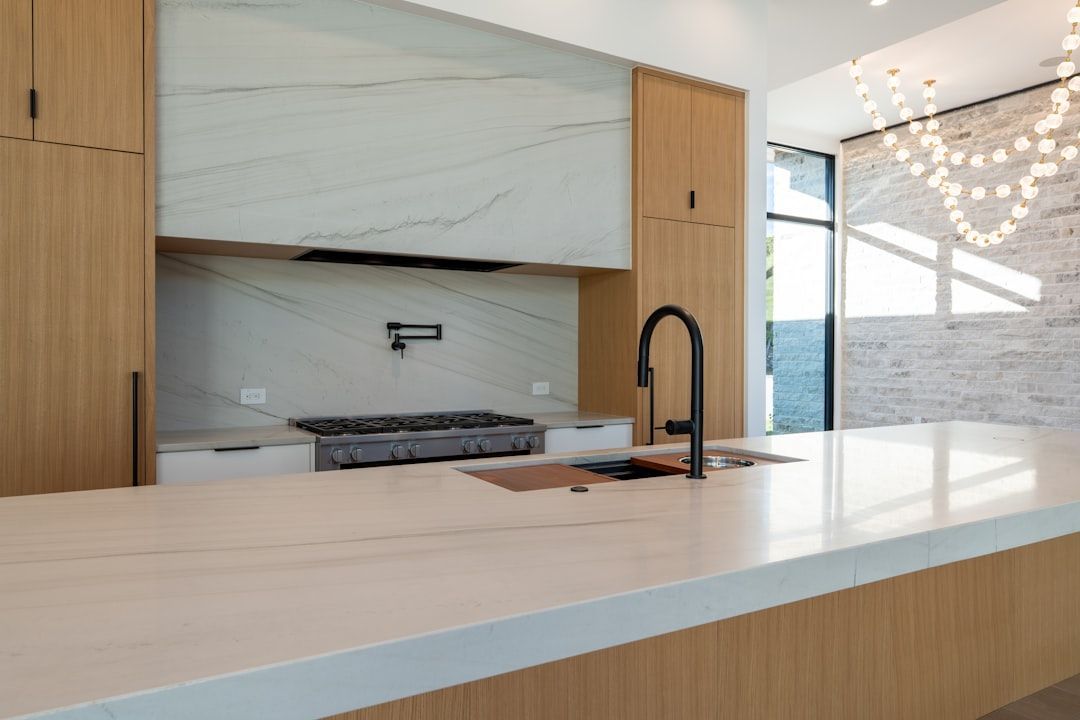
Quartz countertops are more uniform. Since quartz is engineered, you can expect consistent colors and patterns across the slab. This makes it a great option if you prefer a sleek, contemporary aesthetic.
Quartz in luxury spaces is ideal for seamless, clean-lined designs, including spa-like bathrooms, crisp modern kitchens, and hotel-inspired bars. The consistency of quartz makes it easy to design large spaces without worrying about mismatched patterns. For long kitchen runs or matching islands to perimeter counters, that consistency is a practical design advantage.
Quartz vs Granite for Outdoor Kitchens
This is a section most comparison guides skip, and it is one of the most important distinctions for homeowners planning outdoor spaces.
Granite is one of the best materials for outdoor countertops. It is naturally heat-resistant, UV-resistant, and highly durable. Granite countertops are also impervious to moisture, making them ideal for outdoor kitchens and patios where the countertop will be exposed to varying weather conditions.
Quartz, by contrast, should not be installed outdoors in most cases. Every major quartz manufacturer explicitly excludes outdoor use from their warranties. The polymer resin in quartz (5-10% of the material) degrades under UV radiation, causing yellowing, fading, and surface damage.
Many manufacturers do not cover outdoor use under their warranties due to UV sensitivity. Thermal expansion from extreme temperature changes can cause the material to expand and contract, leading to potential cracking or warping.
The bottom line for outdoor projects: Use granite. If you love quartz aesthetics, save it for your indoor kitchen and choose granite for any outdoor entertaining area.
Resale Value: Which Material Makes More Financial Sense?
Both materials add measurable value at resale, but the market is shifting. Quartz has emerged as the fastest-growing segment within the kitchen countertop market, according to Market Research Future's countertop market analysis, reflecting buyer preferences that increasingly reward low-maintenance finishes.
Today's homebuyers are looking for finishes that are modern, neutral, and move-in ready. Quartz checks all those boxes. It delivers a high-end look while staying practical, especially for families and buyers who do not want the hassle of sealing or deep cleaning surfaces.
The National Association of Realtors' remodeling research consistently shows mid-range kitchen remodels, which typically include stone countertops, recovering 50 to 80 percent of their cost at resale depending on the market. Granite is still viewed as a premium feature in most U.S. markets, though its edge over quartz has narrowed as engineered stone went mainstream.
Poor material choices, outdated colors, or low-quality installation can limit or even reduce perceived resale value. Strategic countertop upgrades often help homes sell faster by improving listing photos and reducing buyer hesitation.
What this means for your decision: In contemporary, open-plan, or recently built homes, quartz in a neutral tone maximizes buyer appeal. In older homes with traditional cabinetry and warm wood tones, a well-chosen granite can feel equally premium and more architecturally appropriate.
Common Mistakes to Avoid with Both Materials
Mistakes with Quartz
- Placing hot pots or pans directly on the surface without a trivet, quartz is not heat-resistant enough for direct contact with hot pots or grills, and extreme heat can cause cracking or warping.
- Using quartz outdoors without understanding warranty implications, quartz is not heat-resistant back outdoor installations with warranties, and using quartz outside can void coverage, meaning repairs or replacements might come out of pocket.
- Buying from an unknown manufacturer to save money, when purchasing from a less reputable brand, the quartz could be less durable and can become damaged, have its color fade when exposed to UV rays or high heat for too long.
Mistakes with Granite
- Skipping or delaying the sealing schedule, despite granite's reputation as one of the hardest natural stones, it remains a porous material. Microscopic pores can absorb liquids, leading to staining, bacterial growth, and potential damage over time. Wine, coffee, cooking oils, and even water can penetrate unsealed granite, leaving permanent marks.
- Using acid-based cleaners, vinegar, lemon juice, and bleach all degrade the sealant layer and etch the stone surface over time.
- Ignoring edge support during installation, granite at unsupported overhangs and sink cutouts is where chips and cracks almost always originate.
Pro tip: The team at Home Run Improvement walks every client through a material-specific care guide after installation, a step that many contractors skip but that makes a measurable difference in how long your countertops look their best.
Quartz vs Granite: Head-to-Head Summary
CategoryQuartzGraniteMaterial TypeEngineered (90-95% crushed quartz + resin)100% natural stonePorosityNon-porous, never needs sealingPorous, requires sealing every 1-3 yearsHeat ResistanceModerate (max ~300°F)Excellent (handles direct pan contact)Scratch ResistanceExcellentExcellentStain ResistanceExcellentGood when properly sealedUV/Outdoor UsePoor, not recommended outdoorsExcellent for outdoor usePrice Range (installed)$50-$150/sq ft$40-$175/sq ftDesign ConsistencyHigh (uniform patterns)Low (every slab unique)Lifespan20-30+ years30-100+ yearsResale AppealStrong in modern/transitional homesStrong in traditional/luxury homesMaintenance LevelVery lowLow to moderate
Why Home Run Improvement Is the Best Choice for Your Countertop Installation
Editor's Pick, Best Overall for Quartz and Granite Countertop Installation
When the material decision is made, the quality of installation is what separates a beautiful outcome from a costly one. Home Run Improvement earns the top spot in this guide because of their commitment to getting every detail right, from accurate templating to edge profile execution to proper seam placement.
Best for homeowners who want expert guidance on the quartz vs granite decision. Home Run Improvement's team works with both materials daily, which means they can provide honest, experience-based advice on which option suits your specific kitchen layout, cooking habits, and budget, without pushing you toward a higher-margin product.
What sets them apart for this particular decision:
- Templating precision that prevents material waste and ensures clean seam alignment
- Installation experience with both quartz and granite so you get the right techniques for each material
- Transparent pricing that helps you compare true installed costs across both options
- A local team that stands behind their work after the job is complete
I've found that the homeowners who are happiest with their countertop investment are the ones who chose a contractor who asked the right questions first, about how the kitchen is used, who is cooking in it, and what "low maintenance" actually means in their household. That consultative approach is exactly what Home Run Improvement delivers.
Frequently Asked Questions
Is quartz or granite better for a kitchen with young children?
Quartz is considered the best option for families, as its non-porous surface, stain resistance, and easy maintenance make it ideal for high-traffic areas and busy families. Grape juice, marker, and cooking oils wipe off without staining. Granite can match quartz's performance in a family kitchen, but only if it is sealed consistently, a task that is easy to forget during busy seasons.
How often does granite actually need to be sealed?
Most granite countertops benefit from re-sealing every 12-24 months. Some dense, dark granites can go 3-5 years between sealings. Light, porous granites may need annual sealing. Rather than following a fixed schedule, run the water test every six months: if water absorbs into the stone within 15 minutes, it is time to reseal.
Can I put hot pans directly on quartz countertops?
No. Quartz is sensitive to extreme heat above 300°F, and the resin binders that make quartz non-porous are also what make it vulnerable to thermal shock. Always use a trivet or heat pad. Granite handles direct heat better, but trivets are still recommended for both materials to avoid thermal stress fractures at the edges.
Which countertop material has better resale value?
Both quartz and granite add value, and the better choice depends on your home's style and price point. In $500K+ homes, buyers expect quartz, quartzite, or granite. In contemporary homes, quartz in a neutral tone tends to photograph better and signal move-in readiness. In traditional homes, granite's natural patterns often feel more architecturally appropriate. The material that fits the home's overall aesthetic will outperform the other at resale.
Is quartz more expensive than granite?
In 2025 to 2026, granite countertops typically cost $40 to $100 per square foot installed, while quartz runs $50 to $120 per square foot installed. Quartz almost always costs more, mainly because of manufacturing overhead and brand premiums. However, rare or exotic granite slabs can exceed premium quartz prices. Always compare specific slab pricing rather than assuming one category is cheaper.
Can quartz countertops be used in an outdoor kitchen?
No, quartz should not be used outdoors. Every major quartz manufacturer explicitly excludes outdoor use from their warranties. UV radiation degrades the polymer resin, causing permanent yellowing and fading. For outdoor kitchens, granite is the correct choice; it is naturally UV-resistant, heat-resistant, and built to handle weather variation.
The Verdict: Which One Suits Your Kitchen Best?
Choose quartz if:
- Your household is busy and maintenance-free living is a priority
- You want a modern, uniform aesthetic with consistent color across the slab
- You are renovating to sell and want the widest buyer appeal
- Kids, pets, or frequent entertaining are part of your daily reality
Choose granite if:
- You love the irreplaceable character of natural stone
- You cook frequently with high heat and want to move pans directly to the counter
- You are designing an outdoor kitchen or entertaining space
- You want a traditional or rustic aesthetic that engineered surfaces cannot replicate
Both are excellent materials when they match the homeowner using them. The mistake is treating this as a purely aesthetic decision without accounting for how your kitchen actually functions. Get the lifestyle fit right, then find the slab that makes you smile every morning. And when you are ready to move forward, Home Run Improvement has the experience with both materials to make sure the installation is done right the first time.
Sources
- Countertops Market Size, Share & Growth Report, Grand View Research. Global market data and product segment forecasts for 2025-2033. https://www.grandviewresearch.com/industry-analysis/countertops-market-report
- Quartz vs Granite Countertops: Full Comparison Guide, Arc Surfaces. Material performance comparison including heat and stain resistance. https://arcsurfaces.com/blogs/quartz-vs-granite-which-countertop-is-best-for-your-home/
- Pros and Cons of Quartz Countertops: 2026 MSI Guide, MSI Surfaces. Engineering process, heat sensitivity, and maintenance requirements. https://www.msisurfaces.com/blogs/post/2025/06/14/what-are-the-pros-and-cons-of-quartz-countertops.aspx
- Granite vs Quartz Countertops: Which Should You Choose in 2025?, Granite Prestige. Quartz quality warnings and manufacturer comparisons. https://graniteprestige.com/granite-vs-quartz-countertops-which-should-you-choose-in-2025/
- Granite Countertop Durability & Lifespan Guide, International Stoneworks. Mohs hardness, lifespan data, and fabrication quality. https://www.iswrocks.com/post/how-durable-are-granite-countertops-what-you-need-to-know
- Granite Countertops Durability Guide, SlabWise. Mohs scale data, NAR resale research, and edge vulnerability analysis. https://slabwise.com/guides/granite-countertops-durability
- Cost Difference Between Granite and Quartz Countertops (2025-2026), SlabWise. Installed price ranges and brand-level pricing breakdown. https://slabwise.com/guides/cost-difference-between-granite-and-quartz-countertops-2025-2026
- Countertop Prices by Material: Cost Per Square Foot (2026), SlabWise. Cross-material pricing comparison and market share data. https://slabwise.com/guide/pricing-by-material
- Quartz Granite Cost Guide 2025, American Quartz & Granite. Average project costs and per-square-foot pricing ranges. https://americanquartzgranite.com/quartz-countertop-cost/
- Quartz Countertops and Resale Value, Wise Stone Choice. Remodeling Magazine Cost vs. Value Report data on resale ROI. https://wisestonechoice.com/quartz-and-home-resale-value-understanding-the-roi-of-countertop-upgrades/
- Quartz Countertops and Resale Value, Fox Granite Countertops. Buyer behavior, listing appeal, and move-in-ready finishes. https://www.foxgranitecountertops.com/blog/quartz-countertops-resale-value
- Best Countertops for Resale Value: A 2026 Guide, Natural Stone City. Stone material impact on buyer perception and listing speed. https://www.naturalstonecity.com/blog/will-countertops-increase-my-homes-resale-value
- Can You Use Quartz Countertops Outdoors?, SlabWise. UV damage, warranty exclusions, and outdoor material alternatives. https://slabwise.com/questions/outdoor-quartz
- Why Quartz Can't Be Used Outdoors, Granite Depot Indianapolis. UV sensitivity, heat limitations, and outdoor granite advantages. https://granitedepotindy.com/why-cant-quartz-countertops-be-used-outside/
- Granite Sealing Guide: How Often, What Products, DIY vs Pro (2026), Rose Restoration. Sealing frequency benchmarks and the water test method. https://www.roserestoration.com/blog/granite-countertop-sealing-guide/
- Quartz vs Granite Countertop Material Comparison, CabinetIQ. Lifestyle-based material recommendations for families and rentals. https://cabinetiq.com/learn/quartz-vs-granite-countertop-material-comparison/
- Best Countertops for Busy Kitchens: Quartz vs. Granite, CGD Cabinetry. Daily-use performance comparison for high-traffic households. A comprehensive guide comparing quartz, granite, quartzite, and other materials for high-traffic household performance can be found at https://stonhausdesign.com/best-countertop-materials-for-busy-kitchens/.
- Kitchen Countertop Market Size, Share & Industry Report 2035, Market Research Future. Global market size, material segment valuations, and CAGR forecasts. https://www.marketresearchfuture.com/reports/kitchen-countertop-market-28199
- Do New Countertops Really Add Value to Your Home in 2025?, Granite and Marble Solutions. Remodel ROI data and price-point buyer expectations. https://graniteandmarblesolutions.com/blog/do-new-countertops-really-add-value-to-your-home-in-2025/
- Will Granite Countertops Increase Home Value?, HomeLight. NAR Realtors survey data and countertop ROI benchmarks. https://www.homelight.com/blog/will-granite-countertops-increase-home-value/