LP SmartSide or Hardie Board: Which Fits Kentucky Weather
When comparing LP SmartSide vs Hardie board for Kentucky’s climate, installation quality and wall exposure matter as much as the material. LP SmartSide’s engineered wood can absorb impact energy, which may be an advantage where hail or stray objects are a concern. Its moisture performance depends on details such as sealed cut edges, proper clearances, and a maintained finish.
Both options can suit a Kentucky home, but they respond differently to impacts, moisture, and finishing needs. The practical choice is not about naming one material the winner, but matching its strengths to your home and priorities.
This comparison explains how the materials differ, what to consider about finishes and impact resistance, and why careful installation matters through humid summers, spring storms, and winter freeze-thaw cycles. You’ll have a practical framework for deciding which option better fits your home.
Key Takeaways
- Compare the materials’ composition to understand how each may suit your home’s priorities and exterior conditions.
- Weigh factory finishes against field painting, including how future touch-ups may affect your maintenance plans.
- Use the impact comparison to decide which siding better matches your concerns about hail and everyday knocks.
- Pay close attention to flashing, clearances, and cut-edge sealing, because installation details shape moisture performance.
- Use the decision guide to connect your finish preferences, exposure, and maintenance expectations to a practical siding choice.
Engineered wood and fiber cement siding composition
Material composition shapes how siding handles impacts, moisture, and installation. LP SmartSide is engineered wood made from wood strands bonded with resin binders. Its SmartGuard treatment uses zinc borate to help resist fungal decay and termites. That treatment supports durability, but it doesn’t make installation details optional. The LP Building Solutions product information describes the manufacturer’s siding range.
Fiber cement is a different material, with a mineral-based composition associated with strong fire resistance. Unlike engineered wood, it doesn’t rely on wood strands as its structural base. The distinction matters when comparing how each siding responds to everyday exposure. Neither material alone determines a wall’s complete moisture protection; flashing, clearances, and finish maintenance matter too. James Hardie’s product information covers its fiber cement siding products.
LP SmartSide combines a resin binder and overlay system with SmartGuard treatment. These components make it an engineered wood product, not solid lumber. It is lighter than fiber cement, which can simplify handling and installation. Its edges still need protection: sealing field cuts helps limit moisture entry, especially around trim and openings.
MaterialCompositionNotable characteristicPractical considerationLP SmartSideWood strands, resin binders, and SmartGuard treatmentLighter than fiber cementSeal cut edges and maintain the finishFiber cementMineral-based siding materialStrong mineral-based fire resistancePlan handling and installation around its material properties
Use this comparison as a starting point, not a stand-alone performance guarantee. The wall’s layers work together: siding sheds weather, while housewrap and flashing help manage water behind it. At a window, for example, proper flashing directs water away from the opening instead of letting it collect at the siding edge. A replacement project should account for these supporting details, not just the visible board material.
Composition also shapes maintenance. Engineered wood’s treated surface and sealed cut edges need attention where boards meet trim or openings. Fiber cement’s mineral-based composition offers a different profile, including strong fire resistance. With either material, finish condition and water management affect exterior performance over time.
If siding replacement is part of a broader home update, Louisville homeowners can consider the project alongside Kentucky remodeling services. For the material decision itself, weigh composition alongside impact concerns, finish preferences, and the wall’s exposure.
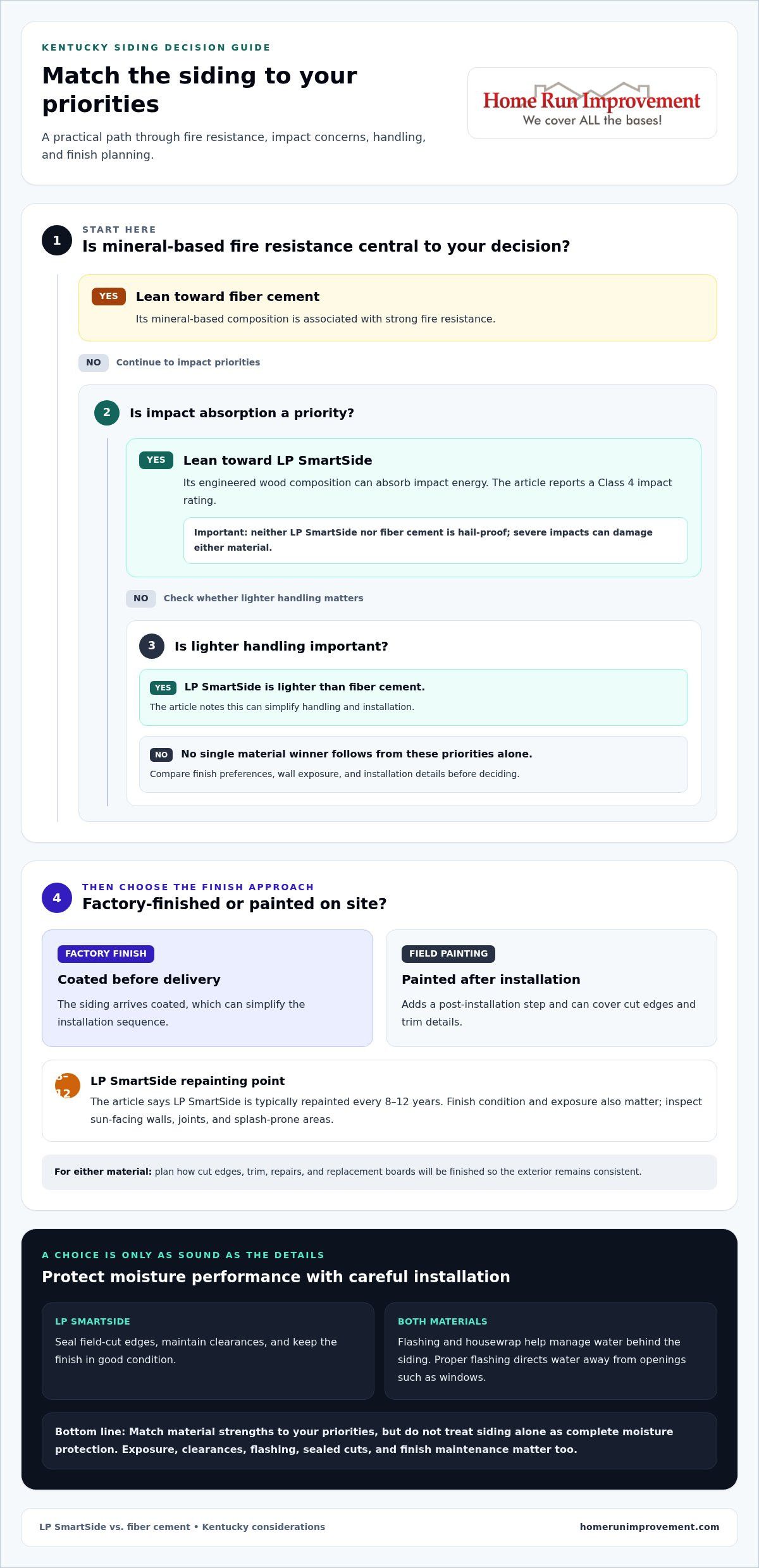
Choose engineered wood if its lighter handling and impact-absorbing composition match your priorities. Choose fiber cement if mineral-based fire resistance is central to your decision.
Factory finishes, site painting, and touch-ups
LP SmartSide and James Hardie siding can have factory-applied finishes or be painted in the field. The choice affects when painting happens, the finished appearance, and how future touch-ups fit into maintenance. Factory finishing means the coating is applied before the siding reaches the job site. Field painting takes place after installation and can cover cut edges and trim details.
Factory-applied finishes can simplify the installation sequence because the siding arrives coated. Field painting adds a step after the boards are installed, making preparation and application part of the job. Either approach needs a sound surface and careful attention to joints, edges, and repairs. For example, a replacement board may need precise finishing to blend with the surrounding exterior.
LP SmartSide is typically repainted every 8-12 years. That interval gives homeowners a useful planning point, but the condition of the finish and exposure also matter. Inspect sun-facing walls, joints, and areas where water may splash. If paint is worn or damaged, timely touch-ups help maintain the protective finish. Fiber cement siding can also be field-painted or finished at the factory.
Appearance matters, too. A consistent finish can unify trim, corners, and long wall sections, while site painting provides a finishing step after installation. Compare the selected color with the home’s roof, trim, and nearby exterior materials before committing. On a replacement project, matching existing surfaces may take more attention than choosing a color for a complete re-side.
Siding finish alone does not determine energy efficiency. For LP SmartSide and James Hardie, insulation depends on the wall assembly behind the siding, including the insulation selected and how it is installed. Treat finish selection and insulation planning as separate decisions.
Terms such as “cellulose” and “ColorPlus” may come up in siding discussions, but they should not distract from comparing the finish options under consideration. Focus on whether the product arrives factory-finished or will be painted on site, and how future repairs will be finished. Ask how cut edges, trim, and replacement boards will be coated so these details support the overall appearance.
For a Louisville home, compare finish timing, repainting plans, and the look you want across the full exterior. If you’re weighing those details for a siding project, discuss your siding plans.
Impact and hail resistance
For Louisville homeowners comparing impact resistance, LP SmartSide’s engineered wood composition offers a distinct advantage. It can absorb impact energy rather than crack or shatter as readily as a more rigid surface. That can matter when hail strikes a wall or a stray ball hits siding near a yard. LP SmartSide siding has a Class 4 impact rating. Still, neither LP SmartSide nor Hardie fiber cement siding is hail-proof, so severe impacts can damage either material.
Fiber cement’s stiffness gives it a different response to a direct hit. A concentrated impact may crack or chip the board, while engineered wood’s flexibility can absorb some force. The result depends on the object, impact location, and severity. For example, a hailstone striking an exposed board edge may cause different damage than one hitting the broad face. Compare likely damage patterns, not just a rating, when choosing siding.
Handling during installation also affects the finished wall. Boards can be damaged before they face the weather, including during unloading, carrying, cutting, or fastening. Keep materials supported, avoid striking board edges, and inspect each piece before installation. If a board cracks or chips during the work, replacing it before completion prevents visible damage from remaining in the exterior.
Repairability is another practical comparison. Both LP SmartSide and James Hardie siding can be repaired one board at a time. After an impact, identify the damaged board, inspect the surrounding area, and replace the affected section as needed. A single-board repair can address localized damage without replacing an entire wall, though matching the existing finish remains part of the plan.
Impact resistance and pest resistance are separate considerations. LP SmartSide’s SmartGuard treatment uses zinc borate to help resist fungal decay and termites. This treatment does not make the siding immune to hail damage, and impact performance does not indicate pest protection. Evaluate each characteristic separately: consider likely impacts when assessing durability, then consider the treatment’s role in resisting decay and termites.
Central Kentucky’s recurring winter freeze-thaw cycles are another reason to inspect siding after seasonal weather. Look over exposed faces, corners, and board joints for visible cracks, chips, or loose sections. After hail, check storm-facing areas and spots near trees or open yards. These checks can help identify damage early on either engineered wood or fiber cement siding.
Choose LP SmartSide if impact absorption is a leading priority; choose Hardie fiber cement if its other material characteristics better suit your plans. With either option, careful installation and prompt attention to damaged boards support the exterior’s ongoing performance.
Installation requirements
Moisture control starts before the first siding board is fastened. Prepare the wall properly, install housewrap, and flash windows and doors so water can drain outward. For LP SmartSide and James Hardie siding, correct flashing at openings, proper overlap between horizontal courses, and clearance from grade help protect the wall assembly.
Clearance matters at several transitions. Keep siding away from soil, roof lines, and hard surfaces, where splashback or trapped moisture can affect exposed edges. At a window, flashing should direct water over the layer below. At a roof-to-wall connection, leave the required separation rather than allowing siding to rest against the roof surface.
LP SmartSide has specific edge and placement requirements. Seal field-cut edges, and keep the bottom edge away from the ground and roof line. Promptly sealing cuts protects exposed material. These steps are especially important around corners, openings, and trim, where boards may need to be cut to fit.
- Prepare the wall and install housewrap before siding.
- Flash windows, doors, and other penetrations.
- Maintain proper clearances at grade, roof lines, and hard surfaces.
- Seal LP SmartSide cut edges and overlap horizontal courses correctly.
Handling differs between materials. LP SmartSide is lighter than fiber cement, which can simplify carrying and positioning boards during installation. James Hardie fiber cement should be handled appropriately for the material and work area. With either option, accurate cuts and careful fastening help keep courses aligned and reduce avoidable damage.
Warranty protection depends on meeting installation requirements. Both LP SmartSide and James Hardie warranties require following the manufacturer’s instructions. Details such as clearances, flashing, and edge treatment are part of installing siding as specified, not mere finishing touches. Shortcuts can undermine intended performance and warranty coverage.
Installation costs depend on project scope and required work, not just the siding material. Wall preparation, openings, trim, flashing, and the number of cuts all shape the job. A straightforward wall with few interruptions differs from one with many windows, corners, or transitions. Compare estimates by reviewing the preparation and water-management steps included, rather than judging the material alone.
For a durable result, compare LP SmartSide and James Hardie installation plans with the wall’s layout. Proper preparation, drainage details, and manufacturer-compliant methods are essential for either choice.
Moisture and weather resistance
Central Kentucky has humid summers, heavy spring storms, hail, and recurring winter freeze-thaw cycles. LP SmartSide’s engineered wood benefits from sealed edges and maintained paint, while fiber cement offers strong mineral-based fire resistance. Neither siding is hail-proof, and impact performance differs.
For fire performance, LP SmartSide can be used in a one-hour fire-rated wall assembly over 5/8-inch Type X gypsum. That assembly detail does not make the siding alone a code approval; the wall configuration and applicable requirements matter.
LP SmartSide Moisture Protection
LP SmartSide uses SmartGuard treatment with zinc borate to help resist fungal decay and termites. This treatment complements, but does not replace, water-management details. In Central Kentucky, moisture performance depends on proper clearances, sealed field cuts, and maintained paint.
Check siding at board ends, penetrations, and areas exposed to splashback. A cut edge near a window needs sealing, for example, while a bottom edge needs clearance from the ground. If paint wears or a joint admits water, address the finish and drainage before moisture reaches the engineered wood substrate. These steps help limit conditions that contribute to rot.
Unlike a comparison based only on composition, this protection depends heavily on installation and upkeep. Factory treatment helps resist decay and termites, but it cannot compensate for water trapped behind siding. Include joints and high-splash areas in an annual walkaround, and address visible gaps or damaged finishes promptly.
Hardie Board Moisture and Freeze-Thaw Performance
Hardie board is fiber cement, a mineral-based material with strong fire resistance. Its moisture performance still depends on the wall assembly: flashing, overlapping courses, and clearance from grade help direct water away. These details matter during humid summers and heavy spring storms, when water can collect at openings or lower wall sections.
Recurring winter freeze-thaw cycles make effective drainage important for either siding choice. Water lingering at joints or edges can challenge the exterior assembly as temperatures change. Keep roof lines and hard surfaces from becoming contact points, and maintain clear drainage paths around windows and doors. Fiber cement differs from engineered wood in composition, but neither replaces proper flashing.
Compare the materials by considering how the wall sheds water, rather than assuming one siding eliminates moisture risk. LP SmartSide has an impact-resistance advantage, but hail can damage either option. For both products, attention to clearances and drainage details is central to weather performance.
Home Run Improvement: LP SmartSide Siding
Home Run Improvement installs LP SmartSide siding for homeowners weighing its impact resistance, finish needs, and moisture-management requirements. If those features fit your priorities, the next step is planning how the material and installation details will work with your home’s exterior. Home Run Improvement is an Owens Corning Preferred Contractor and LP SmartSide Master Lead, with craftsmanship backed by a 10-year warranty.
Bring your questions about siding selection, wall preparation, and project details to Home Run Improvement. A clear plan connects the material comparison to the work your home needs.
Contact Home Run Improvement to discuss your siding project.
Turn Your Siding Choice Into a Clear Project Plan
The LP SmartSide vs. Hardie board decision for Kentucky’s climate becomes more useful when tied to the work your home needs next. Before moving forward, note your priorities: the look you want, the upkeep you’re comfortable with, and the exterior areas that need attention. This short list gives the project conversation a practical starting point.
Then consider how siding work fits with other exterior improvements. Coordinating siding, roofing, or vinyl siding decisions can help you plan the overall look and sequence of work. Focus on a clear scope, including material selection, preparation, and installation details. A good plan makes these choices understandable before work begins.
Contact Home Run Improvement to discuss your siding project
With your priorities in hand, you can take the next step with a steadier view of what your home needs.
Frequently Asked Questions
So which one should you choose?
For the LP SmartSide versus Hardie board decision in Kentucky’s climate, choose according to your leading priority. LP SmartSide suits homeowners who value engineered wood’s impact absorption and lighter handling. Hardie fiber cement may better fit priorities around mineral-based fire resistance. Before deciding, consider the home’s exposure, preferred finish, and maintenance plans. A homeowner in Louisville concerned about frequent hail may weigh impact performance differently from someone focused on fire resistance.
What do local siding experts think?
A useful local recommendation starts with the house, not a universal winner. In Louisville and nearby communities, siding choices should account for humid summers, spring storms, and winter freeze-thaw cycles. A sound comparison also considers wall layout, exposed corners, trees, and existing exterior conditions. Ask for a clear explanation of the proposed material, finish plan, and installation scope so options can be compared on the same basis.
When is LP SmartSide the best choice for your house?
LP SmartSide is a strong fit when impact absorption, lighter board handling, and engineered wood are priorities. It may suit a home with exposed wall sections or a yard where stray impacts are a concern. Consider the maintenance commitment, too: the finish needs upkeep, and edges require protection. If mineral-based fire resistance is your main priority, weigh that factor carefully before choosing engineered wood.
Which one wins?
Neither material wins in every category. LP SmartSide has an impact-resistance advantage, while fiber cement offers strong mineral-based fire resistance. To break a tie, rank your priorities: impact concerns, fire resistance, preferred finish, and willingness to maintain painted siding. Then decide which trade-off matters least to your household. This approach is more useful than naming one product the best choice for every Kentucky home.
How do Kentucky humidity, rain, and freeze-thaw cycles affect siding durability?
These conditions make water management and finish upkeep important to siding durability. Humid summers and spring storms expose walls to moisture, while winter freeze-thaw cycles repeatedly stress exterior materials and joints. Look closely at walls beneath roof edges, around openings, and near ground-level splash zones. For homes in Louisville or Southern Indiana, these exposure points help shape the maintenance plan.
What is the installed cost per square foot in Kentucky?
Installed siding cost depends on the project and is provided after a quote request. Home dimensions, wall layout, removal needs, trim, openings, and preparation affect the scope. A square-foot figure alone may not reflect those differences, especially when a home needs more repairs or detailed work. Compare estimates by checking what they include, such as removal, wall preparation, flashing, installation, and finish work.
How do installation methods and labor costs compare?
Both materials need careful wall preparation, water management, and installation according to manufacturer requirements. LP SmartSide is lighter, which can simplify handling, while fiber cement requires handling suited to the material. Labor needs depend on wall shape, access, openings, trim, and preparation. For an apples-to-apples comparison, review the planned steps and included work rather than judging labor by the siding name alone.
Which siding is best for Kentucky homes near trees, moisture, or wildfire risk?
Match the choice to the specific exposure. Near trees, consider possible impacts from hail or falling branches, and inspect walls where moisture collects. LP SmartSide offers an impact-resistance advantage; fiber cement has strong mineral-based fire resistance. For wildfire concerns, don’t treat siding alone as a complete fire-safety measure. The wall assembly matters, and LP SmartSide can be used in a one-hour fire-rated wall assembly over 5/8-inch Type X gypsum.