
Finding a Trusted Local Kitchen Remodeling Contractor in Louisville KY: A 2026 Vetting Guide

Pat McIntyre • August 23, 2026

Your kitchen is the structural heart of your home, and treating its renovation as a mere cosmetic facelift is a gamble you can't afford to lose. In Louisville, the difference between a high-quality result and a "chuck-in-a-truck" operation often comes down to local accountability and technical precision. We understand the anxiety that comes with choosing a local kitchen remodeling contractor. You're likely concerned about hidden costs or the confusion of navigating Louisville building permits and local codes. If you hire based on the lowest bid alone, you often inherit the risk of project abandonment and subpar workmanship.

This vetting guide ensures you don't become a cautionary tale. You'll learn how to evaluate a contractor's true standing in the Kentucky community and what specific questions to ask to guarantee a stress-free construction process. We're going to break down the essential steps for securing a functional, beautiful space backed by a 10-year craftsmanship warranty. By following a structured cost vs. value approach, you'll have the tools to protect your home and your investment with confidence.

Key Takeaways

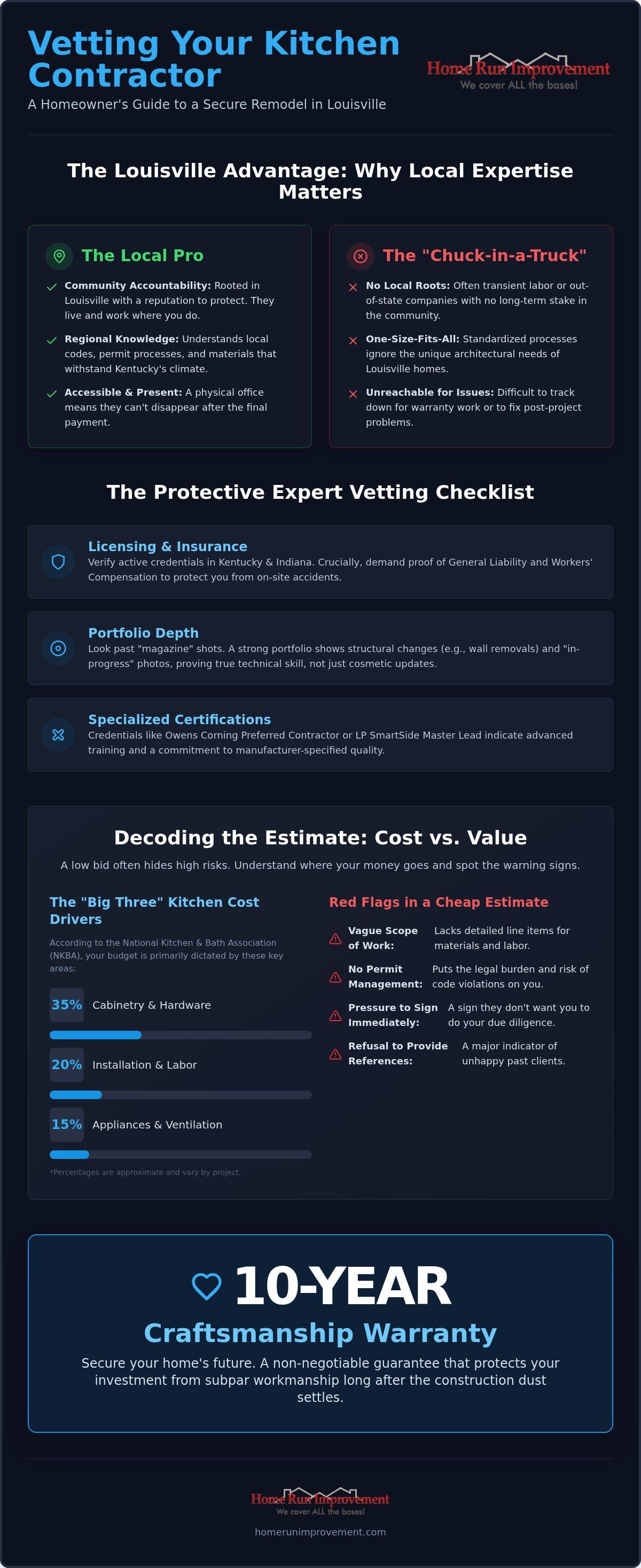
  • Discover why a local kitchen remodeling contractor with deep roots in Louisville provides a level of accountability that national chains cannot match.
  • Learn the essential licensing requirements for contractors in Kentucky and Indiana to ensure your project complies with state regulatory standards.
  • Identify the specific red flags in cheap estimates that signal a contractor is cutting corners on structural integrity.
  • Understand the "Big Three" cost drivers that dictate your budget according to National Kitchen & Bath Association guidelines.
  • Secure your home's future by demanding a 10-year craftsmanship warranty that protects your investment long after the construction dust settles.

Why Choosing a Local Kitchen Remodeling Contractor Matters in Louisville

A local kitchen remodeling contractor is more than just a service provider; they are a business with physical roots and a reputation anchored in the community. When you choose a professional with local references, you're opting for a partner who understands what a general contractor does within the specific context of Kentucky’s building landscape. National conglomerates often rely on transient labor and standardized processes that ignore the nuances of your home. In contrast, a local expert treats your kitchen as a reflection of their standing in the community.

The "Louisville Advantage" is real. Homes in Anchorage and Glenview possess architectural complexities that demand specialized care. If a contractor fails to respect the load-bearing requirements of a historic structure or the specific framing of a classic ranch, you risk structural failure. Local knowledge also influences material selection. Kentucky’s humidity and temperature swings are harsh on wood and finishes. A local specialist knows which materials will remain resilient and which will fail under regional conditions.

Be wary of "storm chasers" who descend on the area after heavy weather or national franchises that outsource their labor. These entities often prioritize speed over precision. If your cabinets begin to sag or your plumbing leaks six months later, these companies are often unreachable. A local firm stays put, protecting your investment through proximity and pride.

The Accountability Factor: Why Proximity Protects You

A contractor who lives and works in Louisville cannot afford to disappear. Their livelihood depends on local word-of-mouth and maintaining a stellar record on Google Reviews. If you choose a firm with a physical office in the metro area, you know exactly where to find them. Local accountability is the primary insurance policy for a homeowner, providing a layer of security that a faceless national hotline can never replicate.

Navigating Louisville and Southern Indiana Building Codes

The bureaucracy of Jefferson County permits is a minefield for the uninitiated. A professional local kitchen remodeling contractor manages this process for you, ensuring every electrical and plumbing upgrade meets current safety standards. In many older Louisville homes, outdated wiring or galvanized pipes require precise intervention. Attempting a "DIY permit" or hiring a contractor who bypasses these steps leaves you liable for future code violations and potentially dangerous structural failures. Professional management ensures your kitchen is both beautiful and legally compliant.

Essential Criteria for Your Kitchen Remodeler Roundup

Vetting a local kitchen remodeling contractor requires a shift in perspective. You must look beyond the bottom-line estimate and scrutinize the actual infrastructure of the business. At Home Run Improvement, we utilize a "Protective Expert" framework. This means we prioritize the safeguards that keep your project on track and your property secure. If a contractor lacks a robust business foundation, their low price is simply a down payment on future headaches. You aren't just buying a kitchen; you're investing in the stability of the team building it.

The non-negotiables start with proper licensing. In our region, a reputable firm must maintain active credentials in both Kentucky and Indiana. This is especially critical for residents in Clarksville and New Albany who need assurance that their contractor understands specific state regulations. Beyond licensing, verify their insurance coverage. You must demand proof of general liability and workers’ compensation. Without these, any accident on your property becomes your financial burden. For a structured approach to these basics, consult the NAHB's remodeler hiring checklist to ensure no detail is overlooked.

Portfolio Depth: Evaluating Real Craftsmanship

When you review a remodeling portfolio, you need to look past the high-end finishes. Look for evidence of structural changes, such as removed walls or relocated utilities, rather than just fresh paint and new hardware. A true portfolio shows a contractor’s ability to solve spatial problems, not just install cabinets. Demand to see "work in progress" photos. These images reveal the cleanliness of the job site and the precision of the framing behind the drywall. If a contractor only shows "magazine" shots, they might be hiding a lack of technical depth.

The Hidden Value of Specialized Certifications

Industry-specific credentials indicate a commitment to excellence that goes beyond the bare minimum. For example, status as an LP SmartSide Master Lead or an Owens Corning Preferred Contractor proves the team has been trained in manufacturer-spec installation. These partnerships aren't just badges; they often unlock superior material warranties for the homeowner. We prioritize these high-level affiliations because they hold our team to a standard of precision that protects your long-term investment. If you're ready to see how these professional standards can transform your home, you can reach out for a detailed project assessment.

Red Flags to Avoid When Comparing Local Remodelers

If a local kitchen remodeling contractor presents an estimate that seems significantly lower than the competition, it's because they're sacrificing your home's structural integrity. Cheap labor and inferior materials are the only ways to slash prices in a high-demand market like Louisville. This is the "Low-Ball" trap. These contractors provide a bare-bones quote to get their foot in the door, only to hit you with "change order" nightmares once your kitchen is demolished. By then, you're financially trapped and your home is in disarray.

Watch for warning signs during the initial consultation. If a contractor fails to take detailed measurements or refuses to discuss the Louisville building permit process, they aren't professionals. They're cutting corners that could lead to legal and safety issues later. Financial red flags are equally dangerous. Never pay 100% of the project cost upfront. According to FTC guidelines on hiring contractors, you should establish a payment schedule tied to specific construction milestones. Demanding full payment before work begins is a clear sign of a business in financial distress.

Communication Gaps and Ghosting Patterns

The way a contractor communicates during the sales process is a blueprint for how they will behave during the build. If they're slow to return calls now, they'll be invisible when a pipe bursts or a delivery is delayed. Insist on a dedicated project manager who serves as your single point of contact. Professional contractors use precise written contracts to define the scope of work. Verbal agreements offer zero protection. If a detail isn't in the contract, don't expect it to be in your kitchen.

The "Subcontractor-Only" Risk

You must distinguish between a contractor who uses vetted, long-term crews and one who hires "daily labor" for every new job. This choice directly impacts the validity of your 10-year craftsmanship warranty and the overall safety of your family. If your contractor doesn't know the background of the people in your house, then your home's security is at risk. We prioritize specialized, consistent teams because precision requires a team that understands our high standards. A "Protective Expert" knows that who does the work is just as important as how it's done.


Planning Your Investment: Budgeting and Timeline Realities

Every homeowner starts with the same question: "How much will this cost?" While no two projects are identical, your budget is primarily dictated by the "Big Three" cost drivers: cabinetry quality, countertop materials, and structural or mechanical changes. If you choose to move a sink or remove a load-bearing wall, you're shifting from a cosmetic update to a major engineering project. A local kitchen remodeling contractor will help you navigate these choices by explaining the long-term value of durable materials over trendy, short-lived finishes. Understanding the ROI of kitchen remodeling in Louisville is critical for protecting your investment, as a precision-built kitchen is often the highest-returning upgrade you can make to a Kentucky home.

What Drives Kitchen Remodel Costs in the Louisville Metro?

Local labor rates and the availability of premium materials in the Kentucky market are major factors in your final estimate. When you choose a "pull and replace" strategy, you're essentially swapping old items for new ones in the same footprint. This is significantly different from a full custom layout change, which requires relocating gas lines, vents, and drainage. If you're looking for a national baseline to compare against local quotes, the National Kitchen & Bath Association (NKBA) provides data on how homeowners typically allocate their funds. We focus on transparency because we want you to understand exactly where your money is going, whether it’s into high-yield structural improvements or premium aesthetic details.

Managing the Renovation Timeline Without Losing Your Mind

Quality construction is a methodical process that cannot be rushed without compromising the result. A professional kitchen remodel is a journey of weeks, not days. As your "Protective Expert," we ensure your project moves through the necessary phases: Demolition, Rough-in (Plumbing/Electric), Installation, and Finishing. A local kitchen remodeling contractor must carefully sequence these steps to ensure that inspections are passed and materials are ready the moment they're needed. If a contractor promises a "lightning-fast" completion, they're often skipping critical drying times or bypassing the permit inspections that protect your safety. We encourage you to visit our FAQ page to learn how we maintain a clean job site and minimize the disruption to your daily life during this transformative process.

Schedule your Louisville kitchen consultation today

Why Home Run Improvement is the Right Choice for Your Kitchen

Selecting a local kitchen remodeling contractor is a decision that determines the long-term stability of your home. You need a partner who balances deep community roots with master-level technical certifications. If you hire a team that lacks this equilibrium, you risk a project that looks acceptable on the surface but fails structurally within a few years. We've spent years building a reputation for excellence across the Louisville metro area, from the historic estates in Prospect to the growing neighborhoods in Crestwood. Our approach is built on the belief that a kitchen is a complex mechanical system, not just a collection of cabinets and appliances.

Our background in high-level exterior work, including roofing and siding, gives us a unique advantage in interior remodeling. We understand the "envelope" of your home. If a contractor ignores how moisture or structural loads move through the building's exterior, your new interior investment is at constant risk. We apply the same precision required for LP SmartSide Master Lead installations to every kitchen layout we design. This holistic perspective ensures that your renovation is as durable as it is beautiful, adhering to the high standards set by organizations like the National Association of the Remodeling Industry (NARI).

Our Signature 10-Year Craftsmanship Warranty

Most contractors offer a standard one-year warranty that barely covers the time it takes for a house to settle. We provide a 10-year craftsmanship warranty because we have absolute confidence in our Louisville crews. This coverage protects the integrity of the work itself, ensuring that your plumbing, electrical, and structural modifications remain sound for a decade. We don't just finish the job; we stand by it for a decade. This long-term commitment is the ultimate safeguard for your property and your peace of mind.

Start Your Dream Kitchen with a Free Estimate

We invite you to experience the difference that a "Protective Expert" brings to the table. When you schedule a Home Run Improvement consultation, you aren't just getting a price quote. You're getting a detailed structural assessment of your space. We'll discuss your goals, identify potential mechanical hurdles, and outline a clear path toward your ideal kitchen. Our goal is to eliminate the typical anxieties of home renovation by providing a transparent, neighborly experience backed by professional authority. Your home is your most significant asset, and it deserves the protection of a local kitchen remodeling contractor who treats every detail with the same care as their own property. You can also review industry-standard planning guides to prepare for our meeting and ensure we cover every aspect of your vision.

Securing the Future of Your Louisville Home

Vetting your local kitchen remodeling contractor is the most critical step in protecting your home's long-term value and your family's peace of mind. You now have the framework to look beyond surface-level aesthetics and identify a team that respects Louisville building codes. By prioritizing structural integrity over the "low-ball" trap, you're choosing a path of security and transparency rather than one of hidden costs and abandoned projects. It's about ensuring your investment remains a source of pride for years.

As a locally owned fixture in the Louisville community, Home Run Improvement offers the accountability you deserve. We back our work with an Owens Corning Preferred Contractor status and a 10-year craftsmanship warranty that sets a new industry standard. We treat your kitchen as a major structural investment, ensuring every cabinet and countertop is installed with absolute precision. Consult the latest industry cost reports to confirm the value of professional intervention over cut-rate alternatives.

Get Your Free Kitchen Remodeling Estimate from Home Run Improvement Today!

Your dream kitchen is within reach when you partner with experts who value integrity as much as you do. We look forward to helping you build a space that serves your family for decades to come.

Frequently Asked Questions

Do I need a permit for a kitchen remodel in Louisville, KY?

Yes, any project involving structural changes, electrical upgrades, or plumbing modifications requires a permit from the Louisville Metro Department of Codes and Regulations. If a contractor suggests bypassing this step, they're exposing you to significant legal and safety risks. Proper permitting ensures that every phase of your renovation is inspected and verified by local officials to meet current Kentucky building standards.

How long does a typical kitchen renovation take from start to finish?

A high-quality kitchen renovation is an intensive structural process that requires weeks, not days, to complete with the necessary precision. The total duration depends on the complexity of your custom layout and the specific mechanical upgrades required for your home. We prioritize a methodical pace to ensure that structural adhesives and finishes cure correctly and that every inspection is passed before moving to the next phase.

What should I look for in a local kitchen remodeling contractor’s contract?

Your contract must include a comprehensive scope of work, a detailed payment schedule tied to construction milestones, and a clear process for change orders. It's vital that the document specifies exactly which materials will be used to avoid "low-ball" material swaps later. For a standard framework of what a professional agreement entails, you should review the FTC's consumer guide for hiring home contractors.

Can I stay in my home during a kitchen remodel?

Most homeowners choose to remain in their residence, though it requires preparing for the loss of your primary cooking and cleaning area. We recommend establishing a temporary kitchenette in an adjacent room equipped with a microwave and a small dining space. While our crews maintain a clean job site, the demolition and rough-in phases are naturally disruptive, so planning your daily routine in advance is essential for a stress-free experience.

What is the average ROI for a kitchen remodel in the Louisville area?

Kitchen renovations consistently offer one of the highest returns on investment for Kentucky homeowners. According to the Cost vs. Value Report, a minor kitchen remodel can recoup over 70% of its cost during a home sale. Beyond the immediate financial gain, a modernized kitchen significantly increases the marketability of your property, making it a strategic choice for long-term home value protection.

Is it better to hire a general contractor or a specialized kitchen remodeler?

You should seek a local kitchen remodeling contractor who possesses specialized expertise in interior structural engineering and cabinetry. While a generalist might handle basic repairs, a specialist understands the nuances of kitchen-specific codes and high-performance material installation. This specialized knowledge prevents common failures in plumbing and electrical loads that generalists often overlook, ensuring your kitchen remains functional and safe for decades.

How do I verify if a contractor is licensed in both Kentucky and Indiana?

Verification is simple through official state databases. In Kentucky, you can check credentials through the Department of Housing, Buildings and Construction. For Southern Indiana projects, licenses are often verified through the local county building commission. A professional contractor will always provide their license numbers upfront so you can confirm their standing and insurance coverage before any work begins on your property.

What does a 10-year craftsmanship warranty actually cover?

Our 10-year craftsmanship warranty covers the technical integrity of the installation work itself, which is separate from the manufacturer’s warranty on individual parts. If an issue arises due to the way a structural element, pipe, or cabinet was installed, we take full responsibility for the repair. This long-term commitment provides a level of security that standard one-year warranties cannot match, protecting your investment long after the project concludes.
By Pat McIntyre August 23, 2026
Your home's exterior is the first thing neighbors, guests, and buyers notice. Yet most homeowners replace siding reactively, after warping, rot, or storm damage forces the decision. On average, homeowners spend $5,561 to $17,719 on the cost to replace siding, with most projects averaging $11,585, a significant investment that deserves a material built to last. That is exactly where LP SmartSide siding stands apart from the crowd. In my experience advising homeowners on exterior improvements, the single most common regret I hear is choosing a cheaper cladding product the first time around. When you understand what LP SmartSide actually is, how it is made, how it performs in the real world, and how it stacks up against vinyl and fiber cement, the case for engineered wood becomes hard to ignore. Key Takeaways LP SmartSide is engineered, not just wood: LP SmartSide is a type of engineered wood siding made from wood strands treated with waxes and resins for added strength and moisture resistance, then compressed and bonded with strong adhesives to form durable boards, giving it capabilities natural wood simply cannot match. Storm resistance that exceeds competing materials: LP SmartSide lap siding is designed to withstand wind gusts of up to 200 miles per hour, and third-party test results demonstrate that LP SmartSide lap siding resisted hail damage better than fiber cement and vinyl, with the warranty covering impacts from hail up to 1.75 inches in diameter. If you live in a storm-prone region, that benchmark matters directly to your repair budget. Carbon-negative manufacturing: A life-cycle assessment found that LP SmartSide is classified as a carbon-negative exterior cladding product, and LP SmartSide stores 10 times more carbon than fiber cement-based products while emitting 59% less greenhouse gas emissions during production. Choose it and you reduce your environmental footprint compared to cement or vinyl alternatives. Strong resale ROI: Homes with LP SmartSide siding have been seen to recover 80-90% of siding replacement costs in resale value, making it one of the highest-ROI exterior improvements available. If you plan to sell within a decade, that return offsets a meaningful portion of the project cost. A 50-year warranty with full first-five-year coverage: LP SmartSide comes with a 50-year limited warranty on the substrate, and for the first five years coverage includes both materials and labor at 100%, after which the warranty becomes prorated, decreasing by about 2.2% each year. Use that as your benchmark, if a contractor cannot guarantee certified installation, find one who can. Quick-Start Prioritization Framework Start here if you're: Budget-conscious but quality-minded: LP SmartSide, sits above vinyl in durability without the steep labor cost of fiber cement. In a storm or hail-prone area: LP SmartSide, its 200 mph wind rating and hail warranty are unmatched by vinyl. Focused on resale value: LP SmartSide, the transferable warranty adds perceived value that buyers notice. What Is LP SmartSide? The Science Behind the Product Before comparing LP SmartSide against traditional cladding options, it helps to understand what it actually is. Many homeowners hear "engineered wood" and assume it is a fancy term for cheap composite. The reality is more precise. How LP SmartSide Is Made All LP SmartSide products are engineered using LP's proprietary SmartGuard manufacturing process, which begins with quality wood strands or wood fibers, then treats every inch of every LP SmartSide product to the core with an advanced formula of waxes, adhesive resins, and zinc borate, applied before being bonded with a resin-saturated, water-resistant overlay. Think of it like this: rather than cutting a plank directly from a tree and hoping for the best, LP engineers each board from the inside out. The zinc borate additive helps panels resist damage from fungal decay and termites, while marine-grade resin provides incredible strength against heavy impacts and fluctuating temperatures. That combination is what separates LP SmartSide from ordinary lumber, or from vinyl, which offers no wood character at all. The SmartGuard Durability Test The durability of LP SmartSide treated engineered wood products has been tested in the tropical climate of Hilo, Hawaii, where nearly 170 inches of rain falls annually and termite colonies thrive. Samples of the material were left in that environment at a reputable third-party testing site for more than 20 years, and even after all those years of exposure, LP SmartSide products remained structurally sound. That is a real-world endurance test, not a lab projection. Pro Tip: When evaluating any siding product, ask the manufacturer or your contractor for third-party test data, not just marketing claims. LP SmartSide's Hawaii field testing and NASA-commissioned impact analysis are publicly documented proof points most competing products cannot match. LP SmartSide vs. Vinyl Siding: A Clear Performance Gap Vinyl remains the most popular siding in the U.S. because of its low price. But understanding exactly what you trade away is essential before committing. Durability and Impact Resistance Engineered wood has higher impact resistance than traditional wood siding and does not easily crack or dent, while vinyl siding can become brittle and crack under impact in extremely cold temperatures, and heavy-gauge vinyl does not offer the same level of impact resistance as LP SmartSide. In hail-prone regions, that gap shows up directly in insurance claims and repair bills. Extreme heat can also cause vinyl to warp, particularly if placed near a direct heat source like a grill or outdoor fireplace. LP SmartSide holds its shape because the wood fibers and resins are engineered to absorb stress rather than transfer it. Aesthetics and Color Flexibility Unlike vinyl's plastic appearance or fiber cement's sometimes flat finish, LP SmartSide looks and feels like genuine wood. Because LP SmartSide takes paint exceptionally well, you can choose literally any color for your home, unlike vinyl, which is limited to factory colors that can't be changed. I've found that this single feature drives a large portion of homeowner satisfaction, especially when clients want a deep charcoal or bold navy that vinyl simply cannot safely handle. Cost Comparison Over Time LP SmartSide typically costs 20-40% more than vinyl siding when installed, which translates to approximately $3,000-$8,000 more for an average-sized home. That sounds significant until you factor in vinyl's long-term limitations. Faded or damaged vinyl panels cannot be repainted and must be replaced, and finding exact color matches for replacement panels can be difficult after several years. With LP SmartSide, a fresh coat of paint restores the exterior completely, no panel hunting required. Pros: Superior impact resistance vs. vinyl Complete color freedom with repainting Authentic wood-grain texture and appearance 50-year limited transferable warranty Carbon-negative manufacturing footprint Cons: Higher upfront installed cost (20-40% above vinyl) Requires periodic repainting every 12-15 years Wood-based, so more combustible than fiber cement Warranty excludes certain high-humidity regions What Is Fiber Cement Siding and How Does It Compare? Many homeowners researching LP SmartSide also ask what fiber cement siding is and whether it is a better choice. The honest answer: each has genuine strengths. What Is Fiber Cement Siding? Fiber cement has a composition that makes it inherently stronger than wood-based products, consisting of Portland cement, water, sand, and cellulose fibers, which allows it to provide unique advantages that are not possible with engineered wood. The biggest of those advantages are non-combustibility and maximum moisture resistance. Where LP SmartSide Pulls Ahead LP SmartSide is significantly lighter than fiber cement, easier to cut and install, and offers a more natural wood-like appearance. In practice, that weight difference affects your project timeline and labor cost. LP SmartSide weighs about half of fiber cement per square foot, which means installs go faster with less crew fatigue, and that translates directly into lower labor bills for a similar scope of work. On the environmental side, the contrast is even sharper. Compared to fiber cement-based products, LP SmartSide products emit 54% less greenhouse gases, LP also uses 99% of logs delivered to mills either in the products themselves or as a renewable energy source in the manufacturing process, and the final product is made of 91% wood fiber coming from renewable wood sources. If sustainability factors into your buying decision, LP SmartSide wins that comparison decisively. Where Fiber Cement Leads Fiber cement is highly durable and much more resistant to weather, fire, and pest damage, and it requires very little maintenance and can go years without needing to be repainted. If fire resistance is your top priority, for example, if you live in a wildfire zone, fiber cement carries a non-combustible rating that LP SmartSide, as a wood-based product, cannot match. Pro Tip: Ask your LP SmartSide installer about fire-rated wall assemblies. All LP SmartSide siding can be used in a 1-hour fire-rated assembly when installed over 5/8 type-X gypsum, which is consistent with other siding types such as fiber cement siding. That means fire resistance is achievable with the right wall system, even with engineered wood. LP SmartSide Performance in Real-World Conditions Understanding how a product performs on paper is one thing. Watching it survive on real homes across real climates is another. Storm and Hail Performance LP SmartSide siding is rated to withstand wind gusts up to 200 mph and hail up to 1.75 inches when correctly installed. To put that in context, EF3 tornado winds peak around 165 mph. For homeowners in the Midwest, Southeast, or any area with frequent severe weather, this rating directly reduces storm repair exposure. LP Building Products asked NASA to evaluate the impact damage resistance of both LP SmartSide engineered wood strand siding and fiber cement siding, and the results confirmed LP SmartSide's superior performance against impact. That kind of independent validation is rare in the building products industry. Moisture and Pest Defense Unlike traditional wood siding, LP SmartSide is manufactured using a combination of wood strands and resins, treated with SmartGuard technology, a blend of waxes, resins, and zinc borate, making the boards resistant to moisture, decay, and termites while still delivering the authentic look of natural wood. That combination matters especially in humid climates, where untreated wood can begin to deteriorate within a few years of installation. All siding manufactured by LP SmartSide can resist twisting, cupping, shrinking, and warping. Those four failure modes are what homeowners most commonly discover when they pull off aging wood or lower-grade composite cladding. Pro Tip: LP SmartSide protects the structure underneath, eliminating the expensive sheathing and framing repairs that water damage creates, and one incident of moisture intrusion can cost $5,000-$15,000 in hidden repairs. When budgeting for siding, always calculate what bad siding costs you, not just what good siding costs you upfront. The Financial Case: ROI, Resale Value, and Total Cost of Ownership Siding is not a purchase; it is an investment. The right framework compares what you spend against what you get back, in avoided repairs, energy savings, and resale value. Installation Cost Reality LP SmartSide material panels run $3.50-$4.50 per square foot, with additional materials for trim, house wrap, fasteners, and paint adding $2.00-$3.00 per square foot, and labor running $4.00-$6.00 per square foot, for a total average installed cost of $5.50-$10.50 per square foot. For most average-sized homes, budget between $11,000 and $20,000 installed, consistent with broader siding replacement industry averages. Return on Investment at Resale The LP SmartSide ROI at resale ranges from 82% to 87%. At the higher end of that range, a $15,000 siding project adds roughly $13,000 in home value. LP SmartSide's transferable warranty adds resale value because future owners benefit from the siding investment, a detail buyers and their agents increasingly look for during home inspections. The Hidden Cost of Delaying Aging or failing siding rarely fails cleanly. It fails slowly, letting moisture seep into sheathing and framing while the exterior still looks passable. Delayed replacement past moisture damage adds $3,000-$8,000 in structural repair costs. A proactive siding upgrade with a quality installer is almost always cheaper than a reactive one forced by storm damage or a failed inspection. Choosing an LP SmartSide Siding Installer: What to Look For The best material in the world underperforms with a poor installation. LP SmartSide requires precise handling, correct fastener placement, proper back-priming, and careful attention to moisture barriers. The biggest thing to understand about LP SmartSide is that installation quality is absolutely critical. Certifications and Credentials LP maintains a network of trained installers who understand the specific requirements for the SmartGuard warranty to remain valid. When evaluating an LP SmartSide siding installer, look for documentation of LP training, a clear labor warranty on top of the manufacturer's material warranty, and a contractor who can walk you through the ExpertFinish vs. primed board options for your project. What Voids the Warranty Although LP SmartSide comes with a warranty, it has specific stipulations regarding installation and maintenance, and failure to meet these requirements can void the warranty, leaving homeowners with unexpected repair costs. Confirm that your contractor follows LP's published installation instructions, specifically for clearance from grade, flashing details, and paint specifications, before work begins. The team at Home Run Improvement understands LP SmartSide installation requirements thoroughly and can help you navigate product selection, finish options, and warranty compliance from day one. The following walkthrough shows how an experienced crew approaches the installation process, which gives you a practical baseline for evaluating the technique and efficiency of any contractor you're considering. https://www.youtube.com/embed/KPt95qdMXcc Frequently Asked Questions What is LP SmartSide siding made of? LP SmartSide is a combination of real wood, resins, glues, and waxes that are combined through a process of heat and pressure to produce a durable board, and all LP SmartSide products are treated with the proprietary SmartGuard zinc-borate process that inhibits fungal growth and termite damage. The result is a board that behaves like natural wood in appearance but performs with the consistency of an engineered product. How does LP SmartSide compare to vinyl siding on cost? LP SmartSide typically costs 20-40% more than standard vinyl siding when comparing installed prices. However, LP SmartSide's superior durability, curb appeal, and home value contribution often make it the better long-term investment. Factor in the inability to repaint vinyl and the brittleness vinyl shows in cold weather, and the cost gap shrinks considerably over a 15-20 year horizon. How long does LP SmartSide siding last? With proper installation and maintenance, LP SmartSide siding can last 30 or more years. The 50-year limited warranty covers substrate defects, with full materials-and-labor coverage for the first five years. With quality exterior paint, LP SmartSide typically needs repainting every 12-15 years, which is comparable to fiber cement and significantly less frequent than natural wood, which may need restaining every 3-7 years. Is LP SmartSide a good choice for storm-prone areas? In most storm-prone regions, yes. LP SmartSide lap siding is designed to withstand wind gusts of up to 200 miles per hour, and the warranty covers impacts from hail up to 1.75 inches in diameter. Vinyl becomes brittle and cracks in cold-weather impacts; fiber cement can fracture under significant hail. LP SmartSide's strand construction absorbs and distributes impact energy more effectively. What should I ask an LP SmartSide siding installer before hiring? Ask whether they follow LP's published installation guidelines, whether they offer a separate labor warranty, whether your project qualifies for the full 5/50 warranty coverage, and whether they recommend the ExpertFinish prefinished option or a field-painted approach for your climate. The ExpertFinish line includes a 15-year finish warranty covering peeling, flaking, and excessive fading, while if you go with a primed version and paint it yourself or through a contractor, coverage depends on the paint manufacturer rather than LP. That distinction affects your long-term maintenance budget significantly. The Bottom Line LP SmartSide siding is not the cheapest option on the market, and it is not trying to be. What it offers is a rare combination of engineered performance, genuine wood character, storm-rated durability, and a sustainability profile that competitors built from concrete or plastic simply cannot replicate. Whether you are weighing LP SmartSide vs. vinyl siding, comparing it to fiber cement, or trying to understand what fiber cement siding even is before making a decision, the data consistently points in one direction: engineered wood delivers more value per dollar over a full ownership cycle. If you are ready to explore LP SmartSide for your home, Home Run Improvement offers expert guidance on product selection and installation built to protect your warranty and your investment. Sources LP SmartSide Product Guide and Specifications , LP Building Solutions. Official product guide covering wind ratings, hail warranty, and SmartGuard specifications. https://images.thdstatic.com/catalog/pdfImages/4f/4f7fda9f-8987-4360-97ce-7223229e8fc5.pdf The LP SmartGuard Process: Providing Protection to the Core , LP Building Solutions. Explains the four-component SmartGuard manufacturing process and Hawaii field testing results. https://www.lpcorp.com/project-resources/blog/the-lp-smartguard-process-providing-protection-to-the-core LP SmartSide Environmental Product Declaration, PR Newswire , LP Building Solutions. Documents carbon-negative classification and greenhouse gas emissions comparison to fiber cement. https://www.prnewswire.com/news-releases/lp-building-solutions-announces-first-lp-smartside-environmental-product-declaration-on-sustainability-day-301409345.html Building a More Sustainable Future with LP Building Solutions , LP Building Solutions. Details renewable sourcing, 99% log utilization, and greenhouse gas comparisons. Compared to fiber cement-based LP SmartSide vs. Vinyl Siding: Complete Comparison , Weatherguard Construction. Side-by-side analysis of durability, cost, and aesthetics. https://wgccinc.com/lp-smartside-vs-vinyl-siding-colorado What is LP SmartSide Siding? , 4Feldco. Explanation of SmartGuard technology, zinc borate treatment, and product composition. https://www.4feldco.com/articles/what-is-lp-smartside-siding LP SmartSide Siding Review for Long Island Homeowners , Unified Home Remodeling. Detailed review of warranty structure, impact resistance, and moisture performance. https://www.unifiedhomeremodeling.com/lp-smartside-siding-review-long-island/ LP SmartSide Installation Guide: Premium Siding Quality and Warranty Coverage , Expert Exteriors. Covers ROI, resale value recovery rates, and moisture damage cost data. https://expertexteriorswi.com/lp-smartside-installation-guide-premium-siding-quality-and-warranty-coverage/ Siding Comparisons: Fiber Cement vs. LP SmartSide vs. Wood Siding , JointFlash. Neutral comparison of three major siding categories across durability and maintenance. https://jointflash.com/siding-comparisons-fiber-cement-vs-lp-smartside-vs-wood-siding/ LP SmartSide Lap Siding, Engineered Wood , Innovative Home Concepts. Weight comparison to fiber cement, 200 mph wind rating details, and strand composition. https://innovativehomeconcepts.com/siding/lp-smartside/lap/ LP SmartSide Engineered Wood Siding Benefits and Performance Guide , Weatherguard Construction. Paint adhesion, color flexibility, and repainting frequency data. https://wgccinc.com/blog/engineered-wood-siding-benefits LP SmartSide Siding Cost vs. HardiePlank Fiber Cement , RGB Construction. ROI percentages for LP SmartSide vs. fiber cement at resale. https://rgbconstructionservices.com/lp-smartside-siding-cost-vs-hardieplank-fiber-cement-siding/ LP Siding Installation Cost Guide , Perfect Windows and Siding. Per-square-foot material and labor cost breakdown for LP SmartSide projects. https://perfectwindowsandsiding.com/lp-siding-installation-cost-guide/ Does New Siding Increase Home Value? New Berlin ROI Guide , Four Leaf Roofing and Windows. 2026 resale value data and freeze-thaw performance benchmarks for LP SmartSide. https://fourleafroofingwindows.com/does-new-siding-increase-home-value-new-berlin/ LP SmartSide Siding FAQ , Bluelinx. Official FAQ covering fire ratings, paint specifications, and installation requirements. https://bluelinxco.com/files/SidingAndTrim/LPSmartside/FAQ_LP_SmartSide.pdf Vinyl Siding vs. LP SmartSide: The Best Siding for Your Home , Scholten Construction. Cost comparison, durability analysis, and maintenance requirements by material. https://scholtenconstructionllc.com/blog/siding-vinyl-vs-lp-smartside/ LP SmartSide Engineered Wood Siding , U.S. Lumber. Product overview covering SmartGuard treatment and natural cedar aesthetic benefits. https://www.uslumber.com/engineered-wood-siding/
By Pat McIntyre August 23, 2026
If you believe all siding materials offer the same protection against the Ohio Valley's punishing humidity, you are likely setting your home up for a costly failure. Most Louisville homeowners feel a justified sense of anxiety when choosing an exterior, fearing that moisture will eventually lead to rot or that a contractor will disappear the moment a leak occurs. When you choose LP SmartSide siding Louisville, you aren't just selecting a product; you're investing in a specialized defense system designed to thrive where traditional wood and vinyl often fail. It is a decision that moves you from uncertainty to long term stability. This guide provides everything you need to know about the premier siding choice for 2026, from technical durability to the specific installation standards required for a valid warranty. You'll discover how this engineered wood technology outperforms competitors in the Louisville climate while maximizing your home's curb appeal and ROI. We will also outline how to verify contractor credentials to ensure your project is backed by the 50-year limited warranty and a professional 10-year labor guarantee. By the end of this article, you will have the clarity needed to transform your home into a maintenance free masterpiece. Key Takeaways Learn why the Ohio Valley's humidity makes standard materials a risk and how engineered wood provides a superior moisture barrier according to Louisville building standards. Understand the science behind the SmartGuard process, which utilizes zinc borate and water-resistant waxes to prevent fungal decay. Compare the impact resistance and installation efficiency of LP SmartSide against fiber cement to ensure you're maximizing your home's long term ROI. Follow our 5-step installation roadmap to avoid common moisture detection failures and secure a flawless LP SmartSide siding Louisville transformation. Identify the specific advantages of hiring an LP Master Lead to protect your investment with an industry-leading 10-year craftsmanship warranty. Why Louisville Homes Need More Than Standard Vinyl Siding Living in the Ohio Valley requires an exterior that can handle more than just curb appeal. Louisville weather is relentless. Homeowners here face a unique set of environmental challenges, from bone-chilling January freezes to the blistering 2026 summer heatwaves. If you choose a budget-grade exterior, you're essentially inviting moisture into your wall cavities. Choosing LP SmartSide siding Louisville provides a necessary barrier against these extremes. It ensures your home remains a sanctuary rather than a liability. Standard materials often fail under the weight of Kentucky's climate. We frequently see vinyl siding that has warped or even melted due to reflected sunlight from energy-efficient windows. Beyond heat, local wildlife like woodpeckers find traditional wood and some composites easy to penetrate. This leads to structural damage, pest infestations, and costly repairs that most warranties don't cover. Engineered wood offers a modern answer. It combines the aesthetic of historic Louisville architecture with the resilience of advanced material science, providing a defense that natural wood simply can't match. To better understand why this material is a top choice for local homeowners, watch this helpful video:  https://www.youtube.com/watch?v=LNVFbtBBSGY The Problem with Traditional Wood in the South Natural cedar and pine might look beautiful initially, but they are highly susceptible to National Weather Service reported humidity levels. In Louisville, the air is often thick with moisture. This moisture penetrates natural wood fibers, causing them to swell, rot, and eventually fail. Maintaining the paint or stain on real wood is a relentless, expensive cycle. If you don't stay ahead of it, the Kentucky humidity will win every time. Engineered alternatives provide that classic look without the constant threat of decay. Vinyl Siding vs. Louisville Storms While vinyl siding installation Louisville remains a popular budget-friendly option, it often lacks structural integrity during severe weather. High winds can strip lightweight vinyl panels right off a house. This leaves the substrate exposed to driving rain and potential mold growth. Brittle vinyl is also no match for the hail that frequently accompanies our spring thunderstorms. LP SmartSide offers the impact resistance needed to survive these events without the cracking or denting common in thinner alternatives. It's the protective expert's choice for long-term peace of mind. The Science of LP SmartSide: Engineered for Kentucky Durability While traditional materials rely on surface coatings, LP SmartSide siding Louisville is built with durability baked into every fiber. It is a high-performance engineered wood siding treated with the proprietary SmartGuard process. This isn't just a marketing term; it's a rigorous manufacturing standard that ensures every board can withstand the specific environmental pressures of the Ohio Valley. When you choose this material, you're investing in a product that has been tested to perform in the most demanding conditions. The strength of this siding comes from four essential components of protection: Zinc Borate: Infused throughout the wood to resist fungal decay and wood-boring insects. Resins: Marine-grade adhesives that provide incredible structural strength and impact resistance. Waxes: Water-resistant coatings that protect individual wood strands from internal moisture. Overlay: A resin-saturated finish that creates a durable base for paint and resists moisture intrusion. SmartGuard is a multi-level treatment that prevents fungal decay and termite damage. Impact resistance is where this technology truly shines during the volatile spring months. If a 2026 Louisville hail storm hits, standard vinyl often shatters and fiber cement can crack. LP SmartSide is engineered to absorb the energy of high-velocity impacts, protecting your home's structural envelope from a breach. When investing in LP SmartSide siding Louisville , you're choosing a product that remains resilient even when the weather turns aggressive. Resistance to Rot and Termites Kentucky’s climate is a breeding ground for subterranean termites and wood-destroying fungi. To combat this, the manufacturing process infuses zinc borate throughout the material. This acts as a natural deterrent for pests common in our region. Additionally, water-resistant waxes are used to coat every wood strand, preventing moisture absorption during heavy rainy seasons. Research from the Louisiana-Pacific Corporation confirms that this deep-level treatment is vastly superior to top-down applications found in lesser products. Aesthetic Versatility for Louisville Architecture Durability doesn't mean you have to sacrifice the character of your property. Whether you're matching the historic look of Anchorage or Glenview homes, you have options that mimic traditional cedar grain or offer smooth finishes for contemporary designs. The use of 16-foot boards is a significant advantage. These longer lengths result in fewer seams across your home's facade, creating a cleaner, more professional appearance. If you're ready to see how these textures look on your specific property, you can schedule an exterior design consultation with our team. Evaluating the Investment: LP SmartSide vs. Fiber Cement If you're weighing your options for a home exterior, you've likely encountered the debate between fiber cement and LP SmartSide siding Louisville . While both are upgrades over vinyl, they perform differently under the specific pressures of the Kentucky climate. Fiber cement is notoriously brittle and heavy. This weight often leads to higher labor costs and a greater risk of boards cracking during transport or while being nailed into place. LP SmartSide is significantly lighter and more resilient, which translates to a faster, more secure installation for your property. Efficiency matters for more than just the schedule. Engineered wood boards come in 16-foot lengths, which is four feet longer than standard fiber cement panels. This means your home will have fewer seams, creating a more cohesive look and reducing the number of potential entry points for moisture. Over a 20-year period, these small technical advantages add up to a significantly lower total cost of ownership because you won't be dealing with the breakage issues common with heavier materials. Choosing the right material is a strategic financial move. High-quality exterior upgrades are proven to increase home value in Louisville by boosting both structural integrity and aesthetic appeal. In fact, Siding material comparisons in recent cost-versus-value reports show that engineered wood consistently ranks as a top performer for ROI. You aren't just buying boards; you're securing your home's equity against the elements. Material Comparison: Strength and Flexibility Brittle materials don't handle movement well. Many neighborhoods in Louisville, from the Highlands to St. Matthews, feature homes with foundations that have settled over decades. If a house shifts even slightly, fiber cement can develop hairline fractures that allow water to seep behind the siding. LP SmartSide siding Louisville possesses a flexible strength that allows it to move with your home. It resists the cracking that often forces homeowners to replace individual fiber cement panels prematurely, providing a more reliable long-term envelope. Maintenance Requirements Your weekends shouldn't be spent scrubbing your house. LP SmartSide is designed for minimal upkeep, requiring only a periodic rinse with a garden hose and mild detergent to look new. Because the material is less porous than fiber cement, paint bonds more effectively to the surface. This superior adhesion means your factory-finished color won't flake or peel as easily, even under the intense Kentucky sun. We back this long-term performance with our 10-year craftsmanship warranty , ensuring your investment stays protected long after the crew leaves. How to Plan Your LP SmartSide Installation: A 5-Step Guide A successful siding project is the result of methodical planning and uncompromising execution. If you treat LP SmartSide siding Louisville as a simple "pull and replace" job, you are likely overlooking the critical details that ensure long-term performance. We follow a structured 5-step process to protect your investment and ensure your home remains the most resilient on the block. Each phase is designed to eliminate the common pitfalls that lead to moisture damage and warranty denials. Step 1: Professional Exterior Audit. We begin with a deep-dive moisture detection sweep of your existing substrate. If there is rot hidden in your sheathing, we find it and fix it before the new siding goes up. Step 2: Profile and Color Selection. You'll select from Lap, Shake, or Vertical profiles. We then help you choose an Expert Finish color that complements the specific architectural style of your neighborhood, whether you're in Anchorage or a more contemporary development. Step 3: Substrate Preparation. Your home needs a high-quality house wrap to act as a secondary drainage plane. We ensure the substrate is flat and secure to prevent "waving" in the finished boards. Step 4: Precision Cutting and Sealing. This is the technical heart of the project. Every cut must be precise, and every exposed edge must be treated to prevent moisture intrusion. Step 5: Final Inspection and Registration. We perform a comprehensive walkthrough to verify every detail. Once we're satisfied, we assist you with the official warranty registration. The Importance of Proper Flashing Flashing is the number one failure point in residential siding. In Louisville, our heavy spring rains will find even the smallest gap in your home's armor. If flashing isn't integrated correctly around windows, doors, and rooflines, moisture will eventually cause structural rot. We take a holistic approach to water management, often coordinating your project with a professional gutter installation Louisville KY . This ensures that every drop of water is channeled safely away from your home's exterior envelope and foundation. Sealing and Painting Best Practices The longevity of your exterior depends on how the installer handles the material on-site. All field-cut edges must be sealed to maintain the 50-year warranty. Master Lead installers don't take shortcuts with "DIY-grade" techniques; we use specialized sealants that are designed to bond with engineered wood. We also pay close attention to the local temperature during the application. If the sealant is applied during extreme humidity or freezing temperatures, it won't cure properly. We monitor these environmental factors to ensure every joint is airtight and warrantied for the long haul. Schedule your professional exterior audit today Why Home Run Improvement is Louisville’s LP SmartSide Master Lead Selecting the right material is only half the battle. If your installer doesn't understand the specific expansion and contraction rates of engineered wood, your 50-year warranty is effectively worthless. Home Run Improvement holds the designation of being Louisville's only LP SmartSide Preferred Contractor at the "Expert" level. This Master Lead status isn't just a certificate on a wall. It represents rigorous, ongoing technical training and a proven track record of excellence in the field. When you choose us for your LP SmartSide siding Louisville project, you are hiring a team that has been vetted by the manufacturer itself. We don't just rely on manufacturer claims; we stand behind our own work. Every siding project we complete comes with an explicit 10-year craftsmanship warranty. This is your local safety net. If a trim piece loosens or a seal fails within a decade of installation, we're the ones who come out to fix it. As a locally owned and operated business serving Louisville and Southern Indiana, our reputation is built on long-term stability rather than quick turnarounds. This commitment to quality is why we've become a trusted home contractor in Louisville for everything from roofing to complete basement transformations. Our Local Expertise in Anchorage, Prospect, and Beyond Neighborhoods like Glenview, Hurstbourne, and Prospect often have strict HOA guidelines regarding exterior aesthetics and material approvals. We understand these local nuances and help you navigate the approval process with confidence. Our crews treat your property with the same care we'd give our own homes. We maintain clean, organized job sites to minimize disruption to your daily life. Don't just take our word for it. Check out our Google Reviews to see what your neighbors in Anchorage and Crestwood have to say about our precision and professionalism. Your Next Step to a Protected Home Your home’s exterior is an ecosystem. If your LP SmartSide siding Louisville is perfect but your gutters are failing, your foundation is still at risk. We specialize in an integrated approach that combines specialized siding installation with professional roofing and gutter systems. This ensures your entire home envelope is managed by a single, accountable expert. Taking the next step toward a protected home is simple. You can schedule your free LP SmartSide estimate with Home Run Improvement to receive a comprehensive, no-obligation audit of your exterior. We provide the clarity you need to make an informed investment in your home's future. Secure Your Home’s Future with Specialized Protection Investing in your home’s exterior is a significant decision that requires more than just picking a color. You now understand that the Ohio Valley humidity demands a material engineered for resilience. By choosing LP SmartSide siding Louisville , you are opting for a system that resists rot, termites, and impact damage better than traditional alternatives. This choice, combined with a professional 5-step installation process, ensures your property remains a high-value asset for decades. As a locally owned Louisville small business, we take personal responsibility for every board we nail into place. Our status as an LP SmartSide Master Lead Certified contractor means we adhere to the highest technical standards in the industry. We encourage homeowners to research exterior energy efficiency to see how quality siding impacts long term utility costs. You deserve the peace of mind that comes with a 10-year craftsmanship warranty protecting your investment. Get Your Free LP SmartSide Estimate Today Don't leave your home’s defense to chance. Secure a beautiful, maintenance-free exterior that is built to last through every Kentucky season. Frequently Asked Questions How much does LP SmartSide installation cost in Louisville? The total investment for your project depends on several variables including your home's square footage and the complexity of its architectural features. While material costs fluctuate based on the current market, choosing the ExpertFinish pre-finished line can impact the initial labor required on-site. We recommend a professional audit to determine the specific needs of your property. This ensures you receive an accurate assessment that accounts for local building permit requirements and structural preparation. Does LP SmartSide siding really last 50 years? LP SmartSide comes with a 50-year limited warranty that covers the structural integrity of the boards. This longevity is a result of the SmartGuard treatment which protects against fungal decay and termite damage. However, the warranty is only fully enforceable if the installation follows strict manufacturer guidelines. When you choose LP SmartSide siding Louisville , you're securing a product designed to outlast traditional wood by decades. Proper maintenance and professional sealing of all field-cut edges are essential. Can LP SmartSide be installed over existing siding? Installing new boards over existing siding is a shortcut that often leads to catastrophic failure. This practice traps moisture between layers, promoting rot and mold growth that stays hidden until the damage is severe. We always remove old materials to inspect the substrate and install a high-quality house wrap. Following industry inspection standards ensures your home’s drainage plane functions correctly. Bypassing this step voids the manufacturer warranty and compromises your structural envelope. Is LP SmartSide better for Louisville weather than HardiePlank? LP SmartSide often outperforms fiber cement in the Ohio Valley due to its superior impact resistance and flexibility. While fiber cement can be brittle and prone to cracking during Louisville’s freeze-thaw cycles, engineered wood moves naturally with your home. The 16-foot board lengths also mean fewer seams compared to the 12-foot standard of competitors. This reduces potential water entry points. For many homeowners, the lighter weight and durability of LP SmartSide siding Louisville provide a better long-term value. How do I maintain my LP SmartSide siding in Kentucky humidity? Maintaining your exterior in Kentucky's high humidity is straightforward. You should clean the surface annually using a cloth or soft brush with a solution of water and mild detergent. Avoid using a pressure washer, as high-pressure water can force moisture behind the panels. It's also vital to keep your gutter systems clear to prevent overflow. Regularly inspecting the sealant around windows and doors helps maintain the moisture barrier during our intense rainy seasons. What is the difference between an LP Preferred Contractor and a Master Lead? The Master Lead designation is the highest level of certification awarded by LP. While a Preferred Contractor has met basic requirements, a Master Lead has completed advanced technical training and maintains a higher volume of successful installations. Home Run Improvement is currently the only contractor in the region with this "Expert" level status. This distinction ensures your project is handled by professionals who understand every nuance of the product, which is critical for securing your 10-year craftsmanship guarantee. Does LP SmartSide come in different colors and textures? You have access to a wide array of aesthetic choices through the ExpertFinish line. This collection includes various colors designed to remain vibrant under the intense sun. Textures range from a traditional cedar grain that mimics natural wood to smooth finishes for a more modern look. You can also choose from different profiles such as lap, vertical siding, or shakes. This versatility allows you to match the historic character of Anchorage homes or create something entirely unique. How long does a typical siding replacement take in Louisville? A typical siding replacement usually takes between one and two weeks to complete. Factors such as the size of your home, the complexity of the trim work, and local weather conditions will influence the final schedule. We prioritize a methodical approach to ensure every step, from the initial moisture audit to the final warranty registration, is performed correctly. Our crews work efficiently to minimize disruption while maintaining the high standards required for our specialized 10-year labor warranty.
By Pat McIntyre August 21, 2026
If there is one home improvement project that Louisville homeowners tend to dread, it is the roof. The price tag feels unpredictable, the timing is often forced by storm damage, and the contractor landscape can feel like a minefield. The good news is that Louisville sits in a market where labor costs run below the national average, and getting accurate numbers before you talk to a single contractor puts you in a far stronger position. This guide breaks down exactly what a roof replacement costs in Louisville in 2026, what drives prices up or down, and how to plan your budget with confidence. The average cost to replace a roof in Louisville, Kentucky is $5,938 on the lower end of the scale, while for a standard, single-family home in Louisville with a walkable pitch and asphalt shingles, a quality roof replacement in 2026 can typically run between $8,500 and $14,000. The wide spread is real and worth understanding before you open your first quote. Key Takeaways Budget $8,500 to $14,000 for most Louisville homes: For a typical single-family home in Louisville, expect to pay between $8,500 and $18,000 for a full roof replacement. If your quote falls well outside that range on either end, ask the contractor to walk you through every line item. Asphalt shingles dominate, and for good reason: Asphalt shingles dominate the Louisville market because they balance cost and performance well for the region's climate. They are your most cost-effective starting point. Labor costs here favor homeowners: In Kentucky, roofers earn a mean wage of $24.37/hr, which is 13% below the national average, according to 2025 U.S. Bureau of Labor Statistics OEWS data . That wage gap translates directly to lower installed costs than you would pay in Ohio or Indiana. Class 4 shingles can pay for themselves: Many insurance providers offer premium discounts ranging from 10% to 35% when you install Class 4 shingles, per FoxHaven Roofing's 2026 impact-resistant shingles guide . In Louisville's hail-prone climate, that discount can offset the upgrade cost in a few years. ROI is real but partial: An asphalt shingle roof replacement costs a national average of $31,871 and adds $21,501 in resale value for a 68% cost recouped, per the 2025 Zonda Cost vs. Value Report . Plan for the investment to protect your home first and recover costs at sale second. Quick-Start Prioritization Framework Start here if you are: A first-time Louisville homeowner: Get a professional inspection first. Many contractors offer free assessments. Understand whether you need a repair or a full replacement before comparing quotes. Dealing with storm damage: After any significant storm request a professional roof inspection within 24-48 hours. Document everything before calling your insurer. Planning a long-term stay (10+ years): Factor Class 4 or metal into your comparison. The upfront premium can be offset by insurance discounts and a longer replacement cycle. What Drives Roofing Costs in Louisville Understanding price variables helps you evaluate quotes with a clear head rather than guessing whether a number is fair. Roof Size and Pitch Roofing professionals typically price roof replacements by the square foot of roof surface, not just by the size of the home. A "square" in roofing terms equals 100 square feet. The average roof size in Louisville, with pitch factored in, is approximately 1,951 square feet, or 19.67 squares. A steeper roof adds labor time and safety equipment costs. Steep pitches of 8/12 and above require safety equipment and slow installation, adding 15 to 30 percent to labor. If your home sits in Louisville's Highlands neighborhood or has a complex roofline with dormers and multiple valleys, budget toward the higher end. Material Choice Material selection is the single biggest lever you have over total project cost. There is a meaningful price difference within the asphalt category: 3-tab shingles cost $4.50 to $6.00 per square foot installed and are the least expensive option with a shorter warranty, while architectural (dimensional) shingles run $6.00 to $9.00 per square foot installed, offering better wind resistance and more curb appeal as the standard choice for most replacements. For homeowners who want premium storm protection, impact-resistant Class 4 shingles run $8.00 to $12.00 per square foot installed, with a premium upfront cost, but some Kentucky insurance carriers offer discounts of 20 to 30 percent on premiums. Labor Rates in the Louisville Metro In Louisville, the cost of roofing labor generally lands in the $150 to $275 per-square range or $45 to $85 per hour, which tends to run below Cincinnati and Indianapolis and essentially matches Lexington's pricing, per Instant Roofer's August 2026 Louisville cost data. That favorable labor market means your dollars go further in Louisville than in many comparable Midwest cities. Tear-Off and Deck Condition Old shingles have to come off before new ones go on. That tear-off adds cost, and so does any rotted or damaged decking discovered underneath. According to This Old House's 2026 Roofing Survey, about 14% of homeowners reported their final roof replacement cost came in higher than expected, and hidden or unexpected roof damage was the most commonly cited factor, reported by roughly 26% of respondents. Ask every contractor how they price decking repairs, ideally per sheet of plywood rather than as a vague allowance. Material-by-Material Cost Breakdown for Louisville Asphalt Shingles: The Louisville Default Most Louisville roof replacements cost $9,000 to $18,000, with architectural asphalt shingles remaining the best balance of cost, durability, and performance for most homeowners, and installed costs averaging $3.75 to $6.75 per square foot. For a standard 1,700 to 2,000 square foot home, that math puts most asphalt projects between $8,500 and $14,000, with higher complexity pushing toward $18,000. In Kentucky's storm-prone climate a properly installed asphalt shingle roof typically lasts 25 to 30 years. Pro Tip: Architectural shingles have largely replaced 3-tab as the market standard in Louisville. They are thicker, more impact-resistant, and considerably better-looking, and the price gap between the two has narrowed enough that most roofing contractors now recommend architectural as the starting point for any quality replacement. If a contractor quotes you 3-tab without explanation, ask why. Metal Roofing: The Long-Term Play Metal is gaining traction among Louisville homeowners who plan to stay put. Shingles cost less upfront and last about 15 to 30 years, while metal costs more but lasts 40 to 70 years, handles high winds, and reflects summer heat. In Louisville specifically, the math on metal roofing changes depending on how long you plan to stay in the home, and for homeowners with a long horizon, the higher upfront cost can look quite reasonable spread across a 40 to 70-year lifespan with minimal maintenance requirements. For budgeting purposes, Kentucky cost guide puts statewide metal roofing at $8 to $17 per square foot installed. Metal roofs typically cost $5,400 to $24,000 for installation on a 2,000 square foot home, while asphalt shingles cost $4,000 to $7,000. However, metal roofs last 40 to 70 years compared to shingles' 15 to 30 years, making metal more cost-effective long-term, per FoxHaven Roofing's 2026 price comparison . Premium Options: Slate, Tile, and Wood Shake For Louisville's historic neighborhoods and custom builds, premium materials are available. Wood shakes run $7 to $14 per square foot, and slate tiles can reach $14 to $30 or more per square foot, pushing complete roof replacements beyond $20,000 for larger homes. These materials require specialized installation and, in some cases, structural reinforcement. They are the right choice for specific homes and budgets, but the majority of Louisville homeowners will find architectural asphalt or metal to be the better long-term value. The Louisville Weather Factor: Why Your Roof Works Harder Here Louisville roofs face more punishment than those in many comparable cities, and that affects both your material choice and your insurance picture. Jefferson County sits at a geographic crossroads where Gulf moisture, Great Plains storm tracks, and Appalachian terrain influences collide. The Louisville area averages roughly 50 severe thunderstorm events per year, with hail-producing storms hitting the metro multiple times annually. Louisville has recorded 120 hail reports within 10 miles of the city center since 2004, with the largest hail reaching 4.25 inches, according to Louisville has recorded 120 hail . Pro Tip: Annual hail frequency around Louisville varies year to year, with most hail days concentrated in April through July. If your roof is aging, schedule your inspection and get your quotes in winter or early spring, before storm season hits and contractor backlogs pile up. Summer is peak roofing season replacement in this climate, with contractors booking about 6.5 weeks out and rates running about 20 percent above the year-round average. That weather reality also has an insurance dimension worth knowing. The Insurance Information Institute reports that 70% of Kentucky storm claims involve wind or hail, with wind accounting for 45% and hail 25%, per RoofPredict's Louisville storm damage claims guide . Kentucky homeowners should know that wind damage from storms is typically covered under dwelling coverage, though some policies impose age-based limitations on roof replacement payments if your roof is older than 15 to 20 years. This is where Class 4 impact-resistant shingles become a smart financial move, not just a premium upgrade. If you use certain impact-resistant roofing products, like hail-resistant shingles or Class 4 shingles, you may be eligible for a discount on your home insurance premiums, and If you use certain among the states where that discount applies. While Class 4 shingles cost 20 to 40 percent more upfront, they offer a longer lifespan, insurance savings, fewer repairs, and increased home value. When you calculate the cost per year of protection and factor in insurance discounts, Class 4 shingles often prove more economical than standard options over the roof's lifetime, according to FoxHaven Roofing's Class 4 guide . Repair vs. Replacement: How to Know Which One You Actually Need In my experience, this is the question Louisville homeowners get wrong most often. They either patch a roof that genuinely needs replacement, or they get sold a full replacement when a targeted Many Kentucky homeowners debate whether to repair or fully replace an aging roof. Repairs are often the right choice for minor leaks or isolated shingle damage, especially if the roof is under ten years old and otherwise sound. However, once a roof reaches the end of its life expectancy or has needed repeated patchwork, the costs of frequent repairs start to add up. Two practical rules help simplify the decision: The 30% Cost Rule: If a repair costs more than 30% of a new roof, replacement is the better financial move. The 25% Damage Rule: Many local building codes require a full replacement if more than 25% of the roof is damaged. In Kentucky, this is reinforced by the Kentucky Matching Law, which means if your shingles are discontinued, a full replacement is usually the only code-compliant option. Pro Tip: Nearly 60% of homeowners in This Old House's 2026 Roofing Survey described their replacement project as urgent or an emergency, according to This Old House's Kentucky roofing cost guide . That means most homeowners are not planning ahead, they are reacting to a crisis. Getting an annual inspection puts you on offense rather than defense, and usually saves money. Seeing the full replacement process on a comparable structure can help you gauge whether your situation calls for a repair or a full tear-off. https://www.youtube.com/embed/GWT5ron81xw Permits and Contractor Standards in Jefferson County I've found that the permit question is where Louisville homeowners get tripped up most often. Skipping permits feels like a shortcut, but it creates real problems at resale and during insurance claims. Roofing contractors should anticipate needing a building permit for significant work, such as full roof replacements, changes to roof structure, or the installation of new materials, per contractor requirements guide for Kentucky in 2026 . In Louisville specifically, permits are governed by the Louisville Metro Department of Codes and Regulations. The applicable building code is the 2018 Kentucky Building Code and Kentucky Residential Code as locally enforced in Jefferson County. If a contractor suggests skipping the permit to save time or money, that is a major red flag. It means no inspection, no code verification, and potential complications when you sell the home, as Home Run Improvement's roofing contractor guide explains. That one shortcut can trigger disclosure issues at closing or void a homeowner's insurance claim after a storm. On the contractor licensing side, to receive a building contractor' license in Louisville, applicants must show proof of general liability insurance, workers' compensation insurance, unemployment insurance, an occupational license number from the Revenue Commission of Jefferson County, and submit a contractor's license application, per Kentucky roofing licensing guide. What a Fair Roofing Quote Looks Like, and Red Flags to Watch For Getting three quotes is the standard advice, and it remains correct. But knowing what those quotes should contain is what separates an informed homeowner from one who gets surprised mid-project. What a Good Written Estimate Includes Every detail should be documented scope of work, materials by brand and model, timeline, payment schedule, warranty terms, and cleanup obligations. A quote that lists only "shingles and labor" with a total number at the bottom is missing critical information. Decking repair allowances, underlayment type, ice-and-water shield coverage, and flashing work should all be spelled out. Pro Tip: Get at least three written itemized estimates with brand, model, color, mil thickness, underlayment, and labor broken out separately. Vague estimates are red flags. If you cannot compare two quotes side by side because they list different things, you cannot make a fair price comparison. Contractor Red Flags in the Louisville Market Starting work immediately or requesting full payment upfront is a red flag. Established contractors follow a professional timeline: inspection, written proposal, scheduling, and payment terms tied to project milestones. Someone pressuring you to hand over cash before work begins is signaling financial instability or worse. Be wary of any extremely low estimates, as they may be making up for their bare-bones overhead expenses with lower-quality materials and inadequate installation techniques. The roof estimate should be in line with other reputable roofers' estimates, per contractor red flags guide. Watch for out-of-town "storm chasers" who show up after a hail event and cannot provide a local Jefferson County business address or verifiable references. Most roof failures stem from installation mistakes rather than shingle defects. While a manufacturer's warranty covers the materials, it will not pay for repairs if a leak is caused by poor workmanship. Look for contractors who offer a separate labor or craftsmanship warranty in addition to the manufacturer's product warranty. The ROI of a New Roof: What Louisville Homeowners Actually Get Back A roof replacement is not purely a cost; it is an investment with measurable returns, both financial and practical. At Resale According to the Remodeling Magazine Cost vs. Value Report, roofing replacement is consistently ranked among the top exterior home improvements for return on investment. Nationally, a new asphalt shingle roof adds an average of $15,247 to resale value, and sellers who invest in a replacement before listing can typically command 1 to 3 percent more for their home, per Opendoor's roof value analysis . With an ROI score of 67/100, a roofing replacement in Louisville recoups an estimated $7,544 at resale. That figure is local to the Louisville market and should anchor your expectations, the investment is worthwhile, but it is not a dollar-for-dollar return. Beyond the Sale Price The financial case extends well past resale. A failed roof costs $5,000 to $15,000 or more in interior damage repair, including drywall, insulation, mold remediation, and related work, per HomeworthHQ's 2026 ROI analysis . A proactive replacement eliminates that exposure entirely. Energy efficiency is another factor: metal roofs and certain reflective asphalt products can reduce summer cooling loads, and some Class 4 shingles come with reflective granules that help reduce cooling costs. For homeowners using Home Run Improvement for their Louisville roofing project, that conversation about material choice, balancing upfront cost, insurance discounts, energy efficiency, and long-term replacement cycles, is exactly the kind of planning support a local contractor should be providing before a single contract is signed. Common Mistakes Louisville Homeowners Make When Budgeting for a Roof Not Accounting for Decking Repairs About 14% of homeowners reported their final roof replacement cost came in higher than expected, with hidden or unexpected roof damage being the most commonly cited factor, according to This Old House's 2026 Roofing Survey . Set aside a contingency of $500 to $1,500 for decking repairs in your budget. It is better to have it and not need it than to be surprised mid-project. Choosing the Cheapest Quote Without Understanding Why It Is Cheap In my experience, a quote that is significantly lower than two others almost always reflects a difference in materials, underlayment quality, or labor standards rather than simply a more efficient operation. Ask the contractor to explain every line item that differs from the other quotes you received. Waiting Until the Roof Fails Completely Once a roof reaches the end of its life expectancy or has needed repeated patchwork, the costs of frequent repairs start to add up. A roof replacement can feel like a big step, but it often pays off in the long run; you will spend less on ongoing repairs, boost your home's efficiency, and know your roof is ready for whatever Kentucky weather brings. Missing the Insurance Discount Opportunity Many Louisville homeowners replace their roof with a standard architectural shingle and never ask their insurance company about Class 4 discounts. Your insurance carrier will not call you up and offer the discount. You have to ask them in writing whether they offer it, install Class 4 shingles, and submit the manufacturer's certificate of installation. That three-step process, as outlined in the discount guide, is entirely in the homeowner's hands. Pro Tip: Before signing any roofing contract, call your insurance carrier and ask two questions: does the current roof age affect my coverage, and does installing Class 4 shingles qualify me for a discount? Those two answers can meaningfully change the financial calculus of your material decision. Frequently Asked Questions How much does a typical roof replacement cost in Louisville in 2026? For a standard, single-family home in Louisville with a walkable pitch and asphalt shingles, a quality roof replacement in 2026 can typically run between $8,500 and $14,000. Larger homes, complex rooflines, or premium materials can push that figure toward $18,000 to $25,000. Get at least three itemized written quotes to establish a fair market range for your specific home. How long does a new asphalt shingle roof last in Louisville? In Kentucky's storm-prone climate a properly installed asphalt shingle roof typically lasts 25 to 30 years. Architectural shingles toward the upper end of that range, 3-tab shingles toward the lower end. Metal roofing extends to 40 to 70 years. Your actual lifespan depends heavily on installation quality and how often your roof takes significant hail or wind hits. Does my homeowner's insurance cover a roof replacement in Louisville? Most standard homeowners policies cover sudden, accidental damage from wind and hail but may exclude damage from flooding unless you have a separate flood insurance rider. Some policies impose age-based limitations on roof replacement payments if your roof is older than 15 to 20 years. Review your declarations page before storm season, and document your roof's condition with photos and timestamps each spring. When is the best time to get a roof replacement in Louisville? Summer is peak roofing season replacement in Louisville's climate, with contractors booking about 6.5 weeks out and rates running about 20 percent above the year-round average. Late fall and winter typically offer shorter wait times and more price flexibility from contractors managing their workloads. If your roof is not urgently damaged, planning a winter or early spring replacement is the smarter financial move. Do I need a permit for a roof replacement in Louisville? Yes, for a full replacement. Roofing contractors should anticipate needing a building permit for significant work, such as full roof replacements, changes to roof structure, or the installation of new materials. Permits are processed through Louisville Metro's Department of Codes and Regulations. Confirm your contractor pulls the permit in their name, not yours, and that they include the permit cost in their written estimate. How do I know if I need a repair or a full replacement? If a repair costs more than 30% of a new roof, replacement is the better financial move. Many local building codes also require a full replacement if more than 25% of the roof is damaged. For roofs under 10 years old with isolated issues, a targeted repair is often the right call. For roofs over 20 years old with recurring problems, replacement almost always wins on total cost of ownership. A professional inspection, which many Louisville contractors offer at no charge, is the best way to get a definitive answer. A Final Word on Getting Started Bottom line: the best time to think about your Louisville roof is before you have a problem. Get an annual inspection, understand what your insurance policy actually covers, and keep a replacement fund building if your shingles are approaching 15 years old. When the time comes, the homeowner who walks into a contractor conversation with a clear budget range, an understanding of material options, and a written checklist of what a fair quote includes will always get a better outcome than one who is reacting to an emergency. If you are ready to get an accurate local assessment, Home Run Improvement serves Louisville homeowners with transparent estimates and no-pressure consultations. The right contractor makes the process far less stressful than the headlines suggest. Sources Kentucky Roof Replacement Cost in 2026 , The Pinnacle List. Statewide material cost ranges and labor benchmarks. https://www.thepinnaclelist.com/articles/kentucky-roof-replacement-cost-in-2026-what-homeowners-should-expect/ How Much Does a Roof Replacement Cost in Kentucky? , This Old House. 2026 Roofing Survey findings and statewide cost data. https://www.thisoldhouse.com/roofing/roof-replacement-cost-kentucky Kentucky Roofing Calculator 2026 , CostFlowAI. BLS OEWS labor wage data for Kentucky roofers. https://costflowai.com/calculators/roofing/kentucky/ Louisville Roof Replacement Cost (40208) , SquareDash. Zip-code-level pricing data for Louisville. https://www.squaredash.com/zip/40208/ Roofing Replacement Cost in Louisville, KY (40210): 2026 Estimate , RemodelFinder. Seasonal pricing factors and ROI estimates for Jefferson County. Summer is peak roofing season Kentucky Roofer License Requirements and Regulations (2026) , ContractorRequirements.com. Permitting and licensing rules for Kentucky and Louisville. https://contractorrequirements.com/roofer/kentucky/ Jefferson County, KY 2026 Building Permit Guide , Jaspector. Jefferson County permit portal and code enforcement details. https://www.jaspector.com/permits/kentucky/jefferson/unincorporated/ Hail Activity in Louisville, Kentucky: 2025 Events and Risk Assessment , Ask.com. Louisville hail frequency and seasonal patterns. Louisville hail frequency and seasonal patterns All Hail Reports Near Louisville, Kentucky , Stormersite. Historical hail reports and event data since 2004. Louisville has recorded 120 hail How to File a Storm Damage Roof Claim in Louisville KY , RoofPredict. Insurance Information Institute storm claims data for Kentucky. https://roofpredict.com/blog/how-to-file-a-storm-damage-roof-claim-in-louisville-ky Roof Replacement ROI and Resale Value Report 2026 , The Roofing Brief. Zonda 2025 Cost vs. Value Report data on asphalt ROI. https://theroofingbrief.com/roof-replacement-roi-resale-value-report/ Does a New Roof Increase Home Value? , Opendoor. Remodeling Magazine Cost vs. Value Report analysis and resale data. https://www.opendoor.com/articles/does-a-new-roof-increase-home-value-roi-costs-and-what-sellers-need-to-know Is a New Roof Worth It in 2026? , HomeworthHQ. Interior damage cost data and total-return analysis. https://homeworthhq.com/roofing/is-a-new-roof-worth-it/ Class 4 Impact-Resistant Shingles: Benefits, Costs and Guide 2026 , FoxHaven Roofing. Insurance discount ranges and Class 4 cost-benefit analysis. https://foxhavenroof.com/class-4-impact-resistant-shingles-benefits-costs-guide-2026/ Metal Roof vs. Shingles Cost: Complete 2026 Price Comparison , FoxHaven Roofing. Material cost comparison and lifespan data. https://foxhavenroof.com/metal-roof-vs-shingles-cost-complete-2026-price-comparison/ Homeowner Insurance Discounts , State Farm. Kentucky-specific impact-resistant roof discount eligibility. If you use certain Roof Repair vs. Replacement Decision Guide , MrRemodel. The 30% Cost Rule and 25% Damage Rule explained. https://www.mrremodel.com/Learning-Center/Roofing/Roof-Repair-vs-Replacement-Cost-Lifespan-Decision-Guide How to Choose a Roofing Contractor: 15-Point Checklist , The Roofing Brief. Itemized estimate standards and contractor vetting. https://theroofingbrief.com/how-to-choose-a-roofing-contractor/ How to Choose a Roofing Contractor Louisville KY Homeowners Can Trust , Home Run Improvement. Local Louisville contractor vetting guide for 2026. https://www.homerunimprovement.com/how-to-choose-a-roofing-contractor-louisville-ky-homeowners-can-trust-2026-guide Roofing Contractor Louisville KY: Expert Protection for Your Home , Home Run Improvement. Permit red flags and contractor credential standards for Louisville. https://www.homerunimprovement.com/roofing-contractor-louisville-ky-expert-protection-for-your-home