
When to Replace Home Siding in Louisville KY: A Homeowner’s 2026 Checklist

Pat McIntyre • August 30, 2026

Is your home's exterior acting as a resilient fortress or is it quietly allowing moisture to compromise your foundation? In the humid Ohio Valley, siding is the first line of defense against structural decay. If you're wondering when to replace home siding Louisville, you're likely noticing subtle changes that signal a breach in your home's envelope. Waiting too long doesn't just hurt your curb appeal; it risks the stability of your property. According to the Louisville Metro Government, maintaining a weather-tight exterior is essential for meeting local standards and protecting your investment.

We understand the anxiety that comes with seeing warped panels or rising energy bills. You want to feel secure without the fear of hidden rot spiraling into an expensive crisis. This 2026 checklist provides the clarity you need to identify critical warning signs before they become emergencies. We'll examine red flags specific to the Kentucky climate, compare the lifespan of materials like LP SmartSide, and help you decide if a full replacement is the only way to ensure your home's long-term integrity.

Key Takeaways

  • Identify the specific visual and structural red flags that signal exactly when to replace home siding Louisville before moisture breaches your home’s envelope.
  • Understand how the Ohio Valley’s humidity and freeze-thaw cycles impact material longevity, following guidelines from the Kentucky Residential Code for exterior wall coverings.
  • Learn to spot the difference between surface-level cosmetic issues and deep-seated failures that invite hidden dry rot into your wall cavities.
  • Discover why engineered wood products like LP SmartSide provide superior protection against the unique environmental stressors found in Kentucky.
  • Establish a logical framework for choosing between a temporary repair and a full replacement to secure your property’s structural integrity and long-term value.

Siding Lifespan in the Ohio Valley: Why Louisville Homes Age Faster

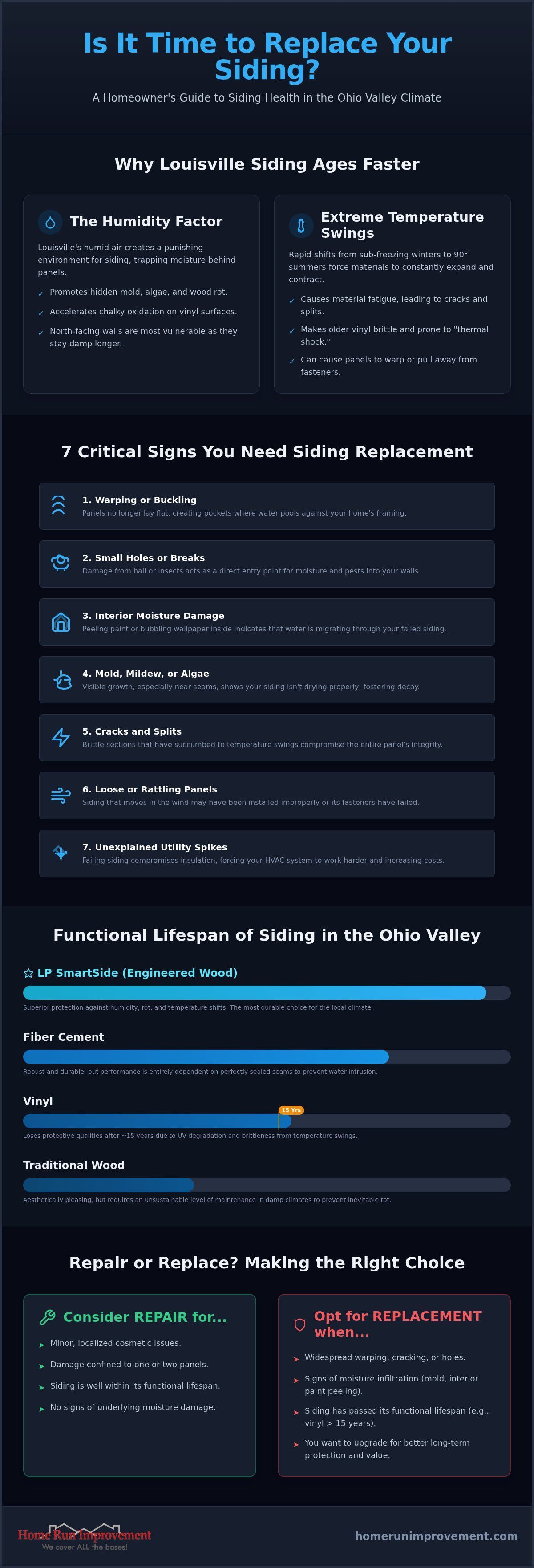
In the Ohio Valley, your home's exterior faces a relentless assault that many national building guides don't fully account for. Your siding or wall cladding is more than a design choice; it's a critical shield. If this shield fails, moisture reaches the OSB or plywood sheathing, leading to structural instability that is far more expensive to fix than simple cosmetic updates. Understanding when to replace home siding Louisville requires a realistic look at how our local climate accelerates material fatigue.

Standard lifespans are often shorter here than in drier regions. Vinyl might technically stay on a house for 25 years, but it often loses its protective qualities by year 15 due to UV degradation and extreme temperature shifts. Wood siding is beautiful, but in our damp environment, it requires a level of maintenance most homeowners find unsustainable. Fiber cement is robust, yet its performance depends entirely on how well the seams are sealed against our driving rains. If your siding is the first line of defense, you must ensure it remains uncompromised to prevent mold from taking hold in your wall cavities.

The Humidity Factor and Moisture Trap

Louisville's air is often heavy with moisture. Data from NOAA confirms that our relative humidity levels frequently create a punishing environment for building materials. When moisture gets trapped behind siding panels, it creates a persistent dampness that never truly evaporates. On vinyl surfaces, you'll see this manifest as chalky oxidation. On wood, it's the precursor to rot that can spread quickly through the grain.

Pay close attention to your North-facing walls. Because these areas receive the least amount of direct sunlight, they stay damp longer after a storm. This makes them a primary target for algae growth and mold. If you see green or black streaks, it's a sign that your siding isn't drying properly. This moisture eventually works its way into the substrate, where it can cause hidden mold colonies to flourish inside your home's walls, compromising your air quality.

Kentucky’s Temperature Swings and Material Fatigue

Our local weather is defined by extremes. We endure 90-degree summers and sub-freezing winters, often with rapid transitions between the two. This cycle forces your siding to expand and contract repeatedly. Over time, this causes material fatigue. Older vinyl becomes brittle and develops "thermal shock" cracks, while wood can warp or pull away from the fasteners as it swells and shrinks.

When you hire a professional siding contractor Louisville KY, they account for this movement. They don't nail siding tight to the wall; they leave specific gaps to allow for this inevitable shifting. If your current siding was installed by someone who didn't understand these local requirements, you'll see buckling or gaps. These openings are an open invitation for pests and water. Deciding when to replace home siding Louisville is often a race against these gaps before they allow permanent damage to your home’s framing.

The Homeowner’s Checklist: 7 Critical Signs You Need Siding Replacement

Determining when to replace home siding Louisville requires more than a casual glance from the driveway. You must perform a methodical walk-around, ideally after the intense spring storms common in the Ohio Valley. While some issues are merely aesthetic, others indicate that your home’s structural envelope is actively failing. Don't limit your inspection to the main panels. Examine the soffits and fascia, as these areas often harbor the first signs of moisture infiltration and pest activity that can compromise your roofing system.

Use this checklist to evaluate your exterior’s health:

  • Warping or Buckling: Panels that no longer lay flat against the wall.
  • Small Holes: Often caused by hail impact or wood-boring insects.
  • Interior Paint Failure: Peeling wallpaper or bubbling paint on inside walls.
  • Mold or Mildew: Specifically around the joints or seams of the siding.
  • Cracks and Splits: Brittle sections that have succumbed to temperature swings.
  • Loose Panels: Siding that rattles or moves significantly in the wind.
  • Unexplained Utility Spikes: Higher heating and cooling costs during peak seasons.

Visual Red Flags: Cracks, Warping, and Holes

Warping is a major indicator that your siding is no longer securely attached to the substrate. When panels buckle, they create deep pockets where water pools against your home’s framing. Small holes are equally dangerous; they act as easy entry points for pests and moisture. Oil canning is a specific visual distortion where the siding appears wavy or rippled due to extreme heat stress or poor installation techniques. If you notice these patterns, your siding has lost its ability to protect your home from the elements.

Moisture Indicators: Mold, Mildew, and Peeling Interior Paint

If you find yourself frequently repainting interior rooms because of peeling or bubbling, the culprit might be outside. Moisture migrating through failed siding often manifests as damage to interior finishes before you notice a major exterior leak. You must distinguish between surface mildew, which can be cleaned, and deep-seated rot that feels soft to the touch. The Vinyl Siding Institute provides rigorous standards for moisture management that every professional installation should meet to prevent this type of decay. If you're unsure about the severity of the growth you see, scheduling a professional assessment can help identify hidden rot.

Energy Efficiency and Rising Utility Bills

Your siding works in tandem with your insulation to maintain your home's R-value. When gaps or cracks develop, they create "thermal leaks" that force your HVAC system to work overtime. If your LG&E bills have spiked without a corresponding change in your habits, your exterior envelope is likely compromised. Modern vinyl siding and engineered wood options are designed to significantly improve thermal performance, keeping your home comfortable regardless of the Kentucky humidity.

Beyond the Surface: The Hidden Dangers of Delayed Replacement

It's tempting to look at a few cracked panels and decide you can wait another year. This delay is a gamble with your home's structural integrity. If you are debating when to replace home siding Louisville, you must realize that siding failure is rarely just a surface issue. It's the start of a silent decay process that targets your home's framing. Once water breaches the exterior, it creates a dark, damp environment where wood-destroying fungi thrive. This fungus quickly moves from the siding into the home's framing, weakening the very bones of your property.

Beyond the wood itself, failed siding seams are an invitation for mold colonies. According to the Environmental Protection Agency, mold thrives in areas with persistent moisture. When your siding is compromised, mold spores can migrate from the exterior wall cavity into your living spaces. This isn't just a maintenance headache; it's a legitimate health risk for your family. Positioning a replacement as a preemptive strike is the smartest financial move you can make. It's far more cost-effective to replace the exterior shell now than to pay for extensive mold remediation and structural sheathing repairs later.

The 'Ohio Valley Rot' Phenomenon

Louisville's relentless humidity fuels a specific type of hidden decay. High moisture levels allow fungus to eat away at the OSB (oriented strand board) sheathing that sits directly behind your siding. Vinyl siding is notorious for hiding this rot. Because vinyl is inorganic and won't rot itself, it can look perfectly fine on the outside while the wood substrate underneath has turned to mush. If you suspect your home's envelope is compromised, getting a free estimate is the only way to identify these soft spots before the damage becomes catastrophic.

Pest Intrusion: Termites and Woodpeckers

Damaged siding acts as an open door for Kentucky pests. Termites are naturally drawn to the damp, rotting wood hidden behind old, porous panels. Research from the University of Kentucky Entomology department highlights how subterranean termites thrive in moist environments. Once they find a breach, they can move from your sheathing into floor joists and studs. Woodpeckers are another concern; they are often attracted to the sound of insects living behind failing wood siding. Choosing engineered materials like LP SmartSide provides a layer of resilience that traditional wood can't match. These products are treated to resist both moisture and pest damage, ensuring your home remains a fortress rather than a feeding ground.


Repair vs. Replace: Evaluating the Best Path for Your Louisville Home

Choosing between a localized fix and a total overhaul is a pivotal decision for your property’s longevity. If you are weighing when to replace home siding Louisville, you must consider the aesthetic and structural consequences of your choice. While a repair might seem like a budget-friendly shortcut, it often becomes a recurring expense that fails to address underlying vulnerabilities. One of the most significant hurdles with partial repairs is color matching. Kentucky’s intense UV exposure causes even high-quality materials to fade over time. Installing new panels alongside aged ones creates a mismatched, patchwork appearance that can negatively impact your home’s market value.

When a Repair is Sufficient

Repairs are appropriate when the damage is strictly isolated and the surrounding system remains healthy. If a single panel is punctured by a stray rock from a lawnmower or a small section is melted by a nearby grill, a targeted fix is logical. We recommend following the "20% Rule" for your exterior. If more than 20% of your siding shows signs of failure, full replacement is almost always the more cost-effective path. Avoid "band-aid" repairs that simply cover up issues. If you nail new material over compromised sections, you risk trapping moisture against the sheathing, which accelerates the decay process we’ve previously discussed.

The Financial Case for Full Replacement

A full exterior renovation is an investment in your home’s equity. In high-value Louisville neighborhoods like Anchorage or Prospect, modern siding significantly boosts appraisal values and buyer interest. Beyond the immediate curb appeal, the long-term savings are substantial. When you choose a full replacement, you eliminate the constant cycle of scraping, painting, and patching that older wood or damaged vinyl requires. New installations also provide a tighter seal, which reduces the strain on your HVAC system and lowers your monthly energy costs.

When you opt for a total upgrade, you are also investing in peace of mind. We provide a 10-year craftsmanship warranty to ensure your investment is protected against installation errors. Whether you choose the versatility of modern vinyl siding or the extreme resilience of engineered wood, a professional installation ensures your home is ready for another two decades of Kentucky weather. If you're tired of temporary fixes, it's time to consider the lasting security of a complete exterior solution.

Schedule your professional siding consultation today

Choosing the Right Protection: LP SmartSide and Professional Installation

Once you've determined when to replace home siding Louisville, the focus must shift to selecting a material that can withstand the Ohio Valley's unique environmental pressures. Siding is a long-term investment in your home's structural integrity. Choosing a subpar material or an inexperienced installer can lead to a repeat of the same moisture and rot issues within a few years. For homeowners seeking a balance of extreme durability and high-end aesthetics, LP SmartSide has emerged as the premier choice. It is engineered specifically to resist the moisture, fungal decay, and impact damage that frequently compromise traditional wood or vinyl products.

Your siding does not exist in a vacuum. It is a critical component of a larger protection system that includes your roofing and gutters. If your siding is installed incorrectly, it can allow water to back up into the soffits or degrade the flashing around your roofline. This creates a domino effect of damage. When you choose a high-performance material, you are securing the entire exterior envelope of your property against the unpredictable Kentucky weather cycles we've discussed throughout this checklist.

Why LP SmartSide Beats Traditional Materials

LP SmartSide offers a significant advantage in impact resistance. While standard vinyl can crack during a spring hailstorm, engineered wood is designed to absorb the energy of an impact without shattering. This resilience is a result of the SmartGuard process. This proprietary treatment uses zinc borate to provide a deep level of protection against fungal decay and termite infestation, which are common threats in our humid climate. You get the authentic beauty of a deep cedar grain texture without the heavy maintenance requirements or the vulnerability of natural wood siding.

The Home Run Improvement Difference

The quality of your siding is only as good as the hands that install it. We are a locally owned and operated contractor deeply rooted in the Louisville community. We take personal responsibility for every detail of your project. Our status as an LP SmartSide Master Lead means we have met rigorous standards for installation excellence and product knowledge. This isn't just a title; it's a commitment to ensuring your siding performs exactly as the manufacturer intended. When you choose an expert who understands the local building codes and climate challenges, you are choosing long-term stability.

Don't wait for a minor leak to become a structural crisis. Protecting your home starts with a clear understanding of its current condition. We are here to act as your protective guide through the replacement process, ensuring your investment is backed by our 10-year craftsmanship warranty.

Schedule your free siding assessment today

Protect Your Louisville Home with Confidence

Louisville's climate is unforgiving to a compromised exterior. You've learned that identifying exactly when to replace home siding Louisville is the difference between a simple aesthetic upgrade and a massive structural rescue mission. By following the 2026 checklist, you can spot the warning signs of "Ohio Valley Rot" before it reaches your OSB sheathing. Waiting for a visible leak is a gamble that risks your family's health and your property's appraisal value. It's time to stop patching and start protecting.

Securing your home requires a combination of elite materials and precise execution. As an LP SmartSide Master Lead and a locally owned contractor, we bring the specialized knowledge needed to navigate Kentucky's relentless humidity. Our 10-year craftsmanship warranty acts as your ultimate safety net, ensuring your new siding remains a fortress for years to come. Don't leave your home's integrity to chance when professional guidance is just a click away. We treat every property with the same level of care we'd provide for our own families.

Secure Your Home with a Free Siding Estimate from Home Run Improvement

We look forward to helping you protect your most valuable investment with the durability and resilience it deserves.

Frequently Asked Questions

How long does siding typically last in Louisville?

Siding lifespan depends heavily on the material and its exposure to our local humidity. In the Ohio Valley, vinyl siding typically reaches its functional limit between 15 and 25 years. Traditional wood requires significant maintenance to last 20 years, while engineered options like LP SmartSide are built for much longer durability. According to InterNACHI, environmental factors are the primary drivers of material degradation. If you're debating when to replace home siding Louisville, consider your home's age and current visible wear.

Can I just paint my siding instead of replacing it?

Painting is a suitable solution for cosmetic fading, but it won't fix structural failure. If your panels are warped, cracked, or allowing moisture to reach the sheathing, paint acts only as a temporary mask. Following Sherwin-Williams guidelines for exterior surfaces is essential for proper adhesion. However, painting over rot traps moisture inside the wood, which actually accelerates decay. Replacement is the only permanent way to restore your home's protective envelope when materials have failed.

Does homeowners insurance cover siding replacement after a storm?

Insurance typically covers "sudden and accidental" damage, such as impact from hail or high winds. It doesn't cover gradual deterioration, rot, or age-related wear. The Kentucky Department of Insurance recommends reviewing your policy's specific exclusions for exterior cladding. If a storm has visibly punctured or stripped your siding, you should file a claim promptly. We provide professional assessments to document storm-related damage, helping you present a clear case to your insurance adjuster for necessary repairs.

What is the best time of year to replace siding in Kentucky?

Late spring and early fall offer the most stable conditions for exterior renovations in Kentucky. These windows avoid the extreme humidity of July and the sub-freezing temperatures of January. Cold weather can make vinyl brittle and difficult to cut without cracking, while extreme heat can cause panels to expand too much during the fastening process. Scheduling during milder months ensures that materials are installed at a neutral temperature, allowing for the natural expansion and contraction required by local building codes.

How do I know if the wood rot has spread behind my siding?

Look for "soft spots" by applying light pressure to your siding panels. If the surface feels spongy or gives way, the OSB sheathing underneath is likely saturated. Other indicators include bubbling interior paint or a persistent musty odor inside your home. Because moisture often hides behind inorganic materials, a professional inspection is the only way to confirm the extent of the damage. Identifying this early prevents the rot from reaching your home’s structural floor joists or wall studs.

Is LP SmartSide better than vinyl for Louisville's humidity?

LP SmartSide offers superior resilience against the relentless moisture of the Ohio Valley. Unlike traditional vinyl, which can warp or rattle in high winds, this engineered wood is treated with the SmartGuard process to resist fungal decay and termites. According to LP Building Solutions, this material withstands high-impact hail and intense humidity better than most alternatives. It provides the durability of a composite with the authentic look of real wood grain without the maintenance.

How much does siding replacement increase home value?

Siding replacement consistently ranks as a high-return home improvement project. National data from Remodeling Magazine suggests homeowners can recoup a significant portion of their investment upon resale. In Louisville’s competitive market, new siding doesn't just increase appraisal value; it reduces "days on market" by boosting curb appeal. It signals to potential buyers that the home has been meticulously maintained and is protected against future moisture issues, making it a much safer investment for them.

What should I look for in a local siding contractor?

Prioritize contractors with specialized manufacturer certifications, such as LP SmartSide Master Lead status. This ensures the team has undergone rigorous training on specific installation standards. You should also demand a clear craftsmanship warranty, like our 10-year guarantee, to protect against installation errors. Verify that the business is locally owned and operated in the Louisville area. A contractor with deep roots in the community is more accountable for the long-term performance of their work and understands local weather challenges.
By Pat McIntyre August 30, 2026
A failing roof is one of the most expensive surprises a homeowner can face. Roof replacement is one of the largest investments homeowners make in their property, and as material prices, labor rates, and supply chain conditions continue to shift, many people are asking what they should realistically expect to pay in 2026. If you are a Louisville, KY homeowner weighing your options, national averages only tell part of the story. Local labor markets, Kentucky's weather patterns, and your home's specific size and design all shape the number on the final invoice. This roof replacement cost guide breaks down everything you need: what you will pay nationally, what Louisville homeowners are actually spending, the hidden costs most contractors never mention upfront, and how to know whether a repair or a full replacement is the smarter move. Key Takeaways National average sits near $9,500 to $10,000: The average cost of a roof replacement is about $10,000, with most projects ranging from $7,500 to $14,000 based on roof size, material choice, roof design, and local labor rates. If your quote lands far below that range, check whether tear-off, permits, and decking allowances are included. Louisville homeowners typically pay $8,500 to $18,000: Most Louisville roof replacements cost $9,000 to $18,000, and architectural asphalt shingles remain the best balance of cost, durability, and performance for most homeowners, with installed costs averaging $3.75 to $6.75 per square foot. Use that range as your local benchmark before collecting quotes. Material choice drives 40 to 60 percent of your total cost: Material selection drives 40 to 60 percent of your total cost, while square footage and complexity determine labor requirements and material waste. Choosing architectural shingles over 3-tab is usually worth the modest price difference. A new roof returns 52 to 68 percent of its cost at resale: A new roof typically adds significant value to your home, with homeowners recouping 52 to 68 percent of their roof replacement investment when selling. Plan accordingly, the investment protects your home's sale price just as much as the structure itself. Budget an extra 10 to 15 percent for surprises: Louisville homeowners should budget 10 to 15 percent beyond the base estimate for unexpected costs. Hidden decking rot, extra shingle layers, and permit fees all add up once the old roof comes off. Quick-Start Prioritization Framework Start here if you are: Reacting to a single leak: Call a licensed roofer for an inspection before committing to anything. The core question is simple, will repairs give you reliable protection for years to come, or are you just delaying an inevitable replacement? Answering honestly requires looking at your roof's age, the extent of damage, your budget, and your risk tolerance. Planning ahead: The optimal timing for roof replacement is when your roof approaches 20 to 25 years old for asphalt shingles or shows warning signs like missing shingles, granule loss, water stains, or visible sagging. If you are planning to sell within 2 to 3 years, replacing your roof proactively prevents buyers from viewing it as a major expense. On a tight budget: Get at minimum three itemized quotes. A quote that is missing tear-off disposal, permits, or flashing replacement is not cheaper; it is incomplete. What Determines Your Roof Replacement Cost Roof Size and Pitch Several core factors influence your final roof replacement cost. Roofers calculate materials and labor using "squares," where one square equals 100 square feet. A 1,200-square-foot roof requires 12 squares of material, and a 1,800-square-foot roof requires 18 squares of material. More squares mean more material, more labor hours, and higher disposal costs. Pitch also matters. Steeper roofs require additional safety equipment and labor time. Complex designs with multiple valleys, dormers, and penetrations also increase installation time. Practically speaking, a steep roof can add 20 to 40 percent to your labor bill compared to a standard walkable slope. If your Louisville home has dormers or multiple roof planes, factor that into your budget from the start. Material Choice and Per-Square-Foot Costs The cost to replace a roof varies dramatically by material. Asphalt shingles remain the most affordable option, while metal and tile command a significant premium. Here is a practical breakdown for Louisville-area homeowners: There is a meaningful price difference within asphalt shingles alone. Three-tab shingles run $4.50 to $6.00 per square foot installed, with the least expensive option and a shorter warranty. Architectural or dimensional shingles cost $6.00 to $9.00 per square foot installed, with better wind resistance and more curb appeal as the standard choice for most replacements. Impact-resistant Class 4 shingles cost $8.00 to $12.00 per square foot installed, with a premium cost upfront but some Kentucky insurance carriers offering discounts of 20 to 30 percent on premiums. Metal roofing runs $12.00 to $18.00 or more per square foot installed, with the longest lifespan of 40 to 70 years and excellent performance against Louisville's freeze-thaw cycles, at a higher initial investment. Pro Tip: Class 4 impact-resistant shingles may cost 20 to 30 percent more upfront, but the insurance premium savings in Kentucky's hail-prone climate often recover that gap within five to seven years. Ask your insurer for a discount quote before you choose your shingle grade. Geographic and Local Labor Factors Roof replacement costs in 2026 vary significantly based on geographic location, local labor markets, and current supply chain conditions that affect both material availability and pricing in your specific area. For Louisville specifically, for a standard, single-family home in Louisville with 1,700 to 2,000 square feet, a walkable pitch, and asphalt shingles, the quality roof replacement cost in Louisville in 2026 can typically be between $8,500 and $14,000. Larger or more complex homes push higher. What you pay here is shaped by several factors: roof size, design complexity, material type, local labor rates, and the storm-driven climate that Kentucky delivers with reliable regularity. This walkthrough of an actual asphalt shingle roof replacement breaks down where the money goes and what drives the final cost. https://www.youtube.com/watch?v=GWT5ron81xw The Hidden Costs That Inflate Your Final Bill This is where many homeowners get caught off guard. A low bid is often a bid that is missing line items. Tear-Off and Disposal Full tear-off adds $1,000 to $3,500 to your roof replacement but is almost always worth it. Skipping it by layering new shingles over old ones saves money short-term but creates serious long-term problems. Overlays save $1,000 to $3,500 in tear-off costs but come with significant trade-offs. They add weight to your roof structure, can trap moisture between layers, hide underlying damage to the decking, and may void certain manufacturer warranties. Decking Replacement Rotted or damaged plywood sheathing costs $2.00 to $4.00 per square foot to replace. Inspectors find that 10 to 25 percent of decking needs replacement on roofs over 20 years old. On a 2,000 square foot home, that can add $1,800 to $6,500 to the final bill depending on how much is affected. The most important action here: ask every contractor to include a per-sheet decking replacement price in writing before you sign. No contractor can see the decking's full condition until the old roof comes off. Professionals handle that uncertainty with a stated per-sheet replacement price on the estimate, not an open-ended allowance. Permits, Flashing, and Soft Costs Flashing replacement runs $200 to $600 for chimney step and counter flashing, $300 to $1,000 for valley and skylight flashings, and $150 to $400 per pipe boot. Many quotes assume reusing existing flashing, which is often at or near end-of-life on an older roof. Permits and inspections run $150 to $600 in most jurisdictions, sometimes up to $900 in major metros. Pro Tip: Always request a fully itemized quote, not a single lump-sum total. The line items reveal whether tear-off, disposal, decking allowance, flashing, and permits are accounted for. If a quote is missing any of those categories, it is not apples-to-apples with a quote that includes them. Roof Replacement Cost Louisville KY: What Local Homeowners Are Paying Louisville's housing stock, climate, and labor market create a pricing environment that differs meaningfully from national averages. The numbers floating around online are often built on national averages that bear little resemblance to what roofing contractors in the Louisville area are actually charging. Here is a practical size-based breakdown for Louisville asphalt shingle projects: Home SizeEstimated Louisville Range1,000 sq ft$5,500, $8,5001,500 sq ft$7,500, $12,0002,000 sq ft$9,000, $15,0002,500 sq ft$11,500, $18,000 These figures reflect asphalt shingles with full tear-off. Metal roofing or complex rooflines will push costs toward or past the high end. For a premium architectural shingle project on a 2,000 sq ft Louisville home, the average roof replacement cost in Louisville, Kentucky, is approximately $11,400 for a 2,000 sq ft home in 2026. Kentucky's storm climate is a major factor in the equation. The Kentuckiana region experiences significant spring storms, humidity swings, and temperature fluctuations that strain aging roofing systems. That means roofs here often age faster than their warranty suggests, and insurance claims for hail and wind damage are common. Some policies cover repairs or full replacement when damage is caused by a covered event, such as wind, hail, or fallen trees. Always get a post-storm inspection before assuming you are paying out of pocket. Pro Tip: In Louisville's hail-prone market, a roofing contractor who is experienced with insurance claims is worth seeking out. The right contractor can help you document storm damage accurately, which can make the difference between a covered replacement and a full out-of-pocket cost. Companies like Home Run Improvement work with Louisville homeowners on full exterior replacements, including roofing and siding, and can help coordinate the scope of work when multiple systems need attention at the same time. Repair vs. Replacement: How to Decide In my experience, one of the most common and costly mistakes homeowners make is repairing a roof that is already past its service life. A $600 patch on a 22-year-old roof often becomes a $600 patch followed by another $800 repair six months later, followed by a full replacement that could have been planned at a better time and price. When Repair Makes Sense For minor issues, average roof repairs in 2026 run around $1,150, typically ranging from $400 to $1,900, with minor repairs like patching a leak or replacing a handful of shingles often staying under $1,000. Repair is the right move when the damage is genuinely isolated, the roof is under 15 years old, and no systemic deterioration is present. When Replacement Is the Smarter Move If your asphalt roof is 20 to 25 years old, it is simply time for a replacement because the materials have maxed out. Age is the clearest trigger, but it is not the only one. Watch for these physical signals: Curling or cracking shingles across large sections of the roof Granule loss, granules are embedded in shingles for fire resistance, color, and UV ray protection. They are crucial to the longevity of your asphalt roof, and losing them is a significant sign that replacement is needed. When it gets bad enough, you will find loose granules in gutters or on the ground around downspouts. Water stains on interior ceilings or in the attic Sagging sections anywhere on the roof deck Roof repair vs. replacement . replacement usually comes down to roof age, leak frequency, and how widespread the damage is. If repeated repairs are needed, replacement may be the better long-term value. Standard 3-tab shingles typically last 15 to 20 years, while architectural shingles often perform well for 20 to 30 years under proper conditions. If your roof is at or beyond those windows, get a professional inspection and use the findings to make a clear-headed decision rather than a reactive one. Does a Roof Replacement Add Value to Your Home? The short answer is yes, but the value shows up in a few different ways, not all of which appear directly in your appraisal. Installing a new roof typically returns 60 to 70 percent of its cost in added home value, making it one of the most impactful home improvements you can make. That means a $12,000 replacement could add $7,200 to $8,400 to your home's market value at resale. The ROI on new roof projects usually comes from protecting your home's price, improving buyer confidence, and preventing negotiations during inspections rather than adding the full replacement cost directly to your appraisal. A failed roof inspection kills deals. A new roof removes the biggest leverage point buyers use to negotiate your price down. According to the 2025 Cost vs. Value Report by Zonda , an asphalt shingle roof replacement cost a national average of $31,871 and added $21,501 in resale value for a 68 percent cost recoup. Also worth noting for Louisville homeowners who are planning a full exterior refresh: siding replacement delivers some of the best ROI of any remodeling project. The 2025 Cost vs. Value Report from Zonda and Remodeling Magazine reports that fiber cement siding recoups close to 114 percent of its cost at resale, with vinyl siding recouping roughly 97 percent. At 114 percent, fiber cement returns more than a homeowner puts in, earning it a spot among the highest-ranked remodeling projects in the report. Common Roof Replacement Mistakes to Avoid I have found that the most expensive mistake homeowners make is choosing a contractor based on price alone. Here is what to watch for: Skipping the itemized quote. A lump-sum number tells you nothing about what is included. Always ask for line-item detail. Ignoring the decking conversation. Hidden costs show up in estimates that look cheap on paper but balloon once work starts. The most common culprit is rotted decking that contractors "discover" after tearing off your old roof. A legitimate contractor gives you a per-sheet price upfront. Choosing an overlay to save money. The short-term savings are real. The long-term consequences, voided warranties, trapped moisture, hidden damage, are also real. Ignoring storm damage until it worsens. The weather in Kentucky does not get easier on aging roofs, and delayed decisions often become emergency decisions that cost more and offer fewer options. Failing to verify licensing and insurance. Always confirm that your contractor carries general liability and workers' compensation coverage before anyone steps onto your roof. Frequently Asked Questions How much does roof replacement cost in Louisville, KY in 2026? For a typical single-family home in Louisville, expect to pay between $8,500 and $18,000 for a full roof replacement. Smaller ranch-style homes with simple rooflines land at the lower end, while larger homes with steep pitches or premium materials push toward or past the top of that range. Always get at least three itemized quotes from licensed local contractors. Is it worth replacing a roof before selling a house? Yes, in most cases. A deteriorating roof can delay sales, reduce buyer offers, and create appraisal challenges. A new roof improves curb appeal, strengthens structural protection, and increases overall buyer confidence. Even if you do not recoup 100 percent of the cost, you avoid losing far more in price negotiations triggered by a failed inspection. What are the signs I need a roof replacement rather than a repair? A roof should be replaced when it shows major signs of wear such as cracked or missing shingles, leaks, moss growth, or sagging areas. Asphalt shingles generally last about 20 years, while metal and slate roofs can last up to 100. Age combined with recurring leaks or widespread shingle deterioration almost always means replacement is the more cost-effective path. What hidden costs should I budget for beyond the base quote? The three most common budget surprises are rotted decking, additional shingle layers that require extra tear-off labor, and permit fees. Rotted or damaged plywood sheathing costs $2.00 to $4.00 per square foot to replace, and inspectors find that 10 to 25 percent of decking needs replacement on roofs over 20 years old. Add a 10 to 15 percent contingency to whatever your base quote is. How long does a new asphalt shingle roof last in Kentucky? In regions with frequent hail high winds, or temperature extremes, a realistic lifespan for architectural shingles is typically 20 to 25 years. Louisville's climate, with its spring storms, humidity swings, and freeze-thaw cycles, puts real stress on shingles, so routine inspections every two to three years help you catch early deterioration before it becomes a major repair or an emergency replacement. The Bottom Line A roof replacement in 2026 is a significant investment, but it is a knowable one. In 2026, the cost to replace a roof in the U.S. ranges from $7,500 to $30,000, with the average homeowner spending between $9,000 and $18,000 on a standard asphalt shingle roof. Louisville homeowners fall solidly within that national range, with most residential projects landing between $8,500 and $18,000 depending on size, material, and condition. The key is entering the process informed: know what is included in a complete quote, budget for hidden costs, and choose a contractor who will give you per-sheet decking pricing and a fully itemized proposal before a single nail is pulled. For Louisville homeowners ready to take the next step on a roof replacement or a full exterior upgrade, the team at Home Run Improvement offers free estimates and straight-forward guidance on what your project actually needs. Sources How Much Does a Roof Replacement Cost in 2026? , Fixr.com. National average cost data, updated February 2026. https://www.fixr.com/costs/roof-replacement How Much Does a Roof Replacement Cost in 2026? (Full Breakdown) , SubcontractorHub. National averages and material cost data. https://www.subcontractorhub.com/blog/how-much-does-it-cost-to-replace-a-roof How Much Does a New Roof Cost in 2026? (By Material & Size) , Apex Roofs. Cost breakdown by material type. https://blog.apexroofs.com/how-much-does-a-new-roof-cost-in-2026-by-material-size How Much Does a Roof Replacement Cost in 2026? Find Your Estimate , Modernize. National pricing data and size-based estimates. https://modernize.com/roof/cost-calculator Key Factors That Drive Up Roof Replacement Costs in 2026 , Jamar Roofing. Regional and complexity cost factors. https://jamarroofing.com/factors-that-drive-up-roof-replacement-costs-in-2026/ Roof Replacement Cost in Zip Code 40208 , SquareDash. Louisville-specific pricing data for 2026. https://www.squaredash.com/zip/40208/ Does a New Roof Increase Home Value in 2026? , FoxHaven Roofing. ROI and resale value data. https://foxhavenroof.com/does-a-new-roof-increase-home-value-in-2026/ Does a New Roof Increase Home Value? , Premier Roofing. ROI breakdown by roofing type. https://premier-roofing.com/blog/does-a-new-roof-increase-home-value/ Roof Replacement ROI and Resale Value Report 2026 , The Roofing Brief. Zonda Cost vs. Value Report data. https://theroofingbrief.com/roof-replacement-roi-resale-value-report/ 2025 Cost vs. Value Report , Zonda / Remodeling Magazine. Industry benchmark for remodeling ROI. the 2025 Cost vs. Value Report by Zonda Tear Off and Replace Roof Cost (2026) , SquareDash. Tear-off cost data and overlay trade-offs. https://www.squaredash.com/cost/tear-off/ Roof Replacement Cost Calculator 2026 , RoofPitch.net. Hidden costs and decking replacement data. https://roofpitch.net/roof-replacement-cost-calculator/ 6 Signs You Need to Replace Your Asphalt Roof , Bill Ragan Roofing. Granule loss and age-based replacement signals. https://www.billraganroofing.com/blog/signs-need-replace-asphalt-roof
By Pat McIntyre August 30, 2026
The "maintenance-free" promise of vinyl siding is often the very thing that leads to costly structural failures during a brutal Kentucky winter. While many homeowners choose vinyl to avoid chores, the reality is that freezing temperatures in the Ohio Valley often leave thin plastic panels brittle and prone to cracking. If you want a home that survives local hail storms and resists the relentless humidity of the region, understanding LP SmartSide siding maintenance is the first step toward true peace of mind. This engineered wood alternative offers the high-end aesthetic of natural cedar without the vulnerability to rot or woodpecker damage that plagues traditional materials. You likely want your property in neighborhoods like Prospect or Anchorage to maintain its prestige without requiring a weekend of scrubbing every month. We agree that your siding should work for you, not the other way around. This guide will show you exactly how LP SmartSide maintenance compares to vinyl and why a proactive approach to your home's exterior can significantly boost your resale value. We'll explore why the 2026 LP SmartSide Color of the Year, Sand Dunes, is trending for its resilience and how proper care ensures your 50 year limited warranty remains fully intact. Key Takeaways Understand how Louisville’s high humidity and seasonal temperature swings necessitate siding that meets the 2018 Kentucky Residential Code for moisture protection. Learn why the "No Pressure" rule is the most critical component of LP SmartSide siding maintenance to preserve the material's protective zinc borate treatment. Discover the financial advantage of choosing engineered wood, which offers higher impact resistance against Ohio Valley hail than standard vinyl. Recognize why professional installation by a certified expert is the only way to safeguard your investment with a 10-year craftsmanship warranty. The Reality of Siding Maintenance in Louisville’s Humid Climate Louisville’s weather isn't just a topic for small talk; it's a direct threat to your home’s structural integrity. According to NOAA climate data for Kentucky, the region’s high humidity and drastic seasonal temperature shifts make moisture-resistant materials a necessity rather than a luxury. Your siding serves as the first line of defense against structural rot and pest infestations that thrive in damp environments. If your exterior fails to repel water, you're inviting costly damage into your wall cavities. Homeowners in Hurstbourne and Indian Hills are increasingly moving away from traditional wood because it simply cannot withstand local pest pressure and moisture levels. When you evaluate different types of siding , you must prioritize materials that act as a shield. Standard wood rots. Plastic cracks. Engineered wood persists. Consistent LP SmartSide siding maintenance ensures your home remains a fortress against the elements while maintaining the high-end aesthetic these neighborhoods demand. Moisture and the Ohio Valley Effect In the peak of summer, the Ohio Valley’s humidity creates an environment where mold and mildew thrive on organic surfaces. If your siding isn't properly treated, these spores won't just sit on the surface; they'll begin to degrade the material itself. The winter brings a different challenge with freeze and thaw cycles. When water enters small gaps in your siding and freezes, it expands. This puts immense pressure on your joints and sealants. Effective LP SmartSide siding maintenance starts with understanding these environmental stressors. If moisture infiltrates your siding, it eventually compromises your home’s insulation, leading to a noticeable drop in energy efficiency and comfort. Storm Resilience in Kentucky Louisville frequently experiences severe thunderstorms that bring high winds and damaging hail. These aren't just minor inconveniences. They're direct tests of your home’s impact resistance. While vinyl often cracks under the force of a mid-sized hailstone, engineered wood is designed to absorb the shock without shattering. This resilience is a core part of your long-term maintenance strategy. By choosing a material that doesn't easily fail during a storm, you avoid the cascading costs of emergency repairs. To ensure these protective features are fully realized, you need an expert siding contractor in Louisville KY who understands the specific flashing and sealing requirements of the Kentucky building code. Proper installation is the only way to guarantee your home stays dry when the next storm rolls through the valley. LP SmartSide vs. Vinyl Siding: Maintenance Myths and Realities The phrase "maintenance-free" is often a marketing smokescreen used to sell vinyl siding to unsuspecting homeowners. While it’s true you don’t have to paint plastic, you also can’t repair it when things go wrong. If a vinyl panel cracks, sags, or melts, your only option is a full replacement of that section, which often leads to a mismatched, patchy appearance. LP SmartSide siding maintenance , by contrast, involves minor proactive care that preserves the home’s structural integrity for decades. Engineered wood offers a level of structural rigidity that plastic simply can’t match. While vinyl relies on flexibility to survive installation, that same flexibility makes it prone to rattling in high winds and sagging during hot Kentucky summers. LP SmartSide utilizes the SmartGuard process, where every wood strand is treated with zinc borate and water-resistant waxes. This built-in protection is far superior to the surface-level resistance of vinyl, as it actively repels termites and fungal decay from the inside out. The Vinyl Siding Maintenance Trap Kentucky’s climate is particularly harsh on vinyl. During freezing winters, the plastic becomes brittle. A single impact from a stray hailstone or a lawnmower-flung pebble can cause a spiderweb crack that lets moisture behind the facade. There’s also the "melt factor" to consider. Modern high-efficiency windows can reflect sunlight with enough intensity to warp and melt vinyl panels on adjacent walls. Once this thermal distortion happens, the material is permanently compromised. Because vinyl colors are baked in, matching a new panel to a five-year-old faded wall is nearly impossible, ruining your home’s curb appeal. LP SmartSide: Minimal Effort, Maximum Protection The primary concern homeowners have with engineered wood is the need for repainting. However, modern factory finishes are designed to last significantly longer than traditional field-applied paint. When you commit to a basic schedule of LP SmartSide siding maintenance , you're investing in a material that maintains its shape and density while plastic alternatives begin to sag. When you do eventually decide to refresh the color, the underlying substrate remains rock-solid. This material is also far easier to repair. If a board is damaged, it can be swapped out and painted to match the rest of the house perfectly. If you're unsure which material is best for your property's exposure, reach out for a professional exterior assessment . Step-by-Step LP SmartSide Siding Maintenance Guide Maintaining your home's exterior isn't about constant labor; it's about strategic vigilance. While engineered wood is designed to be incredibly resilient, the Ohio Valley’s environmental debris and seasonal pollen can accumulate on the surface. A disciplined approach to LP SmartSide siding maintenance ensures that your home stays as beautiful as the day we finished the installation. If you ignore basic care, you risk surface staining that can dull your curb appeal over time. The most important rule for any Louisville homeowner is the "No Pressure" rule. If you own a pressure washer, keep it away from your siding. High-pressure water can drive moisture behind the panels, damage the protective overlay, and potentially void your warranty. Instead, rely on a standard garden hose and a soft-bristle brush. For specific technical details on chemical compatibility, always reference the official LP SmartSide Care and Maintenance guide before starting. Cleaning and Washing Procedures For basic dirt and grime, a simple solution of water and a mild, ammonia-free detergent works best. If you notice stubborn mildew or mold growth, which is common in shaded areas of Glenview or Anchorage properties, use a solution of three parts water to one part white vinegar. This natural acidity kills spores without stripping the factory finish. Always work from the bottom up to prevent streaking and finish with a thorough, low-pressure rinse from the top down. This methodical process keeps the protective zinc borate treatment from being overwhelmed by surface contaminants. The Homeowner’s Annual Inspection Checklist Schedule a walk-around of your home every spring. Catching a minor issue now prevents a major repair later. Use this checklist to stay ahead of the elements: Check for Paint Chips: Look for any small chips or deep scratches. If the wood strand is exposed to the air, it needs a touch-up to prevent moisture absorption. Evaluate Sealants: Inspect the caulk around windows, doors, and corners. If you see signs of hardening, cracking, or pulling away, the seal must be replaced to maintain a watertight envelope. Manage Water Flow: Ensure your gutters are clear of debris. Clogged gutters cause water to overflow and cascade down your siding, leading to unnecessary wear and potential rot at the foundation level. Downspout Direction: Verify that downspouts are directing water at least five feet away from your siding and foundation. If your inspection reveals damage beyond a simple touch-up, don't wait for the next storm to make it worse. Check our frequently asked questions for more details on identifying structural concerns versus cosmetic wear. Long-Term Performance: Impact Resistance and Resale Value Choosing a siding material is a defensive strategy for your home's equity. While the ASTM D3679 standards establish the baseline for siding performance and quality, LP SmartSide is engineered to exceed standard expectations for impact resistance. In a region where hail can reach 1.75 inches in diameter, this resilience is not a luxury; it's a financial safeguard. When you invest in a material that doesn't shatter under stress, you effectively lower your long-term repair costs and insurance claim frequency. The longevity of your exterior is directly tied to your commitment to LP SmartSide siding maintenance . Because this material resists the warping and cracking common in vinyl, it retains its straight lines and deep wood grain for decades. This consistency is exactly what prospective buyers look for when evaluating a property's value. If the exterior looks solid, it builds immediate trust in the rest of the structure. Engineered Wood and Property Appraisal In high-end neighborhoods like Anchorage or Prospect , curb appeal is a primary driver of property appraisal. The authentic texture of engineered wood commands a higher price point than the synthetic look of plastic. A well-maintained exterior often reduces the "days on market" for local listings because it signals to buyers that the home has been cared for by a professional. Prospective buyers are savvy; they recognize that a pristine exterior suggests the interior systems have been equally prioritized. When you can show future owners that the work is backed by a 10-year craftsmanship warranty , you provide the peace of mind necessary to close a high-value sale. Cost-to-Value Analysis While vinyl offers a lower initial price, the long-term ROI of LP SmartSide is significantly higher. In 2026, engineered wood siding has an average resale value of $15,140 on an average job cost of $18,400, recouping 82.3% of its cost. This outperforms vinyl, which typically recoups around 80.2%. These figures don't even account for the energy efficiency gains or the lack of emergency repair costs following a storm. When you choose professional LP SmartSide installation in Louisville , you aren't just buying boards. You're securing a high-performance building envelope. The minimal effort required for LP SmartSide siding maintenance ensures these financial benefits remain intact for the full 50-year life of the product warranty. Request a professional siding assessment for your Louisville home Why Professional Installation is the Foundation of Siding Longevity Even the most diligent LP SmartSide siding maintenance schedule can’t compensate for a flawed installation. If your moisture barriers aren't perfectly sealed or your flashing is misaligned, water will find a way into your home's framing regardless of how often you clean the boards. This is why professional expertise is non-negotiable. A "standard" installation often overlooks the small details that lead to big failures, such as improper fastener placement or inadequate clearance from rooflines and grade. When you choose a contractor who treats these technical details as optional, you're essentially setting a timer on your home’s structural health. The Master Lead Advantage Being an LP SmartSide Master Lead contractor means our team has undergone specific training to meet the manufacturer’s highest standards. When you choose an expert, you’re ensuring that every board has the correct expansion gaps to prevent buckling during extreme temperature swings. We use high-grade moisture management materials that act as a secondary defense for your home. Standard installers might use lower-quality wraps to save on costs, but we know that the integrity of the substrate is what truly matters. This level of precision is why we can confidently offer a 10-year craftsmanship warranty . Whether we’re working on a full exterior remodel in Jeffersontown or a siding replacement in Clarksville, IN , our commitment to local accountability remains the same. We follow the official LP SmartSide installation instructions to ensure your 50-year warranty stays valid. A Master Lead professional approach prioritizes the long-term stability of the building envelope, whereas a standard approach often focuses only on immediate cosmetic results. Protect Your Home Today If you wait until you see visible rot or mold, the damage has likely already reached your home's structural framing. A professional assessment can identify failing sealants or poor drainage before they become catastrophic issues. Proactive care is the most cost-effective way to manage your property. When you partner with a "Protective Expert," you're not just buying a renovation; you're securing peace of mind for the next several decades. Our team understands how to integrate your siding with existing roofing and gutter systems to create a seamless, watertight envelope. If your current siding is showing signs of age, don't let another humid summer or freezing winter compromise your investment. Effective LP SmartSide siding maintenance starts with a foundation that was built to last. You can contact Home Run Improvement for a professional LP SmartSide estimate and maintenance consultation to ensure your home remains protected for years to come. Secure Your Home with a Durable Louisville Exterior Louisville’s weather patterns, documented by the National Weather Service , demand an exterior that can handle heavy humidity and sudden freezes. While vinyl is often marketed as a hands-off solution, its vulnerability to these temperature swings often results in brittle panels. By contrast, a proactive approach to LP SmartSide siding maintenance ensures your home remains resilient against the Ohio Valley's unique climate challenges. You gain a high-performance building envelope that offers superior impact resistance and a significantly higher resale value in neighborhoods like Glenview or Crestwood. As an LP SmartSide Master Lead Contractor and Owens Corning Preferred Contractor, Home Run Improvement provides the specialized knowledge required to protect your investment. We're locally owned and operated right here in Louisville, and we stand behind every project with a 10-year craftsmanship warranty. Don't settle for the risks of poor workmanship or inferior materials when you can choose a partner who treats your property with the same level of care as their own. Request Your Free LP SmartSide Estimate in Louisville Take the first step toward a worry-free exterior today. We look forward to helping you build a home that stands the test of time. Frequently Asked Questions Is LP SmartSide more expensive to maintain than vinyl siding? While vinyl has no paint costs, its inability to be repaired means a single crack requires a full panel replacement. LP SmartSide siding maintenance involves minor cleaning and touch-ups, preventing the expensive "patchwork" repairs plastic siding demands. Over a 20-year cycle, the structural durability of engineered wood often proves more cost-effective for Louisville homeowners than the frequent failures associated with brittle vinyl during harsh Kentucky winters. How often do I need to paint LP SmartSide siding in Louisville? Factory-applied finishes like LP SmartSide ExpertFinish are engineered to last significantly longer than field-applied paint. In the Ohio Valley climate, you can typically expect 15 to 20 years of color performance before a refresh is necessary. If you choose a custom field-applied paint, the duration depends on the quality of the coating used, but the substrate remains protected by the manufacturer's 50-year limited warranty against structural failure. Can I use a pressure washer to clean my LP SmartSide siding? No, you must never use a pressure washer on engineered wood siding. High-pressure water can force moisture behind the panels and damage the protective resin overlay. The safest method for cleaning is using a soft-bristle brush and a garden hose with a low-pressure spray. For stubborn grime, a solution of water and mild detergent is sufficient to maintain the home’s exterior without risking the structural integrity of your professional siding installation. Does LP SmartSide siding rot or attract termites in humid climates? LP SmartSide is treated with zinc borate throughout the wood strand to resist fungal decay and termite infestation. This proprietary SmartGuard process ensures the material remains durable even in the high humidity of a Louisville summer. Unlike traditional wood, which is vulnerable to subterranean termites common in Kentucky, engineered wood provides a chemically bonded defense that protects your home's structural framing from the inside out and prevents rot. What happens if LP SmartSide siding gets hit by hail? LP SmartSide is engineered to withstand hail up to 1.75 inches in diameter without shattering. This impact resistance is a major advantage over vinyl, which often becomes brittle and breaks during severe Kentucky thunderstorms. The product’s durability is verified through rigorous ASTM testing , ensuring your home remains a secure fortress even when wind-borne debris or large hailstones strike the exterior during the peak of the spring storm season. How long does the factory finish last on LP SmartSide siding? The factory-applied finish is designed to maintain its vibrancy for approximately two decades under normal environmental conditions. LP SmartSide uses advanced coatings that resist the fading effects of UV exposure, which is critical for homes in unshaded areas of Prospect or Indian Hills. If you notice minor surface wear, localized touch-ups are a standard part of LP SmartSide siding maintenance that can extend the aesthetic life of the finish well beyond the initial mark. Is LP SmartSide better than vinyl for home resale value in Kentucky? Engineered wood siding consistently offers a higher return on investment than vinyl in the Kentucky real estate market. In 2026, homeowners can recoup approximately 82.3% of their investment, which is higher than the 80.2% average for vinyl. Buyers in high-end neighborhoods like Anchorage prioritize the authentic wood-grain texture and proven durability of LP SmartSide, making it a strategic choice for those looking to maximize their property’s appraisal value. Does Home Run Improvement offer a warranty on siding installation? Home Run Improvement provides a 10-year craftsmanship warranty on every siding installation we perform. This local guarantee supplements the manufacturer's 50-year limited warranty, ensuring your home is protected from both material defects and installation errors. As an LP SmartSide Master Lead contractor, we take personal responsibility for every detail of the project, providing Louisville homeowners with the long-term security and peace of mind they deserve when making a significant investment in their property. 
By Pat McIntyre August 28, 2026
If you have an unfinished basement, you are sitting on some of the cheapest square footage you will ever add to your home. Basement finishing converts unfinished space into habitable living area by adding framing, insulation, drywall, flooring, electrical, lighting, and plumbing to meet local building codes. Unlike above-grade additions, it uses existing square footage already enclosed by the foundation, making it one of the most cost-efficient ways to expand a home's livable area. The catch is that costs vary enormously, and walking into a project without a realistic number can derail the whole effort. The average cost to finish a basement in 2026 ranges from $15,000 to $75,000, with most homeowners spending around $32,000. That wide spread exists for a reason: scope sets the price more than size does. The same 1,000 square feet can cost $20,000 as an open rec room or $90,000 as a one-bedroom apartment with a kitchen and full bath. Understanding exactly what drives your number, before you talk to a single contractor, puts you in control of the budget. Key Takeaways Expect $30 to $75 per square foot for a contractor-led finish: A standard contractor-led finish runs about $30 to $75 per square foot in 2026, so a 1,000 sq ft basement typically lands between $30,000 and $75,000. If your quote is far outside that band, investigate what is included or excluded. Construction costs rose 5.6% in 2026: Construction costs have increased 5.6% for 2026 due to inflation and material shortages, with the average basement remodel now costing $24,050 compared to $22,800 in 2025. Budget for this inflation early rather than discovering it mid-project. Labor is your biggest line item: Key cost factors include basement size, type of finish, labor costs, and materials, with labor typically making up about 40% of the total project cost. Focus cost-saving efforts here before cutting corners on materials. A finished basement returns roughly 71% at resale: The 2025 Cost vs . Value Report from Zonda and the Journal of Light Construction puts the national average basement-remodel cost recovered at roughly 71%, meaning a $50,000 finished-basement project tends to add about $35,000 to your home's resale price. Design for broad buyer appeal to protect that return. Moisture must come first: With 60% of US homes experiencing wet basements, professional assessment and waterproofing before any framing or insulation goes in is the difference between a durable finished basement and an expensive mold problem. Quick-Start Prioritization Framework  Start here if you are: Working with under $40,000: Keep an open floor plan, skip the bathroom addition, and choose luxury vinyl plank (LVP) flooring. Choosing an open floor plan could save you thousands in lumber, drywall, and insulation. Planning to sell within 5 years: Design your finished basement with flexibility in mind. Open floor plans, neutral finishes, and multipurpose spaces appeal to the widest range of buyers. Maximizing long-term ROI: Add an egress window and a full bathroom. A code-compliant egress installation costing under $6,000 can add $15,000 to $30,000 in appraised value by converting the space into a legal bedroom, one of the best returns in the entire renovation. What You Actually Pay For: A Cost Breakdown by Component The biggest surprise most homeowners face is discovering that the headline cost per square foot does not capture every line item. Here is where the money goes. Framing and Insulation Wood framing costs $1 to $5 per square foot for materials, depending on local lumber prices, plus $4 to $8 per square foot for labor. Insulation adds another layer of cost on top. Material costs for insulation range from $0.50 to $2 per square foot, with labor costs adding $1 to $1.50 per square foot. Do not skip quality insulation; it pays back through lower energy bills and prevents the moisture infiltration that can destroy a finished basement over time. Electrical, Plumbing, and HVAC Mechanical trades are where costs escalate quickly if you are adding rooms with specific functions. Electrical work for a 1,000-square-foot basement ranges from $3,000 to $5,000, while plumbing installations cost between $2,500 and $5,000. HVAC extension adds another $2,000 to $4,000 for extending ductwork or adding a dedicated zone to your system. Always hire licensed trades for these systems, unlicensed work creates liability, insurance complications, and resale problems you do not want. Bathroom Addition A bathroom is the single most impactful upgrade for resale value. A basement bathroom addition costs $10,000 to $25,000, depending on the size. A half-bath sits at the lower end while a full bathroom with tile, fixtures, and proper ventilation pushes toward the top. Position new plumbing near existing supply and drain lines whenever possible, positioning new fixtures near existing plumbing is a primary way to cut costs. Adding a small bathroom near existing pipes typically costs between $10,000 and $15,000. Permits and Waterproofing These two items are non-negotiable, and they often surprise first-time renovators. Any basement project touching electrical, plumbing, HVAC, or structural framing requires a building permit in most US jurisdictions. Permit costs range from roughly $1,200 to $2,000 for a full finishing project. Waterproofing costs depend heavily on your starting conditions: waterproofing can add $3 to $10 per square foot to the total cost. Pro Tip: Never skip permits to save time or money. Unpermitted basement finishing causes serious problems at resale, buyers' agents flag it, lenders may refuse financing, and you may be required to tear out all the work and redo it to code before closing. Pull the permit every single time. Basement Finishing Alternatives: Choosing the Right Finish Level "Finishing a basement" covers a wide spectrum of approaches. Knowing your alternatives lets you match the project to your actual goals. Open Concept vs. Divided Rooms An open-plan basement is the most affordable finishing path and often the smartest for resale. Keeping the layout open means building fewer walls, which means less framing, less drywall, and less labor. Divided rooms cost more but serve specific functions, a legal bedroom, a home office, a dedicated gym, or a media room. Before committing to room divisions, confirm ceiling height requirements: the International Residential Code, adopted in most states, sets a minimum finished ceiling height of 7 feet in habitable rooms, with an egress window required in any sleeping room. Ceiling Finish Options Ceiling choice is one of the most consequential decisions in basement finishing, affecting both budget and functionality. Basement ceiling options include drywall for a traditional look, drop tiles for easy access, wood panels for style, PVC for moisture resistance, metal for unique design, and paint for budget-friendly simplicity. For basements with any history of moisture or with plumbing running overhead, a drop ceiling or PVC panel system is the practical choice. A drop ceiling provides excellent utility access and is moisture-tolerant in most configurations, but requires ceiling height clearance and has a more utilitarian appearance. For basements with any moisture history or frequent maintenance needs, a drop ceiling or PVC panel system is the more practical choice. If ceiling height is tight, avoid drop systems entirely: drop ceiling systems require 3 to 4 inches of clearance for the grid hardware and can make an already-low basement feel cramped. Flooring Choices That Actually Work Below Grade Luxury vinyl plank (LVP) is the gold standard for basements. It looks like wood, is 100% waterproof, and is cheaper than tile or hardwood. Carpet is comfortable but risky: even "dry" basements have seasonal humidity changes that trap moisture in carpet padding and create mold conditions that are invisible until severe. Restrict carpet to bedrooms only where foot traffic is light. Before committing to a finish level, this walkthrough covers the key decisions and trade-offs you'll face when planning a basement renovation. https://www.youtube.com/watch?v=kxMLd3LNwcQ How Scope Drives Your Final Number The most common reason budgets explode is scope creep discovered mid-project. Understanding in advance what each addition costs keeps you in the driver's seat. The Bathroom Decision Adding a bathroom is the highest-ROI single upgrade in a basement, but it is also the biggest cost jump. A mid-range renovation runs $50 to $80 per square foot, the tier that covers adding a bathroom, laminate flooring, and a wet bar. Budget for the full system including rough-in plumbing, a pressure-assisted toilet (standard toilets often cannot generate enough force at basement depth), ventilation, and tile work. The Egress Window Question An egress window is required in any basement room used or intended as a bedroom, and in some jurisdictions in any finished basement, full stop. Egress windows add $2,500 to $5,000 each to the project total, but the return justifies the expense when the alternative is a space that cannot legally be called a bedroom and therefore cannot command bedroom-level appraisal value. High-End Upgrades and Their Real Costs High-end renovation runs $80 to $120-plus per square foot and includes structural changes, a home theater, luxury bath, and custom cabinetry. In practice, these upgrades make sense only if your neighborhood's comparable sales support the valuation. If a contractor quotes far above the national midrange benchmark, it is likely high-end finishes the market may not pay back. Match your finish level to what buyers in your zip code are actually paying. Pro Tip: In my experience, the homeowners who finish a basement for $90,000-plus rarely recoup that premium at resale. Set a budget ceiling at the midrange for your market, finish cleanly, and leave room for the next buyer to personalize. ROI and Resale Value: What the Numbers Mean for Your Decision A finished basement typically adds 70% to 75% of the renovation cost back to your home's value. If you spend $50,000 on a basement renovation, you can expect your home's value to increase by roughly $35,000 to $37,500. That means you are capturing 70+ cents on every dollar you put in, a strong return compared to most major renovations. Finished basement space is not valued equally to above-grade living space. Appraisers typically assign below-grade square footage 50% to 60% of the value per square foot compared to above-ground rooms. That distinction matters for expectations but should not discourage the project: a beautifully finished basement can still make your home more competitive. Buyers compare homes within price ranges, and having polished lower-level living space can tip the scales in your favor over similar homes without it. The national average recovery sits at 71%, with returns ranging from 23% in some rural markets to 86% in competitive suburban markets. This means your location is as important as your finish quality. Before committing to a high-dollar finish in a slower market, check recent comparable sales with a local agent first. Pro Tip: I've found that the single best move for resale ROI is adding a legal bedroom, egress window, closet, door, and code-compliant ceiling height, because it officially expands your bedroom count, which is how most buyers search and how appraisers measure value. Four Costly Mistakes That Blow Up Basement Budgets Skipping the Moisture Assessment Basements are naturally more prone to moisture issues than the rest of your home. Ignoring this step can lead to mold, mildew, and long-term damage behind finished walls. Before any work begins, it is critical to assess for moisture and address any issues properly. A moisture assessment costs almost nothing compared to tearing out a finished basement after mold takes hold. Going Without a Permit One of the most serious mistakes is going through with the project without a permit. You may find it more convenient, but it can lead to so many problems along the way, especially if you are trying to sell the home and are asked for verification that the building meets necessary codes. The permit also works in your favor: inspections catch contractor errors before walls close. Using the Wrong Materials Wood materials when mixed into the moist environment of a basement begin to rot, warp, and grow mold. Wood studs in the walls of your basement are not designed to handle the moist and humid air. Use pressure-treated lumber at the base plate and moisture-resistant drywall (green board or cement board) in any area near plumbing. Over-Finishing Without Leaving Storage Real estate agents consistently flag this as a value-killer. A common mistake sellers make is that they finish the entire basement without leaving storage space, which leads to many buyers walking away no matter how nice the basement looks. Reserve at least one area, ideally behind a door, for mechanical equipment and owner storage. Frequently Asked Questions How much does it cost to finish a 1,000-square-foot basement in 2026? A standard contractor-led finish runs about $30 to $75 per square foot in 2026, so a 1,000 sq ft basement typically lands between $30,000 and $75,000. A basic finish on a dry, code-ready shell can come in lower, while a full living suite with a bathroom and kitchenette can pass $100 per square foot. Get at least three quotes from licensed contractors in your area before settling on a budget. What is the cheapest way to finish a basement? Handling framing, insulation drywall, and painting yourself can save 30 to 50 percent on labor, roughly $15,000 to $25,000 on a mid-range project. DIY is reasonable for homeowners with construction experience on these trade categories. However, always hire licensed professionals for electrical, plumbing, HVAC modifications, egress window installation, and any structural or waterproofing work. Do I need a permit to finish my basement? Yes, in virtually every US jurisdiction. Converting an unfinished basement into habitable space triggers a permit that covers framing, electrical, plumbing, mechanical, and often a separate egress inspection. Skipping permits is the fastest way to trigger a stop-work order, blow up a future appraisal, and void your homeowners policy after a claim. What flooring works best in a finished basement? Luxury vinyl plank is the most reliable all-around choice for below-grade spaces. It handles moisture, installs directly over concrete, and comes in wood-look finishes that match above-grade rooms. Not all flooring is suited for below-grade spaces. Materials that work upstairs may warp, buckle, or degrade in a basement environment. Choosing moisture-resistant, durable flooring designed for basements will save you from headaches down the road. How do I find a reliable basement finishing contractor? Request at least three bids from licensed, insured contractors who specialize in basement work. Ask each contractor to show proof of license and insurance, reference completed permits on past projects, and provide a written scope of work that itemizes every trade. Teams like Home Run Improvement handle the full scope of a basement finishing project and can help you understand what is realistically achievable at your budget before a single wall goes up. Sources How Much Does It Cost to Finish a Basement in 2026? , Trusscore. Complete 2026 pricing guide with national averages. https://trusscore.com/blog/the-cost-to-finish-a-basement-in-2024.html Cost to Finish a Basement in 2026: Prices and Estimates , Block Renovation. Scope-based cost breakdown and per-square-foot analysis. https://www.blockrenovation.com/guides/the-complete-guide-to-basement-remodel-costs 2026 Basement Remodeling Costs: Complete Guide and Pricing , USA Cabinet Store. Inflation data, smart tech trends, and component cost breakdown. https://www.usacabinetstore.com/basement-remodeling-costs/ 2026 Guide: How Much Does a Basement Renovation Cost? , Jazz Construction Group. Finish-level tiers and cost percentage breakdown. https://www.jazzconstructiongroup.com/blog/how-much-does-a-basement-renovation-cost/ Does Finishing a Basement Increase Home Value? ROI, Costs and What Buyers Look For , Opendoor. 2025 Cost vs. Value ROI data and appraisal analysis. https://www.opendoor.com/articles/does-finishing-a-basement-increase-home-value Does a Finished Basement Add Value? , iBuyer. 2025 Cost vs. Value Report data and market-by-market ROI ranges. https://ibuyer.com/blog/does-a-finished-basement-add-value-to-your-home/ 2026 Basement Cost: How Much Does It Cost to Finish a Basement? , Newton Basement Finishing. Component-level cost breakdown including electrical and plumbing. https://newtonbasementfinishing.com/how-much-does-it-cost-to-finish-a-basement/ Basement Finishing Cost Guide 2026: Breakdowns and ROI , The Basement Guide. Full finishing process, component costs, and DIY savings analysis. https://thebasement.guide/articles/basement-finishing-cost Basement Finishing Cost in 2026: Permits, Moisture, and Design Pitfalls , James and Co. Design. Permit requirements, IRC code standards, egress window guidance. Basement finishing cost in 2026: permits, moisture, and design pitfalls Basement Finishing and Renovation Statistics 2026 , Pro House Maintenance. Waterproofing statistics, permit costs, and egress window ROI data. https://www.prohousemaintenance.com/guides/basement-renovation-statistics/ 5 Alternatives to Drop Ceilings to Finish Your Space , Trusscore. Ceiling material comparison including PVC panel, drop tile, and drywall options. https://trusscore.com/blog/5-alternatives-to-drop-ceilings-to-finish-your-space.html How to Plan Your Basement Renovation Budget , BasementRemodeling.com. Real estate agent insight on resale design and storage planning. https://basementremodeling.com/how-it-works/basement-tips/how-to-plan-your-basement-renovation-budget Common Basement Finishing Mistakes to Avoid , Mandolin Rising. Moisture, permits, layout, and flooring mistake guide. https://www.mandolinrising.com/post/common-basement-finishing-mistakes-to-avoid