
Missing Shingles in Louisville, KY? Here Is What to Do Next

Pat McIntyre • August 17, 2026

Louisville homeowners have good reason to keep a close eye on their roofs. The Louisville area averages roughly 50 severe thunderstorm events per year, with hail-producing storms hitting the metro multiple times annually. After every one of those storms, shingles end up on lawns across Jefferson County, and the clock starts ticking the moment they land there. Ignoring a few missing shingles feels easy to justify, but the damage that follows is anything but minor. This guide walks you through exactly what to do after discovering missing shingles in Louisville, from that first ground-level look to the final insurance check.


Key Takeaways

  • Act within 24 to 48 hours. Roofs should not go without shingles for more than a day or two, because gaps expose your roof to leaks, mold, and structural damage by allowing water to seep beneath the surface. Schedule a professional inspection the same day you spot the problem.
  • Louisville weather is a repeat offender. The June 2023 derecho produced wind gusts measured at 75 to 85 mph across the metro, stripping shingles from thousands of homes in a matter of hours. Wind events here are severe and frequent, your roof needs to be ready year-round.
  • A small repair left waiting becomes a large bill. A missing shingle or a cracked pipe boot is a $150 repair. Leave it for two years and you are looking at $3,000 in water damage. Catch it early and keep costs manageable.
  • Most storm-related damage is covered. A standard Kentucky HO-3 homeowners policy covers the dwelling against damage from sudden, unexpected perils: wind, hail, lightning, and fallen trees. Document the damage before touching anything.
  • Repair or replacement depends on the numbers. A roof should generally be repaired if damage is localized, under 20 to 25 percent of the surface area, the underlying decking is dry and structurally sound, and the roofing system is under 15 years old.

Quick-Start Prioritization Framework

Start here if you are:

  • Dealing with one or two missing shingles on a newer roof: Call a local contractor for a targeted repair. Most jobs are completed in a single visit and the cost is well under $1,000.
  • Looking at multiple missing shingles after a Louisville storm: Get temporary protection up first, photograph everything from the ground, and call your insurance company before authorizing repairs.
  • Unsure whether to repair or replace: Use the 25 to 30 percent rule, if more than a quarter of your roof surface is damaged or your roof is past 75 percent of its expected lifespan, replacement saves more money long-term.

Why Louisville's Weather Pulls Shingles Off Roofs

Understanding what causes shingle loss in Louisville tells you a lot about what to expect throughout the year, and why staying ahead of this problem is not optional.

The Local Storm Pattern

Kentucky weather brings high winds, heavy rain, hail, ice, and temperature swings that can weaken shingles, flashing, ventilation components, and roof decking over time. Jefferson County sits at a geographic crossroads where Gulf moisture and Great Plains storm tracks converge, producing conditions that are punishing for residential roofing.

According to the National Severe Storm Laboratory, severe thunderstorms in Louisville can generate winds exceeding 100 mph, about twice the 50 to 60 mph threshold for damaging winds. In fact, thunderstorms account for half of all severe damage in the lower 48 states. That is not a distant threat; it is a regular Louisville reality. The National Weather Service Louisville office documents dozens of significant severe weather events in the metro area across recent years, including multiple tornado outbreaks, derechos, and hail events.

How Wind Actually Lifts Shingles

High winds can loosen roofing materials even if they do not immediately blow off. In many Louisville home inspection appointments after storms, inspectors commonly observe shingles that are creased or lifted along the edges. Once the seal breaks, when wind breaks the seal that holds shingles in place, shingles may lie flat again but remain vulnerable. You could look up at your roof the morning after a storm and see what appears to be a fully intact surface, when in reality, half the shingles are compromised.

Age Makes the Problem Worse

Wind events regularly strip shingles from Louisville rooftops, especially on older homes with dried-out adhesive strips. This tends to happen more often on older roofs with old, dried-out materials, but it can also happen on newer roofs after extreme weather or impact damage. Most homeowners with asphalt shingles can expect 20 to 30 years of life from their roof, but Louisville's freeze-thaw cycles and summer humidity put roofs on the lower end of that range if maintenance is skipped.

Pro Tip: After any storm with winds above 45 mph, walk the perimeter of your home from the ground. Scan your roof from several angles, including from the street and sidewalk, looking for gaps or curled shingles. Walk around your yard and driveway to see if any shingles blew off; they often land nearby after a storm. Do this before rain returns.

Step One, Inspect Safely and Document Everything

The first thing most homeowners want to do after spotting damage is get up on the roof and look for themselves. Resist that instinct. Your first job is documentation, not repair.

How to Inspect from the Ground

Scope your roof with binoculars for signs of missing shingles. Inspecting your roof from the ground helps prevent shingle damage from walking on the roof and, most importantly, fall-related injuries. Scope your roof with binoculars as a color change in your shingle pattern. While you are at it, look for shingles that are cracked, curled, or sagging or that are not aligned with the others.

Then check inside your home. Go into your attic or upper floors and look for water stains, wet insulation, or daylight showing through. Even a small roof opening can drip water onto the ceiling, but the damage may not be obvious right away.

Also check your gutters. As shingles age, granules will break free and find their way into your gutters. If you see a lot of asphalt granules in your gutters, check the roof carefully for damaged or missing shingles.

Document Before You Do Anything Else

Take photos before any cleanup or temporary tarping begins. Your insurance company will want documentation of the damage. Capture wide shots of each elevation from the ground, close-ups of any visible gaps, and photos of any fallen shingles in the yard. Take wide shots of each elevation and closer shots of missing shingles, tree impact, bent flashing, or visible tarp coverage. Photograph every room that got wet, including ceilings, walls, insulation, flooring, and trim, before cleanup changes the scene.

Write down the date, the approximate time you noticed the damage, and any weather events that preceded it. This record becomes critical if you file an insurance claim.


Step Two, Apply Temporary Protection If Rain Is Coming

If a storm knocked your shingles off and another system is on the way, temporary protection is not optional. Even a 24-hour window of rain exposure can create water intrusion that costs far more than the original repair.

When Tarping Makes Sense

When a roof sustains damage from storms, missing shingles or holes can quickly expose your home's interior to harsh elements. Acting quickly with a tarp minimizes the damage caused by water leaks, falling debris, and wind, especially in regions prone to frequent storms.

While a few missing shingles may look manageable, a large hole or section that seems to be caving in is a completely different story. If your roof is steep, wet, multi-story, or shows signs of structural damage, a DIY tarp job quickly becomes unsafe. In those cases, call a professional for emergency tarping instead of climbing up yourself.

Basic Tarping Steps for Accessible Sections

If the damaged area is on a lower, accessible slope and conditions are safe, here is how to handle it:

  • Start by identifying the damaged area from the ground using binoculars.
  • Measure the damaged area and add at least 4 feet on all sides. Your tarp needs to extend beyond the damage to create proper overlap.
  • Secure the tarp to the highest part of the roof above the damaged area. Spread it out and secure it with screws or nails. Ensure the tarp covers the damaged area and the non-damaged area next to the damage, this keeps water out and helps prevent new damage from forming before professional roofers get there.
  • To tarp a roof without nails, use sandbags or wood anchor boards to weigh down the edges of the tarp. You can also attach poly tarp clips to the tarp's edges and secure them with rope tied around the fascia boards. These methods can keep down a tarp without puncturing your roof.
Pro Tip: Temporary tarping is documented mitigation, not a permanent fix. Take wide shots of each elevation tarps, buckets, plastic, fans, contractor invoices, and debris removal. These costs may be reimbursable under your insurance policy.

Step Three, Call a Professional for the Repair

Once the immediate threat of water intrusion is handled and everything is documented, your next call is to a licensed Louisville roofing contractor. In my experience, this is where homeowners most commonly make costly mistakes, either by waiting too long or by choosing the wrong contractor after a storm.

What the Repair Process Looks Like

A professional repair for missing shingles typically involves inspecting the entire roof, not just the obvious gap. Regular roof inspections help spot small issues like a single loose or missing shingle that can quickly snowball, because shingles work as a sealed system: once one fails, nearby shingles become more vulnerable to wind and rain.

Missing shingles expose the underlayment and quickly the decking to moisture. A good contractor will match existing shingle color and profile as closely as possible and seal the repair for long-term performance.

What to Expect on Cost

The cost to fix roof shingles in 2026 typically ranges from $363 to $1,916, with a national average of approximately $1,136. Louisville's labor market tends to run slightly below major coastal cities, so local repair quotes often come in at the lower end of that range. Many homeowners need to replace a few shingles every five to ten years, especially after storms. Costs range from $100 to $700, including materials and labor, depending on the number of shingles and the roof's pitch.

For perspective on why acting fast saves money: a missing shingle or a cracked pipe boot is a $150 repair. Leave it for two years and you are looking at $3,000 in water damage. It can turn into $10,000 when the decking needs replacing too. Therefore, getting a repair scheduled within the week is not just best practice; it is basic financial self-defense.

I've found that the most reliable contractors are those who inspect the full roof system, not just the spot that's obviously damaged. Ask any contractor you contact whether they check the surrounding shingles, the flashing, and the underlayment, not just the missing pieces.

Pro Tip: Scope your roof with binoculars Association recommends professional-level roof inspections twice a year, once in the spring and once in the fall. Scheduling one of those inspections in May, before Louisville's peak storm season, puts you in the best position to catch problems before they cost real money.

Home Run Improvement is a locally based, family-owned contractor that has been serving Louisville homeowners for over 20 years. Home Run Improvement has earned the distinction of being an Owens Corning Roofing Materials preferred contractor. This means you get not only quality materials but also quality craftsmanship and installation. Whether you need an entirely new roof or a repair to your existing structure, their certified installers are always at your service.


Step Four, Understand Your Insurance Options

Many Louisville homeowners do not realize that their homeowners insurance may cover the full cost of shingle repair or replacement after a storm, including the cost of shingles that went missing years before they noticed the gap. The key is acting before any work begins.

What Kentucky Policies Typically Cover

A standard Kentucky HO-3 homeowners policy covers the dwelling against damage from sudden, unexpected perils: wind, hail, lightning, fallen trees, and similar events. These are the events that generate roof claims, and they generate a lot of them in Central Kentucky.

Most standard homeowners policies cover sudden, accidental damage from wind and hail but may exclude damage from flooding unless you have a separate flood insurance rider. Kentucky homeowners should know that wind damage from storms is typically covered under dwelling coverage, though some policies impose age-based limitations on roof replacement payments if your roof is older than 15 to 20 years.

How to File a Claim That Holds Up

The Forbes Advisor roof damage claims guide recommends documenting the damage thoroughly before contacting your insurer. Here is the sequence that works:

  • Photograph all exterior damage from the ground before touching anything.
  • Document the date and cause, reference any NWS storm reports from the Louisville weather office that match the event.
  • Call your insurer to open a claim and request an adjuster visit.
  • Bring a contractor to the adjuster visit, a qualified roofer can ensure nothing is missed or minimized.
  • Understand ACV vs. RCV, ACV (Actual Cash Value) is what your roof is worth today minus depreciation, while RCV (Replacement Cost Value) is what it costs to replace your roof in full. Know which policy you have before the adjuster arrives.

It is illegal for a roofing contractor to file or negotiate your insurance claim; they may only provide repair estimates and point out damage during the adjuster's inspection. Under KRS § 367.628, roofing contractors in Kentucky cannot represent or negotiate insurance claims on your behalf.

Pro Tip: Ignoring missing shingles may lead to complications with your homeowners insurance. Some insurers could deny claims related to water or structural damage if they find that neglecting your roof contributed to the issues. Act promptly and document that you acted, a timestamped repair receipt can protect a future claim.

Repair vs. Replace, How to Make the Right Call

This is the question Louisville homeowners dread, mostly because the answer can mean the difference between a $700 repair and a $12,000 replacement. The good news is that the framework for deciding is straightforward.

The 25 to 30 Percent Rule

If a repair quote is more than 30 percent of what full replacement would cost, replacement is usually the better financial decision, because the repair buys you the remaining life of an already aging system, while replacement buys you 25 to 30 fresh years. Replace when damage crosses roughly 25 to 30 percent of the surface, the roof is past 75 percent of its lifespan, or repair quotes exceed 30 percent of replacement cost.

For Louisville roofs, here is a working decision table:

ConditionRecommended Action1 to 5 missing shingles, roof under 15 years oldTargeted repairStorm damage under 25% of surface areaRepair with inspectionDamage between 25 and 30% of surfaceGet repair and replacement quotes, compareDamage over 30% of surface, or roof over 20 years oldFull replacement is likely better valueMultiple leak events in past 3 yearsReplacement evaluation required

Age Is the Strongest Signal

If your roof is under 50 percent of its lifespan, repairs are usually a practical option. Replacement is a safer long-term choice if it has reached 75 to 80 percent of its lifespan. Even if the damage looks minor on an aged roof, the structure may already be weakened.

The heat and humidity of Louisville River Valley, with frequent thunderstorms and relentless freeze-thaw cycles, can shave several years off a roof's lifespan. In Louisville, roof damage often stems from the fierce spring and summer thunderstorms that unleash straight-line winds and hail, which pry up shingles and crack tiles. A Louisville roof operating at the high end of its age range should be evaluated honestly, not just patched through another storm season.


Common Mistakes Louisville Homeowners Make After Shingle Loss

After years of seeing what happens when these situations are mishandled, a pattern emerges. These are the mistakes that turn a manageable repair into a major project.

Waiting to Call a Contractor

Untreated water damage can create moist and humid conditions in dark spots, allowing mold spores to grow on surfaces within 24 to 48 hours. This makes fast action critical against mold growth. According to the American Housing Survey conducted by the US Census Bureau, 3.9 million homes in the country reported mold in the previous 12 months. That number is almost entirely preventable with prompt roof attention.

Climbing the Roof Without Experience

Leave climbing, material testing and repairs to trained professionals who have the proper safety equipment. Wet shingles after a storm are slippery, and the edge of a Louisville roofline is not a safe place for a homeowner without fall protection. Inspection from the ground gives you all the information you need to brief a contractor.

Filing an Insurance Claim Without Documentation

If you do not follow the proper steps when filing a roof claim, your insurance company may deny your claim because of an administrative error. The fix is simple: photograph everything before the adjuster arrives, write down the timeline of events, and get a contractor on-site for the inspection.

Choosing a Storm-Chasing Out-of-Town Contractor

After major Louisville storm events, out-of-state contractors flood the area. I've found that homeowners who use local contractors consistently get better follow-up, faster warranty service, and contractors who actually understand Louisville's building codes. Verify that any contractor is licensed in Kentucky and carries active liability insurance before signing any contract.

Skipping the Attic Check

Check inside your home for longer-term signs of missing shingles. Evidence of leaks in your attic or water stains on your interior ceilings or walls can indicate wider-spread water damage in your home. Many homeowners document the obvious exterior gap but never look upstairs. By the time a stain appears on a ceiling, the moisture has often been sitting in the attic insulation for weeks.


Frequently Asked Questions

How long can my Louisville roof go without shingles before serious damage happens?

Roofs should not go without shingles for more than a day or two. Gaps expose your roof to leaks, mold, and structural damage by allowing water to seep beneath the surface. Even one damaged or missing shingle can weaken protective layers, especially around seams or low points where water tends to pool. In Louisville, where rain is a near-constant factor with roughly 45 inches per year, there is no safe "waiting period."

Will my homeowners insurance cover missing shingles in Louisville?

Coverage depends on the cause and how quickly you act. The coverage depends almost entirely on what caused the damage and how old the roof is. A hailstorm that shreds your shingles is a covered event. A roof that has been aging for 20 years and finally gives out is not. Document the storm event immediately, contact your insurer before authorizing any repairs, and have a contractor present during the adjuster's visit.

How much does shingle repair typically cost in Louisville in 2026?

Roof repair price ranges from $600 to $6,000 for most residential projects, with the typical homeowner spending $1,147 for standard repairs in 2026. Louisville's labor costs tend to sit slightly below the national average, per The heat and humidity of Louisville, meaning many simple missing-shingle repairs come in under $700 for a modest number of affected shingles. The key variable is whether the underlayment or decking was also damaged.

How do I safely inspect my roof after a storm?

You do not need to climb onto the roof to gather useful information. A safe inspection from the ground, attic, and upper rooms can reveal plenty. Use binoculars to scan each slope from multiple angles. Walk the yard to look for shingle pieces on the ground. Then check your attic with a flashlight for water stains, wet insulation, or light showing through. That information is enough to brief any contractor.

When should I replace my roof rather than repair the missing shingles?

Full roof replacement is necessary when damage exceeds 30 percent of the roof area, the roof is past its expected lifespan, or structural issues exist. The "30 percent rule" is a reliable threshold: if repair costs exceed 30 percent of replacement cost, replacement is the better investment. If your roof is over 20 years old and you are having recurring shingle loss, get a full inspection and ask for both a repair quote and a replacement quote before deciding.

What makes Louisville's climate especially hard on shingles?

The heat and humidity of Louisville about 45 inches of rain per year, with average wind speeds around 8 to 10 mph and frequent thunderstorms. The heat and humidity of the Ohio River Valley with relentless freeze-thaw cycles can shave several years off a roof's lifespan. That combination of summer heat, winter ice cycles, and spring storm activity is among the more challenging in the Midwest for residential roofing.


Final Thought

A few missing shingles seem like a minor inconvenience right up until the moment your attic insulation is soaked and your ceiling drywall starts to bubble. Louisville's storm season does not pause while you decide whether to make the call. The steps in this guide, inspect safely, document immediately, apply temporary protection if needed, contact your insurer, and schedule a professional repair, keep a $500 problem from becoming a $5,000 one.

If you are a Louisville homeowner dealing with missing shingles right now, Home Run Improvement has over 20 years of local experience with exactly this kind of storm-related repair work. They provide a 10-year craftsmanship warranty on all roofing services, and as an Owens Corning preferred contractor, they have access to materials rated for Kentucky's demanding climate. Reach out for a free estimate before the next storm system rolls through.


Sources

  1. Louisville Area Storm Event History, National Weather Service, Louisville, KY. Past severe weather event summaries for the Kentuckiana region. https://www.weather.gov/lmk/events
  2. How Long Can a Roof Go Without Shingles?, Roof Maxx. Guidance on shingle gap exposure risks and timelines. Roofs should not go without
  3. Roof Repair Cost 2026, Excellent Roofs. National average costs for shingle repair in 2026. https://excellentroofs.com/blog/roofing-tips/roof-shingle-repair-costs-what-to-expect-in-2025/
  4. Roof Repair Price Guide 2026, Roof-Installation.com. Detailed breakdown of repair costs by damage type. https://roof-installation.com/roof-repair-price/
  5. Does Home Insurance Cover Roof Damage in Kentucky?, Nova Insurance Group. Kentucky HO-3 policy coverage details for roof claims. https://novainsurancegroup.com/blog/does-home-insurance-cover-roof-damage-in-kentucky-what-your-policy-pays-and-what-it-doesnt/
  6. Louisville Roof Replacement Costs, Instant Roofer. Local labor rate data and climate considerations for Louisville. The heat and humidity of Louisville
  7. How Long Does a Roof Last?, Modern Exteriors. Shingle lifespan and cost escalation data for delayed repairs. https://modernexterior.com/blog/how-long-does-a-roof-last/
  8. Roof Repair vs. Replacement: Expert Decision Guide, Certaroof. The 30 percent rule and replacement thresholds. https://certaroof.com/roof-repair-vs-replacement/
  9. Roof Repair vs Roof Replacement, Roofpitch.net. Financial decision framework for repair vs. replace. https://roofpitch.net/roof-repair-vs-roof-replacement/
  10. Water Damage Statistics, This Old House. FEMA mold growth timelines and homeowner impact data. According to FEMA mold growth guidelines, mold can develop within 24 to 48 hours of water exposure.
  11. How to Make a Home Insurance Claim for Roof Damage, Forbes Advisor. Step-by-step insurance claim guidance for roof damage. Forbes Advisor roof damage claims guide
  12. Missing Shingles on Your Roof: Here's What to Do, GAF. Safe inspection techniques and NRCA inspection frequency guidance. Scope your roof with binoculars
  13. Roofing Services, Louisville KY, Home Run Improvement. Local roofing warranty and Owens Corning preferred contractor status. https://www.homerunimprovement.com/services/roofing-louisville
  14. Roof Repair vs Replacement, Kellow Construction. Decision checklist using lifespan percentage thresholds. https://www.kellowconstruction.com/blog/roof-repair-vs-replacement-costs-lifespan-amp-smart-decision-checklist
By Pat McIntyre August 16, 2026
Most Louisville homeowners don't think about their roof until something goes wrong, a ceiling stain after a spring storm, granules piling up in the gutters, or a shingle spotted in the backyard after a windy night. By that point, a small problem has already grown into a larger one. The good news is that every reputable roofing company in the area offers a free roofing estimate in Louisville, which means getting a professional opinion costs you nothing but an hour of your time. The hard part is knowing how to use that free estimate effectively so you end up with the right contractor, the right materials, and a project that actually protects your home. Louisville has recorded 120 hail reports within 10 miles of the city center since 2004, and the Insurance Information Institute reports that 70% of Kentucky storm claims involve wind or hail. That means the question is rarely whether Louisville weather will eventually test your roof, it's whether your roof will pass the test. Getting a free estimate before a crisis gives you the clearest, most unbiased picture of where your roof stands today. Key Takeaways Free estimates are a standard industry practice. Every credible Louisville roofer offers free inspections and written estimates, so never pay for one upfront. Reputable roofers offer free inspections and document everything for your insurance claim. Louisville roof replacements run between $5,938 and $18,000 on average. The average cost to replace a roof in Louisville is about $5,938, though most Louisville roof replacement cost $9,000 to $18,000 depending on size and material. Get a free estimate before you budget so you have a local number, not a national guess. Kentucky has no statewide roofer license, so vetting matters more here. As of early 2026, Kentucky does not mandate a statewide license for roofing contractors, and unlike trades such as electrical, plumbing, and HVAC, roofing professionals currently operate without a general state-level contractor license. Always ask for proof of insurance and local business registration before signing anything. A new roof delivers 60-68% ROI at resale. A new asphalt shingle roof adds an average of $15,247 to a home's resale value, and the national ROI range falls between 60-68% of the total project cost recouped at sale. Use your free estimate to calculate whether repair or full replacement makes more financial sense for your situation. Act quickly after storms. File a claim immediately after the storm, most policies require reporting within 24-48 hours. Your free estimate appointment doubles as damage documentation for your insurer. Quick-Start Prioritization Framework Start here if you are: A first-time homeowner: Book a free baseline inspection with Home Run Improvement to know exactly what condition your roof is in before problems surface. A long-term Louisville homeowner: If your roof is more than 15 years old, a free estimate gives you a written repair-versus-replace recommendation before your insurer gets involved. A homeowner who just experienced a storm: Request an estimate within 48 hours of the weather event to preserve your insurance claim window and document damage while it's fresh. Why Louisville Homeowners Need a Free Roofing Estimate Sooner Than They Think Louisville's climate puts roofs through the full spectrum of stress. Kentucky's weather can be unpredictable, and in Louisville, homeowners often face heavy rain, strong winds, and occasional hail that put significant stress on their roofing systems. The Ohio Valley geography funnels storm systems through Jefferson County with regularity, and most homeowners underestimate how much cumulative wear each season adds. The Cost of Waiting In my experience, the homeowners who end up with the largest bills are the ones who noticed a warning sign and postponed the call. Preventative maintenance and addressing minor problems promptly can significantly prolong the life of your roof. Ignoring small issues can lead to major problems and expensive repairs down the line, and regular inspections help you avoid these costly surprises. Reputable roofers offer free inspections fail between 18-25 years due to heat, hail, and humidity. If your roof is anywhere near that age range and you have never had it professionally inspected, today is the day to schedule your free estimate. Waiting until the first interior water stain appears means the damage has already penetrated the sheathing, and what could have been a repair has become a full replacement. Louisville Storm Activity Is Not Average Louisville has recorded 120 hail reports within 10 miles of the city center since 2004, and the largest hail event near Louisville measured 4.25 inches in diameter. That scale of hail causes immediate structural damage, and even smaller events cause granule loss that accelerates aging. Annual hail frequency around Louisville varies year to year, with most hail days concentrated in April through July, and 2025 activity showed episodic intensity in certain outbreaks. Pro Tip: After any storm that drops quarter-inch or larger hail, walk your property and check your gutters for shingle granules. If you find them, call for a free estimate the same day, this is documentary evidence your insurer needs to see. What Happens During a Free Roofing Estimate in Louisville Many homeowners imagine a quick walk-around and a number written on a napkin. A professional free estimate is far more thorough than that, and knowing what to expect puts you in a much stronger position. The Physical Inspection A professional inspection typically includes an initial assessment evaluating the property layout and access points, an exterior ground inspection using binoculars or cameras, a physical roof inspection examining the roof surface which may involve walking accessible areas or using drones for steep roofs, an attic and interior inspection checking for leaks and ventilation issues, documentation with photographs and measurements, and a debriefing discussing findings with the homeowner. A thorough roof inspection involves a series of internal and external checks, and most inspections take between 45 minutes and two hours depending on the roof's size, slope, materials, and condition. Budget that time accordingly and plan to be present for the debriefing portion, where the inspector walks you through the findings in person. What the Inspector Examines A professional roof inspection should examine all components of your roof, check for signs of damage throughout the ceiling and walls, evaluate structural support, and assess roofing material. Expect it to include an interior inspection, material inspection, structural inspection, and workmanship inspection. Inspectors check for water damage signs such as stains or streaks on the attic ceiling or walls, and they also inspect for any airflow issues such as poor ventilation, which can lead to moisture buildup and eventual material deterioration. Your Written Report Once the inspection is complete the roofer provides a report outlining the condition of your roof. This includes any issues found, potential repairs needed, and recommendations for maintenance. If necessary, the roofer also provides an estimate for repairs. A high-quality written estimate breaks down labor, materials by brand name, tear-off costs, disposal fees, and warranty terms separately. If those line items are missing, ask for them before moving forward. Understanding Louisville Roofing Costs Before Your Estimate Arrives Going into your free estimate appointment with a baseline sense of local pricing makes you a better-informed homeowner. You will recognize whether a quote is reasonable, inflated, or suspiciously low. What Louisville Homeowners Typically Pay The average cost to replace a roof in Louisville is about $5,938, based on the average Louisville roof size of 1,951 square feet and the most common material, asphalt shingles, which run about $3.04 per square foot. That said, pricing varies widely with home size, complexity, and material choice. Most Louisville roof replacements cost $9,000 to $18,000, with architectural asphalt shingles remaining the best balance of cost, durability, and performance for most homeowners, and installed costs averaging $3.75 to $6.75 per square foot. If you receive a quote far outside that range, either dramatically above or dramatically below, treat it as a signal to ask more questions. Louisville homeowners can expect to pay somewhere between $3,100 and $18,600, depending on the size of their home. The wide range reflects the difference between a small ranch-style repair and a full replacement on a complex multi-slope home in the east end. Pro Tip: Always ask your estimator to break out labor and materials separately. This lets you compare apples to apples when you collect multiple quotes, and it reveals exactly which shingle tier and underlayment system each contractor is pricing. Material Choices and Their Impact on Cost On average, a new asphalt shingle roof in Kentucky costs between $7,000 and $12,000 for a standard-sized home, and asphalt shingles remain one of the most cost-effective options for homeowners in Louisville and Lexington. For homeowners with longer time horizons or storm-prone properties, stepping up to metal makes sense. The average cost for a metal roof in Kentucky is typically between $14,000 and $25,000 depending on the type of metal and the size of the roof. While more expensive initially, metal roofs offer greater longevity and durability, which can be beneficial in areas prone to storms. I've found that Louisville homeowners who choose architectural shingles with impact-resistant ratings see meaningful insurance premium savings that help offset the slightly higher upfront cost. Ask your estimator to price both standard and Class 4 impact-resistant options side by side. How to Vet a Roofing Contractor in Louisville Before You Commit A free estimate is only valuable if the contractor delivering it is credible. In Kentucky, the licensing landscape requires extra diligence from homeowners. The Kentucky Licensing Reality Kentucky currently does not require roofers to obtain a state-level license. However, this may change in the future, as House Bill 527 was introduced in the 2024 legislative session to establish licensing requirements for roofing contractors. Because anyone can currently market themselves as a roofer, manufacturer certifications and insurance documentation become your most important filters. While there is no statewide licensing, some Kentucky municipalities have their own requirements. In Louisville, contractors must obtain a contractor's license before pulling permits for work, and Louisville residents can verify a contractor's license status through the city's online database. Insurance Is Non-Negotiable Your roofer should carry two essential types of insurance: general liability and workers' compensation. General liability insurance protects you if the contractor accidentally damages your home, a neighbor's property, or causes injury to someone on the job, with coverage amounts typically ranging from $300,000 to $2 million per incident. Workers' compensation insurance covers medical costs and lost wages if a worker is injured during the project, and in Kentucky, any contractor with employees is required by law to carry this coverage. Ask the contractor to provide a certificate of insurance before any work begins. A credible company does this without hesitation. Manufacturer Certifications as a Quality Signal Most certification programs and professional associations require contractors to be properly insured and bonded. A certified contractor is a licensed and insured roofer who has been vetted for honesty and reliability, which protects you as a homeowner since you know the company has the necessary insurance if something goes wrong. Home Run Improvement is an example of what this looks like in practice. Home Run Improvement specializes in different types of roof installation and replacement services and has earned the distinction of being an Owens Corning Roofing Materials preferred contractor, which means homeowners can rest assured they are getting quality materials and quality craftsmanship and installation. Home Run Improvement is a family business owned and operated by Kevin McIntyre, covering home improvement services in Louisville and the neighboring area, and you can count on them for high-quality craftsmanship and personalized customer service. Pro Tip: Look for contractors with at least 40 Google reviews, an active physical address in the Louisville area, and a response rate that reflects genuine local accountability. Reputable roofers have honest reviews online and are often BBB-accredited with an A+ rating. Look for at least 40 reviews on Google, Yelp, BBB, or Nextdoor. Warning Signs to Watch for During and After the Free Estimate A free estimate appointment is also your chance to evaluate the contractor's professionalism and honesty. Certain patterns are consistent across roofing scams and should prompt you to walk away. High-Pressure Tactics A contractor who pressures you to make an immediate decision or sign a contract on the spot should set off alarms. Legitimate roofing companies understand that replacing or repairing a roof is a significant decision and will give you time to compare estimates, check references, and make an informed choice. Disreputable roofing contractors often rely on urgency and pressure to force quick decisions. They may claim their offer expires today, warn that your roof is in immediate danger, or insist you must sign before your insurance deadline passes. Reputable contractors are busy enough that they do not need to manufacture urgency. Lowball Bids and Vague Estimates A bid that comes in significantly lower than two to three other reputable estimates is a major red flag. Roofing costs are based on fixed factors like material quality, skilled labor, safety requirements, and code compliance. Scam contractors often underbid to win the job, then cut corners using inferior materials or uninsured labor. In other cases, they increase the price after tear-off by claiming hidden damage. Always request at least three detailed, itemized estimates to understand the true market cost. If a contractor cannot or will not give you a clear, written estimate with material specs and installation details, that itself is the red flag. Deposit Expectations A reasonable deposit for roofing work is 10-30% at signing, with the balance due at completion. A request for 50% or more upfront, or full payment before work is done, is a red flag. Never pay in full before a shingle has been laid. Reading the Signs, Does Your Louisville Roof Actually Need Attention? One of the most practical outcomes of your free estimate is getting a definitive answer to the repair-versus-replace question. Before the appointment, do a quick self-assessment so you can share meaningful observations with the inspector. Visible Warning Signs If you discover chipped, warped or missing shingles, cracked flashing, loose seams, or large amounts of shingle granules inside the gutter, call a roofing specialist for assessment of whether a repair or a replacement can solve the issue. If your asphalt roof is 20-25 years old, replacement is likely necessary because the materials have maxed out. Granules are pieces of asphalt embedded in shingles for fire resistance, color, and UV ray protection. They are crucial to the longevity of your asphalt roof, and losing them is a major sign that you need to replace it. When granule loss is severe, you will find loose granules in gutters or on the ground around downspouts. Age-Based Triggers Owens Corning advises that most asphalt shingle roofs last between 15 and 30 years, and it's critical to start planning for replacement once your roof hits the 20-year mark, even if problems aren't yet visible. This is the right time to schedule a free estimate so you're in front of the decision rather than behind it. Standard 3-tab shingles typically last 15-20 years, while architectural shingles often perform well for 20-30 years under proper conditions. Knowing which type of shingle is currently on your home helps you frame the right questions during your free estimate appointment. Pro Tip: Check your home purchase documents, permit history through the Louisville Metro government, or any prior inspection reports for the original installation date. Bringing that date to your estimate appointment helps the inspector give you a much more precise remaining-lifespan assessment. How a Free Estimate Connects to Your Insurance Claim For storm-damaged roofs, the free estimate appointment and the insurance claim process are deeply connected. Handling them in the right order can mean the difference between a claim that gets approved quickly and one that gets denied or underpaid. Document Before You Repair Insurance coverage for hail damage typically falls under standard homeowners or commercial property policies. Policyholders should document damage promptly with dated photos and contemporaneous notes, retain damaged components where practical, and file loss notices per insurer timelines. Filing a claim for storm damage in Louisville requires a strategic approach. A good contractor acts as your advocate, ensuring the adjuster sees the full extent of the damage. The Kentucky Matching Law The Kentucky Matching Law (KRS 304.12-095) is vital. If your shingles are discontinued, the insurer cannot simply patch a few spots; they must replace the entire roof to ensure a reasonable match. A knowledgeable local contractor will flag this during your free estimate and include the relevant language when communicating with your adjuster. When a homeowner contracts a roofing company after hail damage, the contractor must pull a permit from the local building department, install materials meeting the IRC 2021 wind resistance standards adopted by Kentucky, and pass a final inspection before final payment is released. Insurance adjusters may require documentation of permit issuance and inspection sign-off. The Financial Case for Acting Now Delaying your free estimate appointment has a measurable financial cost. Every month of deferred maintenance on a deteriorating roof adds risk without adding any upside. Home Value Protection A new asphalt shingle roof adds an average of $15,247 to a home's resale value, and the national ROI range falls between 60-68% of the total project cost recouped at the point of sale. That means a roof replacement that costs $12,000 today typically returns $7,200 to $8,200 when you sell, and it eliminates the risk of a buyer using a failing roof as a negotiating hammer. A home-inspection callout on an end-of-life roof typically reads "roof at or near end of useful life; replacement recommended within 1-3 years; budget contractor estimate." That estimate becomes the buyer's negotiating anchor, and buyers usually ask for more than the actual replacement cost, because they are inheriting the project. Energy Savings as a Secondary Return Utility bills can be greatly impacted by a new roof. Old roofs are notoriously drafty, forcing homeowners to pump up the heat in winter and the air conditioning in summer. Better insulation properties of a new roof add value when it comes time to pay the utility bills. The bottom line is simple: a free estimate costs you nothing and gives you actionable information worth thousands of dollars in potential savings. Delaying it costs you time, money, and negotiating leverage. Home Run Improvement serves Louisville and Southern Indiana with free estimates on roof repair, replacement, siding, and gutters, with over 20 years of local experience backing every appointment. Frequently Asked Questions What does a free roofing estimate in Louisville actually include? A legitimate free estimate includes a physical inspection of the exterior roof surface, an attic check for moisture or structural issues, a written report of findings, and an itemized quote covering materials, labor, tear-off, disposal, and warranty terms. A comprehensive inspection examines all aspects of your roofing system, including shingles, flashing, gutters, ventilation, and structural components. Following the inspection, you receive a detailed report outlining findings, including photos and recommendations for any necessary repairs or maintenance. If a contractor offers a verbal estimate with no written documentation, ask for it in writing before proceeding. How long does a free roofing estimate appointment take? A thorough roof inspection involves a series of internal and external checks, and most inspections take between 45 minutes and two hours depending on the roof's size, slope, materials, and condition. Larger or more complex homes, and those with suspected storm damage, often take closer to the two-hour mark. Plan to be available for the full appointment so you can participate in the findings debrief and ask questions on the spot. Does getting a free estimate obligate me to hire that contractor? No. A free estimate is a no-obligation assessment of your roof's condition and the projected cost of any needed work. Legitimate roofing companies understand that replacing or repairing a roof is a significant decision and will give you time to compare estimates, check references, and make an informed choice. You should collect at least two to three written estimates before committing to any contractor or project scope. How do I verify a Louisville roofing contractor is legitimate? In Louisville, contractors must obtain a contractor's license before pulling permits for work, and Louisville residents can verify a contractor's license status through the city's online database. Beyond that, ask for a certificate of insurance covering general liability and workers' compensation, check Google and BBB reviews, and confirm the contractor has a physical Louisville-area address. Look up the contractor's license number directly on your state's licensing board website. Do not rely on a license number printed on their business card or truck, verify it independently. Confirm the license is active, not expired or suspended, and matches the company name. Will my homeowners insurance cover the cost of a Louisville roof replacement? Reputable roofers offer free inspections U.S. cities for hail claims, and most insurance policies cover full replacement minus your deductible if damage is properly documented. Coverage depends on your specific policy, the cause of damage, and the age of your roof. Storm damage, wind, hail, fallen trees, is typically covered under standard homeowners policies. Cosmetic wear and normal aging typically are not. Your free estimate appointment with a knowledgeable contractor can help determine whether your situation is likely to qualify as a covered claim. When is the best time of year to schedule a free roofing estimate in Louisville? You can schedule a free estimate at any time of year, inspections happen year-round regardless of weather. However, if you are planning to sell within a few years two to three years, replacing your roof proactively prevents buyers from viewing it as a major expense and helps avoid deal-breaking negotiations. Spring and fall typically offer the best contractor availability and pricing. After any significant storm, prioritize a prompt appointment regardless of season to preserve your insurance claim eligibility. Sources Stormer Site, Louisville Hail Reports , Hail event history and statistics. https://www.stormersite.com/hail_reports/louisville_kentucky/all RoofPredict, How to File a Storm Damage Roof Claim in Louisville KY , Insurance claim guidance and Kentucky law. https://roofpredict.com/blog/how-to-file-a-storm-damage-roof-claim-in-louisville-ky Ask.com, Hail Activity in Louisville, Kentucky: 2025 Events and Risk Assessment , Seasonal hail risk analysis. Insurance coverage for hail damage Hulsey Roofing, Roof Inspections: All You Need to Know 2025 , Inspection timeline and methodology breakdown. https://hulseyroofingstl.com/2025/04/roof-inspections-all-you-need-to-know/ ContractorRequirements.com, Kentucky Roofer License Requirements 2026 , Regulatory status and legislative updates. https://contractorrequirements.com/roofer/kentucky/ Yahoo Local, Kentucky Roofing Licensing and Regulations: A Homeowner's Guide , Louisville-specific licensing and permit rules. https://local.yahoo.com/roofing/kentucky-roofing-licensing-regulations-160043494.html Home Run Improvement, Roofing Services Louisville, KY , Local roofing, contractor certifications, and warranty details. https://www.homerunimprovement.com/services/roofing-louisville Home Run Improvement, About , Company background and service area. https://www.homerunimprovement.com/about-home-run-improvement-louisville RoofCrafters, Roofing Estimate Red Flags , Contractor vetting and warning signs guide. https://www.roof-crafters.com/learn/roofing-estimate-red-flags-watch-before-signing-contract Premier Roofing, Common Roofing Scams and How to Avoid Them , Lowball bid patterns and verification steps. https://premier-roofing.com/blog/common-roofing-scams/ Opendoor, Does a New Roof Increase Home Value? , ROI data and inspection callout impact on sales. https://www.opendoor.com/articles/does-a-new-roof-increase-home-value-roi-costs-and-what-sellers-need-to-know Redfin, Does a New Roof Increase Home Value? , Resale recovery and buyer confidence data. https://www.redfin.com/blog/does-a-new-roof-increase-home-value/ Owens Corning, Questions to Ask Before Hiring a Roofing Contractor , Contractor selection framework. https://www.owenscorning.com/en-us/roofing/blog/choosing-a-contractor ShinglesCalculator, Roofing Scams Guide 2026 , Red flag checklist and verification tools. https://shinglescalculator.com/guides/roofing-scams-guide/
By Pat McIntyre August 16, 2026
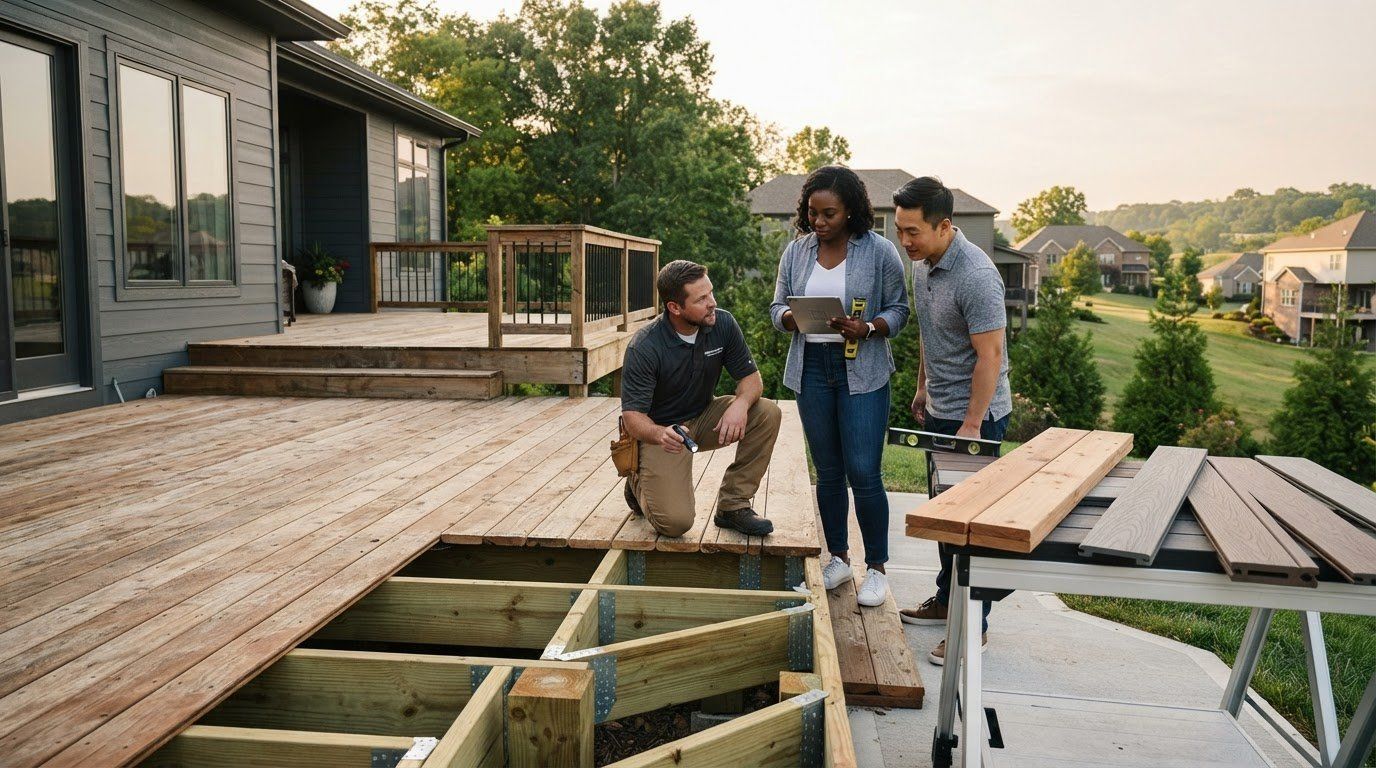
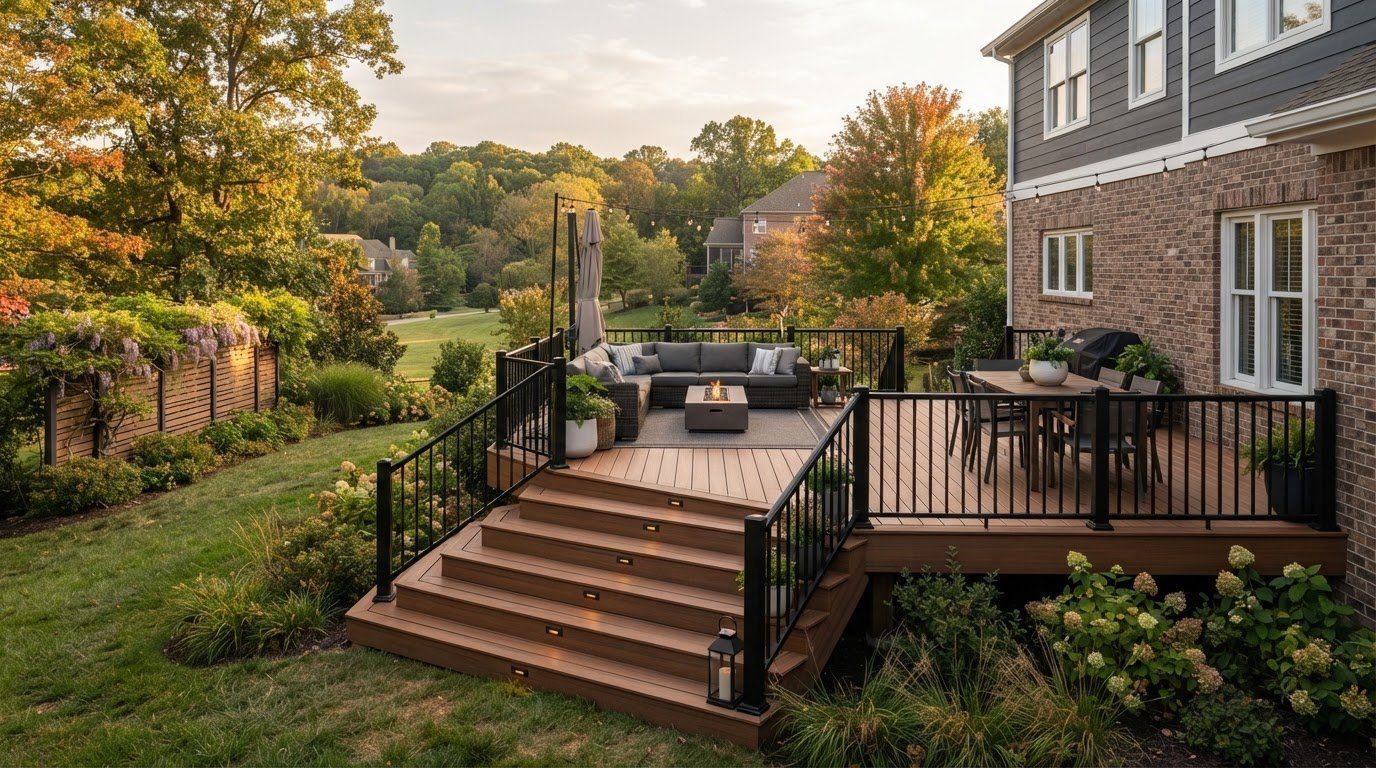
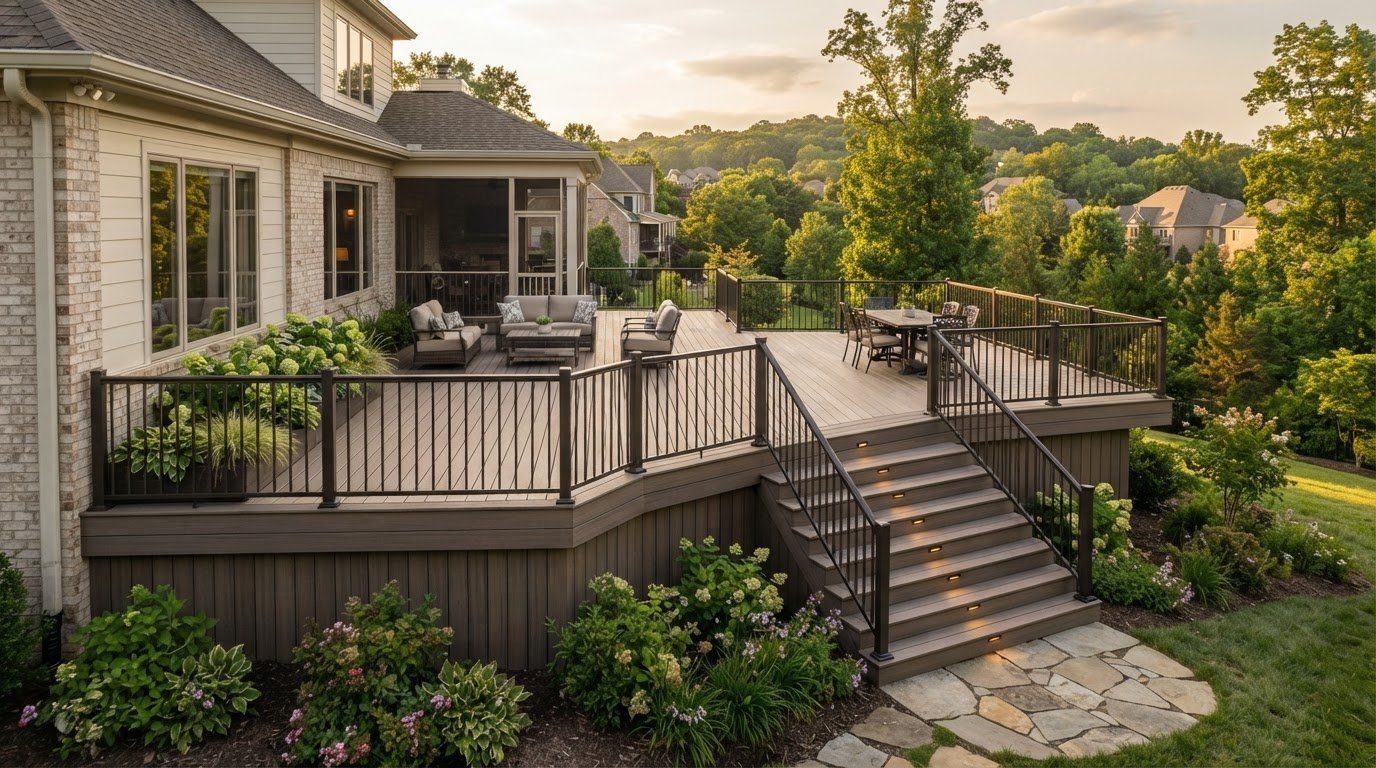
The most expensive mistake you can make with a new deck isn't the boards you walk on; it's the frame you never see. If you're tired of the endless cycle of sanding and staining wood, you've likely realized that hiring a professional composite deck builder is the only way to reclaim your weekends. You want a beautiful outdoor space that looks as good in ten years as it does on day one. We agree that a premium project should be a permanent solution, not a temporary fix that hides structural shortcuts behind fancy plastic boards. In this guide, you'll discover how to choose a contractor who treats your home with the precision it deserves. We'll explain why the "invisible" details of your deck's sub-structure determine whether it actually reaches a 25-year lifespan in the Louisville humidity. You'll learn the critical differences between Advanced PVC and traditional composites, the importance of 30-inch deep footings, and how a 10-year craftsmanship warranty provides the security you need for a large-scale investment. When you prioritize the foundation, you get a deck that remains a point of pride for decades. Key Takeaways Learn why the true longevity of your deck depends on protecting the wood frame with joist tape, even when using premium 25-year boards. Discover how to vet a specialized composite deck builder to ensure your project meets strict local codes and qualifies for full manufacturer warranties. Understand the performance of TimberTech Advanced PVC, which is engineered to withstand Ohio Valley temperature swings from 20°F to 170°F. Navigate the essential permit and planning steps required for homeowners in Jefferson and Clark counties to avoid costly construction delays. Gain long-term security by learning about the protection offered by a 10-year craftsmanship warranty from a locally owned expert. Choosing a Composite Deck Builder in Louisville: Why Local Expertise Matters A general handyman might be capable of fixing a leaky faucet or patching drywall, but a specialized Composite Deck Builder is a structural expert. While a generalist often treats composite boards exactly like pressure-treated wood, a specialist understands that synthetic materials require precise expansion and contraction tolerances. If you choose a builder who lacks this specific knowledge, you risk the structural failure of a high-end investment. We believe that a premium project should be a permanent solution, which is why our philosophy focuses on protecting the homeowner from common industry shortcuts that lead to sagging or warped boards. The "Protective Expert" approach prioritizes the integrity of the frame over the aesthetics of the surface. Most homeowners focus on the color of the boards, but the true value of your deck lies in the ledger board connection and the depth of the footings. In the Ohio Valley, building a deck is an engineering challenge against the elements. Choosing a locally owned and operated contractor ensures you're working with someone who is accountable to the community and understands the specific soil conditions found in neighborhoods like Anchorage and Prospect . Louisville Weather and Your Deck Foundation Louisville’s climate is notoriously aggressive toward exterior structures. With summer humidity levels frequently reaching 90%, untreated or poorly ventilated wood framing will rot long before your composite boards show any signs of wear. Furthermore, the Kentucky Residential Code requires deck footings to be at least 30 inches below grade to remain below the frost line. If your Composite Deck Builder doesn't account for the local freeze-thaw cycle, the ground will heave and shift, causing your deck to become unlevel or pull away from your home. Moisture resistance is not a luxury in the Louisville area; it is the absolute baseline for survival. Vetting Your Contractor for Longevity When you interview potential contractors, ask direct questions about their sub-structure protection methods. You should verify their status as a preferred installer for brands like TimberTech, as professional installation is required for warranty compliance. A contractor with deep roots in areas such as Indian Hills or Hurstbourne will be able to show you local projects that have already survived several Kentucky winters. Always look for a clear 10-year craftsmanship warranty . This level of commitment ensures that the builder takes personal responsibility for every detail, treating your property with the same care as their own. Advanced Materials: TimberTech PVC and Composite Performance Selecting the right surface material is the second most critical decision for your project. While the frame is the heart of the deck, the boards are what you'll live on every day. As a professional Composite Deck Builder , we recommend TimberTech because their engineering solves the specific failures of early-generation synthetics. TimberTech Advanced PVC is a 100% polymer product, meaning it contains zero wood fibers. This science is vital in Louisville, where high humidity usually invites rot and mold into traditional materials. If you choose a material with wood fillers, you're still inviting organic decay into your outdoor space. One common objection homeowners raise is surface heat. TimberTech addresses this with materials engineered to perform across a massive temperature range, specifically from 20°F up to 170°F. Their CoolTouch Technology ensures that your deck remains comfortable under the Kentucky sun, staying up to 30° cooler than many competitive products. Beyond performance, these materials are a win for the environment. TimberTech is on track to utilize 1 billion pounds of waste and scrap annually by the end of 2026, turning recycled content into high-performance outdoor flooring that mimics the deep grain of real wood without the risk of splinters. Advanced PVC vs. Capped Composite Choosing between Advanced PVC and capped composite depends on your specific lifestyle. PVC is significantly lighter and completely moisture-proof, making it the ideal choice for pool surrounds or homes with heavy shade. Capped composite features a durable polymer shell over a recycled wood and plastic core, offering a sturdy feel underfoot for high-traffic areas. Both options eliminate the need for annual staining or sanding. However, professional installation is required for warranty compliance, ensuring your investment is protected by the manufacturer's long-term guarantees. If you're unsure which material fits your backyard's exposure, you can request a material comparison from our team. The Aesthetic Advantage of Hidden Fasteners A premium deck should not be littered with visible screw heads. We utilize hidden fastener systems like Cortex and CONCEALoc to create a sleek, fastener-free surface. Traditional surface-screwing often leads to "mushrooming," where the composite material bulges around the screw head and creates a trip hazard. Hidden fasteners prevent this damage and ensure the boards can expand and contract naturally without warping. This level of precision creates clean lines that significantly enhance your home's curb appeal and long-term value, providing a smooth finish that looks professional and feels secure. The Invisible Standard: Protecting the Sub-structure with Joist Tape The biggest industry secret in outdoor construction is a lifespan mismatch. Most homeowners see a 25-year or 50-year warranty on their composite boards and assume the entire structure is permanent. However, the wooden frame underneath rarely lasts that long without specialized protection. If your Composite Deck Builder uses standard pressure-treated lumber without a moisture barrier, the frame will likely begin to rot within a decade. This leads to a heartbreaking scenario where you have perfectly good boards sitting on a structural frame that is no longer safe to walk on. We believe a deck is only as good as the skeleton that supports it. The Science of Wood Rot in Deck Framing Rot occurs when water becomes trapped in the narrow space between the deck board and the joist. This "rot sandwich" prevents evaporation and allows moisture to seep into screw holes, where it slowly dissolves the wood fibers from the inside out. We only use kiln-dried, moisture-resistant lumber for our sub-structures to minimize the natural warping that occurs with "wet" wood. Joist tape is the critical waterproof barrier that seals the top of your frame and prevents moisture from reaching the wood fibers where rot begins. By applying TimberTech ProTac Joist Tape, we ensure that the frame's lifespan actually matches the longevity of the premium boards you've selected. Installation Best Practices for Framing A rigid, high-end feel underfoot is not an accident; it is the result of strict framing standards. Joist spacing should never exceed 16 inches on center, and for a truly rock-solid surface, we often recommend 12-inch spacing. To prevent boards from warping or twisting over time, we install flush blocking every 4 to 6 feet. This extra step provides lateral stability and ensures the joists remain perfectly upright. If the framing is neglected, the surface will eventually develop "waves" or a bouncy feel that ruins the outdoor experience. Precision installation also requires matching the protection to the specific structural component: Standard Joists: We use 1.625-inch tape to cover the top of every individual joist. Double Beams: We utilize 3.25-inch or 4-inch tape to seal the seams where two boards are sandwiched together. Ledger Boards: Specialized flashing and tape ensure water cannot migrate behind the board and into your home's foundation. When you choose a builder who follows these invisible standards, you're protecting your home from the structural failures common in cut-corner projects. Our commitment to these details is why we can offer a 10-year craftsmanship warranty that provides genuine peace of mind. We don't just build for the initial reveal; we build for the next quarter-century of use. Designing Your Outdoor Living Space: From Permits to Planning Designing a high-performance deck involves more than choosing a color and a layout. A professional Composite Deck Builder approaches the design phase with the same precision as an architect, ensuring that every structural calculation meets the 2018 Kentucky Residential Code. In Jefferson County, Louisville Metro Planning and Design Services requires a building permit for any deck attached to a house or any structure higher than 30 inches above grade. If you skip this step, you risk the forced removal of the deck or significant issues during a future home sale. We handle the permit process to protect you from these administrative pitfalls. Every design must account for a live load of at least 40 pounds per square foot. While generic online design tools might help you visualize a space, they rarely account for the specific engineering needs of your property's soil or the ledger board connection to your home's unique rim joist. When you choose a qualified Composite Deck Builder , your design undergoes a rigorous review to ensure it remains stable through decades of use. This planning stage is the ideal time to map out zones for dining, grilling, and lounging to ensure the traffic flow feels natural rather than cramped. Planning for Stairs and Code Compliance Stairs are often the most scrutinized element of a local building inspection. For safety and compliance, the rise and run of each step must be consistent to prevent trip hazards. Because composite boards are more flexible than traditional lumber, stair stringer spacing must be tighter, typically 12 inches or less on center. This prevents the bouncy feel that occurs when builders use standard 16-inch spacing. Additionally, local codes in Southern Indiana and Louisville require graspable handrails that meet specific diameter standards, ensuring that everyone can navigate the levels of your deck securely. Enhancing Functionality with Lighting and Drainage A well-designed deck remains functional long after the sun sets. We integrate recessed stair lights and post cap lights early in the planning phase to ensure all wiring is hidden within the sub-structure. For homeowners building two-story decks, we can install under-deck drainage systems. These systems divert water away from the area below, creating a dry, usable patio space underneath your main deck. If you plan for these features during the initial design, you avoid the high cost of retrofitting them later. Start your professional deck design today The Home Run Difference: 10-Year Warranty and Local Roots Most contractors in the Ohio Valley offer a standard one-year labor warranty, but we believe that is insufficient for a project intended to last a quarter-century. If a builder isn't willing to stand behind their structural work for at least a decade, they likely aren't following the rigorous "invisible" standards required for long-term stability. As a locally owned and operated Composite Deck Builder , we take personal responsibility for every ledger board connection and footing we pour. We don't just finish a project and disappear; we remain a dependable fixture in the Louisville community, ensuring your investment remains secure for years to come. Our approach is built on accountability. We understand the specific anxieties that come with large-scale home investments, which is why we prioritize structural integrity over quick turnarounds. When you choose a partner with deep local roots, you're choosing a contractor who treats your property with the same level of care as their own. This commitment to quality is what separates a professional installation from a general handyman project. Why a Craftsmanship Warranty Matters It is essential to distinguish between the manufacturer’s material warranty and the builder’s labor warranty. While TimberTech provides industry-leading material guarantees, those warranties often require proof of professional installation to remain valid. Our 10-year craftsmanship warranty protects your investment against installation errors that might not surface until several Kentucky freeze-thaw cycles have passed. This long-term guarantee is the core of our "Protective Expert" philosophy. If you choose a builder who ignores joist tape or proper spacing, you risk structural failures that a material warranty won't cover. We provide the peace of mind that comes from knowing the job was done right the first time. A Legacy of Quality in the Louisville Community Our expertise isn't limited to the surface of your deck. Because we are a "one-stop" exterior expert specializing in roofing and siding, we have a superior understanding of how water migrates across your home’s envelope. This knowledge allows us to build decks that integrate perfectly with your existing structure without risking water damage to your foundation. We have a proven track record of excellence in neighborhoods like Hurstbourne and Glenview , where homeowners demand both aesthetic beauty and structural resilience. If you are ready to reclaim your weekends and upgrade your outdoor living space, contact us today to schedule your consultation. We will provide a comprehensive review of your property and a free estimate for your Louisville deck project . Let us show you how a professional Composite Deck Builder can transform your backyard into a permanent, low-maintenance retreat. Build Your Legacy on a Foundation of Excellence Investing in a premium outdoor space shouldn't be a gamble on how long the hidden framing will last. You've learned that a truly durable deck depends on the invisible details, from moisture-sealing joist tape to footings that sit deep below the Kentucky frost line. When you choose a specialized Composite Deck Builder , you're ensuring that the science of the materials matches the precision of the installation. We've seen too many homeowners forced to replace rotting frames underneath perfectly good boards; our methods are designed to prevent that exact failure and provide lasting structural stability. As a locally owned and operated TimberTech Preferred Installer, we take personal responsibility for every structural connection we make. Our 10-year craftsmanship warranty provides the long-term security you need to invest with absolute confidence. If you prioritize quality and integrity, then you're ready to build a space that remains a dependable fixture of your home for the next quarter-century. We're ready to help you navigate the permits and planning to create a backyard retreat that stands the test of time. Get Your Free Composite Deck Estimate in Louisville Frequently Asked Questions Is a composite deck builder more expensive than a wood deck builder? The upfront cost of hiring a professional Composite Deck Builder is higher than a standard wood contractor because of material prices and specialized labor. However, if you account for the annual cost of staining, sanding, and eventual wood rot, composite is the more economical choice over a ten-year period. You avoid the recurring expenses of chemical treatments while maintaining a surface that looks new for decades. How long does a composite deck actually last in Louisville humidity? High-quality composite boards are engineered to last 25 to 50 years in our intense local humidity. While the Ohio Valley's moisture levels quickly degrade traditional lumber, synthetic polymers are immune to rot and insect damage. The real variable is the sub-structure. If the frame is properly protected with joist tape, your deck will remain structurally sound for the full lifespan of the premium surface materials. Does composite decking require any maintenance at all? Composite materials are low-maintenance but not maintenance-free. You will never need to sand, stain, or seal your deck, but you should perform a basic cleaning with soap and water at least twice a year. This prevents pollen, dirt, and organic debris from building up in the grain. If you live in a heavily wooded area, more frequent rinsing helps maintain the slip-resistant surface and aesthetic clarity. Can I install composite decking over my existing wood frame? You can only install new boards over an existing frame if the original structure is in perfect condition and meets current safety codes. We must verify that the joists are spaced no more than 16 inches apart and that the footings reach the 30-inch frost line. If the frame shows any signs of soft spots or structural sagging, a full replacement is required to protect your investment. What is the best composite decking brand for the Kentucky climate? TimberTech Advanced PVC is specifically engineered for the drastic temperature swings found in the Louisville area. It maintains its structural integrity from 20°F in the winter up to 170°F in the peak of summer. Because it contains no wood fibers, it won't swell or contract like cheaper alternatives. This makes it the most resilient choice for homeowners who want a deck that survives the Kentucky climate. Do I need a building permit for a deck in Louisville, KY? A building permit is mandatory for any deck in Louisville that is attached to the dwelling, exceeds 200 square feet, or stands more than 30 inches above the ground. Louisville Metro Planning and Design Services oversees these requirements to ensure structural safety. If your project meets these criteria, we handle the application process to ensure your new structure is fully compliant with the 2018 Kentucky Residential Code. How does the 10-year craftsmanship warranty protect my new deck? Our 10-year craftsmanship warranty covers any issues resulting from the installation process, such as improper ledger board attachment or sagging due to poor joist spacing. While manufacturer warranties cover material defects like fading or staining, they don't protect you if the builder cuts corners on the frame. If you choose a Composite Deck Builder who offers this level of protection, you're securing your home's long-term value. Does composite decking get too hot for bare feet in the summer? Modern composite technology has significantly reduced heat retention compared to older generations of synthetic decking. TimberTech products featuring CoolTouch Technology can stay up to 30° cooler than competitive boards in direct sunlight. While any dark surface will absorb heat, choosing a lighter color and a PVC-based material ensures the surface remains comfortable for bare feet even during the most intense July heatwaves in Southern Indiana. 
By Pat McIntyre August 16, 2026
Your wood deck is likely losing the battle against Louisville's relentless humidity before the first summer is even over. It's a frustrating cycle of power washing, staining, and eventually replacing rotted boards that compromises your home's value. If you're searching for "composite decking near me," you already know there's a better way to reclaim your weekends. You deserve an outdoor space that stands up to Kentucky weather without demanding a second mortgage in annual maintenance costs. We agree that a deck should be a sanctuary, not a chore or a safety hazard due to poor structural framing. This guide will show you why advanced composite technology is the ultimate solution for our local climate and how to identify a contractor who stands behind their work. You'll learn how to secure a beautiful, maintenance-free space backed by a signature 10-year craftsmanship warranty. We'll explore the specific materials that thrive in Louisville and the professional standards required to ensure your investment lasts for decades. By the end, you'll have the confidence to choose a partner who treats your property with the care it deserves. Key Takeaways Louisville’s high humidity is the primary enemy of traditional wood decks, making rot-resistant composite materials a necessity for long-term durability. Learn the critical performance differences between wood-plastic composites and TimberTech Advanced PVC, which offers superior resistance to moisture and extreme Kentucky temperatures. When searching for "Composite Decking Near Me," prioritize local experts who understand Louisville building codes and avoid contractors who compromise on structural framing. Discover why a high-performance deck depends on a sub-structure of kiln-dried lumber and precise joist spacing to prevent sagging or instability. Protect your home investment by choosing a professional installation backed by a signature 10-year craftsmanship warranty for total peace of mind. Why Composite Decking is the Smart Choice for Louisville’s Climate Louisville's climate is notoriously harsh on exterior building materials. The Ohio Valley humidity creates a constant moisture load that turns traditional pressure-treated lumber into a breeding ground for mold and wood rot. If you've spent your weekends searching for Composite Decking Near Me , you're likely tired of seeing your current deck splinter and warp under the Kentucky sun. Modern decking technology solves these problems by creating a surface that's virtually impervious to the elements. The Battle Against Kentucky Humidity Standard wood decks in Louisville often face structural failure within 10 to 15 years. This isn't just an aesthetic issue; it's a safety concern. High moisture levels lead to fungal growth that eats away at wood fibers from the inside out. When you choose moisture-resistant materials like composite or Advanced PVC, you're investing in a product that doesn't absorb water. This is critical for surviving our local freeze-thaw cycles. During winter, water trapped in wood fibers freezes and expands, causing deep cracks. Composite technology remains stable through these shifts, ensuring your deck stays safe and level year after year. Long-Term Value vs. Upfront Cost While the initial investment in high-quality decking is higher than wood, the long-term ROI is undeniable. Consider the relentless two-year cycle of sanding, staining, and sealing required to keep a wood deck from falling apart. These costs add up quickly when you factor in professional labor and premium chemicals. The "hidden cost" of wood isn't just money. It's the time you lose every spring performing maintenance instead of enjoying your backyard. A professional deck addition increases home value, particularly in upscale neighborhoods like Anchorage and Prospect . Prospective buyers prioritize low-maintenance features that offer long-term stability. When you choose a local expert, you're also securing a 10-year craftsmanship warranty. This guarantee provides a level of security that a cheap wood installation simply cannot match. Modern boards also maintain their color integrity despite intense UV exposure. While the sun bleaches wood to a dull grey within months, composite materials stay vibrant and beautiful for decades. TimberTech Advanced PVC vs. Traditional Composite: A Performance Breakdown If you're searching for Composite Decking Near Me , you've likely seen a dozen different brands. It's easy to assume they're all identical. They aren't. Standard wood-plastic composites (WPC) mix recycled wood fibers with plastic. TimberTech Advanced PVC is a 100% polymer material. This distinction is vital for long-term performance. Advanced PVC offers the highest resistance to moisture and rot because there's zero organic material to decay. These boards are engineered for extreme environments. They operate within a service temperature range of -70°F to 200°F. This ensures your deck won't become brittle during a polar vortex or warp under a record-breaking heatwave. While early synthetic decks looked like cheap plastic, modern Advanced PVC uses sophisticated embossing to mimic authentic wood grain. You get the aesthetic of hand-scraped hardwood without the structural vulnerabilities of organic timber. Advanced PVC: The Premium Choice for Louisville This is the ideal selection for properties with pools or heavy shade where moisture lingers. Because it's 100% polymer, it doesn't just resist water; it's waterproof. Heat dissipation is another major factor. Advanced PVC stays significantly cooler on bare feet during July heatwaves compared to traditional composites. To maintain a sleek look, we utilize hidden-fastener systems like Cortex® and CONCEALoc®. These eliminate visible screw heads, creating a smooth, safe surface for your family. If you're ready to see these materials in person, you can request a consultation with our team to view samples. Capped Composite: The Balanced Investment For homeowners seeking a balance between performance and budget, capped composite is a reliable alternative. Unlike older generations of composite, the TimberTech Pro™ series features a 4-sided cap. This protective shell wraps entirely around the board, including the grooves. It prevents moisture from reaching the core. If your deck receives moderate sun exposure and isn't adjacent to a pool, this material provides excellent durability. When you choose this path, we still back every project with our 10-year craftsmanship warranty to ensure your sub-structure is as resilient as the surface. Evaluating Composite Decking Contractors Near You When searching for Composite Decking Near Me , you'll find plenty of local results. However, the quality of the surface board doesn't matter if the crew installing it lacks a deep understanding of Louisville’s specific environmental demands. Local roots are essential. A contractor who knows the clay-heavy soil conditions and local building codes in Jefferson County will ensure your deck’s foundation doesn't heave or settle over time. We've seen too many decks fail because the installer didn't account for the expansion and contraction of our local soil during Kentucky's seasonal shifts. You must be wary of "Solar Cowboys." These are contractors who pivot from unrelated trades to follow high-demand trends without the proper structural training. These installers often cut corners on the sub-structure, using inferior lumber or improper joist spacing that leads to sagging boards within months. If a contractor cannot explain their framing standards in detail, they aren't the right choice for your home. A deck is only as strong as the frame beneath it. Cutting corners on the skeleton of your deck is a recipe for a costly collapse. Vetting Your Louisville Deck Builder Don't settle for surface-level promises. Ask potential builders about their specific blocking and framing techniques. A high-integrity contractor should be able to provide local references in neighborhoods like Anchorage , Glenview , or Crestwood . Look for elite certifications that demonstrate a broader commitment to excellence. Being an Owens Corning Preferred Contractor or an LP SmartSide Master Lead proves a company has been vetted by industry giants for their installation quality across the entire home exterior. These credentials indicate that the contractor is a permanent fixture in the community, not a fly-by-night operation. The Home Run Improvement Difference We operate as your "Protective Expert," treating your property with the same precision we would our own. We understand the anxieties that come with a major home investment. That's why we offer a signature 10-year craftsmanship warranty. This isn't just a marketing claim. It's our commitment to long-term accountability. If a structural issue arises due to our workmanship, we fix it. You can learn more about our 10-year warranty and how it protects your peace of mind. When you choose a partner with local pride and proven expertise, you eliminate the fear of poor workmanship. You secure an outdoor space that truly lasts. The Anatomy of a High-Performance Deck Installation A deck is only as reliable as the skeleton beneath the surface. While you might be searching for Composite Decking Near Me to find the perfect color or texture, the longevity of your investment depends on what you can't see. Most contractors use standard pressure-treated lumber that's still dripping wet from the yard. We don't. We use kiln-dried, moisture-resistant lumber for our framing. If you use wet lumber, the boards will inevitably twist and shrink as they dry, causing your expensive composite surface to ripple and move. Structural integrity requires strict adherence to spacing and support standards. Our joist spacing never exceeds 16 inches on center. This creates a stable, rock-solid feel underfoot that won't bounce or flex. To ensure lateral stability, we install structural blocking every 4 to 6 feet. This prevents the joists from "rolling" and keeps the entire system rigid against the heavy winds and soil shifts common in the Ohio Valley. Framing and Joist Protection The most common failure point in a deck isn't the board; it's the top of the joist where the screw penetrates the wood. To prevent this, we apply ProTac joist tape to every framing member. Applying 1.625 inch or 2.5 inch tape creates a waterproof seal that stops moisture from seeping into screw holes. For high-load areas or double beams, we utilize 3.25 inch tape to ensure total coverage. This simple step can extend the life of your sub-structure by decades, protecting it from the rot that usually claims Louisville decks. When we build, we ensure the joist planes are perfectly even, providing a flat surface that allows your composite boards to shine. Schedule your structural deck inspection today Hidden Fasteners and Finishing To achieve a truly high-end aesthetic, we utilize hidden-fastener systems like SIDELoc® or FUSIONLoc®. These tools allow us to secure the boards through the side or bottom, leaving the top surface completely fastener-free. This isn't just about looks. It's about safety. No visible screws mean no "mushrooming" or sharp metal edges for bare feet to catch on. We also ensure every staircase meets strict stair code compliance for tread depth and riser height, guaranteeing safety for every family member. Because we're confident in these technical standards, every project is backed by our signature 10-year craftsmanship warranty. With minimal cleaning and annual inspections, this system will maintain its beauty and performance for over 25 years. Home Run Improvement: Your Louisville Composite Decking Experts Choosing a contractor for Composite Decking Near Me is a decision that affects your home's integrity for decades. When you search for Composite Decking Near Me , you're looking for more than just a builder; you're looking for a specialist who understands Kentucky’s unique climate. Home Run Improvement is a locally owned and operated fixture in the Louisville community. We serve homeowners across Southern Indiana and the surrounding Kentucky counties with a level of personal commitment that national chains cannot replicate. Because we're comprehensive exterior experts, we understand how your new deck interacts with your existing roofing , siding, and gutters . This holistic approach prevents common drainage issues that often plague poorly planned deck additions. If you choose a big-box retailer, you're often left with a rotating cast of subcontractors. When you choose us, you're securing a partner who takes personal responsibility for every structural detail. Our signature 10-year craftsmanship warranty is a firm declaration of our standards. It provides the security you need when making a significant investment in your property. We don't just build surfaces; we build high-performance systems designed to survive the Ohio Valley’s specific environmental challenges. Our elite status as an Owens Corning Preferred Contractor and LP SmartSide Master Lead proves our dedication to high-end installation practices across every project we touch. Start Your Outdoor Transformation Today The journey to a maintenance-free backyard begins with a professional consultation where we assess your site's specific drainage and soil conditions. We prioritize TimberTech Advanced PVC for our most demanding projects because its performance in high-moisture environments is unmatched. Our process is methodical, moving from a precise design phase to a final inspection that meets our uncompromising internal standards. You can view our previous decking work in Louisville to see the level of precision we bring to every job site. We take the time to explain the "why" behind our methods, ensuring you feel informed and confident in the stability of your new outdoor space. Contact Home Run Improvement Ready to upgrade your outdoor living experience? Don't settle for a rotting wood deck that requires constant attention and expensive chemicals. We provide free estimates for homeowners in Prospect , Anchorage , Jeffersontown, and throughout the greater Louisville area. Whether you need a simple platform or a complex multi-level structure, we have the specialized knowledge to execute the project correctly the first time. Our team is ready to protect your investment with the craftsmanship and integrity your home deserves. Schedule your free composite decking estimate now Secure Your Louisville Home with High-Performance Outdoor Living Louisville's relentless humidity doesn't have to dictate the lifespan of your outdoor space. By choosing advanced polymer materials and a sub-structure protected by joist tape and kiln-dried lumber, you ensure your investment survives Kentucky's seasonal extremes for decades. If you choose a specialist with an A+ local reputation, you gain the security that comes from elite certifications like Owens Corning Preferred Contractor and LP SmartSide Master Lead status. When you search for Composite Decking Near Me , you deserve a team that treats your property with the precision of a "Protective Expert." We back every installation with our signature 10-year craftsmanship warranty because we have total confidence in the stability of our work. Your transition to a maintenance-free lifestyle starts with a single professional consultation. Don't settle for a contractor who cuts corners on the sub-structure when you can have a high-performance system built by local experts who care. Request Your Free Composite Decking Estimate in Louisville We look forward to helping you reclaim your weekends and build an outdoor sanctuary that increases your home's value and provides lasting peace of mind. Frequently Asked Questions How much does composite decking cost near me in Louisville? The total cost for your project depends on several variables, including the total square footage, the specific material line you choose, and any necessary structural framing upgrades. While the initial investment for composite materials is higher than traditional pressure-treated lumber, you must factor in the total cost of ownership. When you choose a professional installation, you eliminate the recurring expenses of professional staining, sealing, and board replacements that wood decks require every few years. Is composite decking worth the investment compared to wood? Composite decking is a superior investment for Louisville homeowners because it ends the expensive cycle of wood rot and maintenance. In our local humidity, wood decks often require significant repairs within a decade. Composite materials resist moisture and UV damage, maintaining their structural integrity and color for much longer. This durability increases your home's resale value and provides a maintenance-free lifestyle that pays for itself over the life of the deck. Does composite decking get too hot in the Kentucky summer? Modern decking technology has made significant strides in heat dissipation, especially with 100% polymer products. If you're looking for "Composite Decking Near Me" that stays comfortable, TimberTech Advanced PVC is engineered to stay cooler on bare feet than traditional wood-plastic composites. While any surface will absorb some heat in direct July sunlight, choosing lighter colors and high-performance materials ensures your outdoor space remains usable even during record-breaking Kentucky heatwaves. How long does a composite deck last in the Ohio Valley climate? A professionally installed composite deck can last between 25 and 50 years depending on the specific product tier you select. The longevity of the surface is only half the story; the sub-structure must be built to match. By using kiln-dried lumber and joist protection tape, we ensure the frame survives as long as the boards. This comprehensive approach protects your investment from the freeze-thaw cycles and heavy moisture loads common in the Ohio Valley. Can I install composite decking over my existing wood frame? We generally advise against installing new composite boards over an old wood frame. Most existing frames weren't built to the strict 16-inch on-center spacing required for a stable composite surface. Even if the frame looks sturdy, hidden rot in the joists can lead to structural failure long before the new boards wear out. Starting with a fresh, expertly engineered sub-structure is the only way to guarantee the long-term stability of your new deck. What maintenance is required for a TimberTech deck? Maintenance is incredibly simple and requires only an occasional cleaning with mild soap and water to remove dirt or pollen. You'll never need to sand, stain, or seal your deck to protect it from the elements. This lack of intensive upkeep is a primary reason homeowners search for "Composite Decking Near Me" in the first place. Regular inspections to keep the gaps between boards clear of debris will ensure proper drainage and keep the system performing perfectly. Do I need a permit for a deck replacement in Louisville, KY? Yes, most deck projects in Louisville and Jefferson County require a building permit to ensure the structure meets safety codes. This process involves submitting detailed framing plans and undergoing inspections for footings and final structural integrity. We handle the entire permitting and inspection process for our clients. This ensures your project is fully compliant with local regulations, which is essential for your safety and for maintaining your home's insurance coverage. Why should I choose a contractor with a 10-year warranty? A 10-year craftsmanship warranty provides the ultimate peace of mind because it proves the contractor stands behind their structural work. Many installers only offer the manufacturer's material warranty, which doesn't cover issues caused by poor framing or improper fastening. Our signature warranty ensures that if a structural problem arises due to our installation methods, we'll fix it. It’s a level of accountability that protects you from the long-term risks of cut corners or poor workmanship.