How to Choose a Roofing Contractor Louisville KY Homeowners Can Trust (2026 Guide)

Pat McIntyre • August 9, 2026

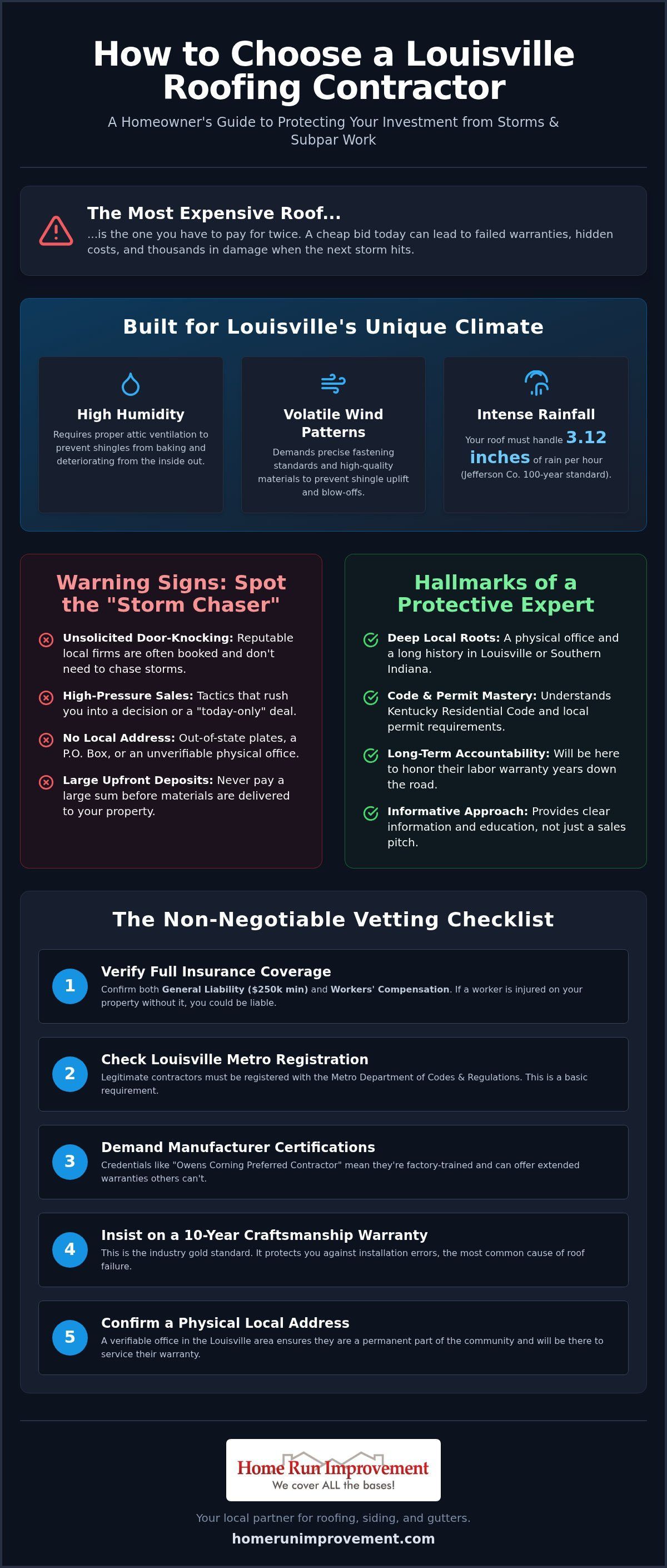
The most expensive roof you'll ever buy is the one you have to pay for twice. In the wake of a heavy Kentucky storm, the pressure to repair damage quickly often leads homeowners straight into the hands of "storm chasers" who lack local roots and long-term accountability. If you choose the wrong contractor based on a low bid today, you'll likely face hidden costs and failed warranties when the next heavy Louisville rain arrives. You deserve a roof that protects your investment for 20 years or more, not a temporary fix that leaves you vulnerable.

We understand the anxiety that comes with vetting local trades. This guide simplifies the process of how to choose a roofing contractor Louisville residents can actually trust. When you follow a structured vetting system, you eliminate the guesswork and protect your home from subpar workmanship. We will walk you through the essential steps for 2026; including verifying Louisville Metro registrations, understanding the latest building code requirements, and identifying the specific markers of a "Protective Expert" who stands behind their labor with a 10-year craftsmanship warranty. By the end of this guide, you'll have the confidence to secure a roof that survives the elements and a contractor who stays in the community.

Key Takeaways

  • Identify the specific wind and humidity standards required for Louisville roofs to ensure your installation survives local weather patterns.
  • Master the vetting process for how to choose a roofing contractor Louisville residents can trust, including verifying local permits and specific roofing insurance.
  • Learn why a 10-year craftsmanship warranty is the industry gold standard for protecting your investment against installation errors.
  • Discover the seven critical interview questions that expose out-of-state "storm chasers" and reveal a contractor's true labor practices.
  • Understand the long-term value of choosing a locally owned partner who manages your home's total exterior, from roofing to gutters and siding.

Navigating the Louisville Roofing Landscape: Why Your Choice is High-Stakes

Your home is your most significant investment, and the roof is its primary shield. Understanding what a roofing contractor does involves more than just swapping shingles; it requires a deep mastery of structural protection and regional environmental stressors. In Kentucky, the stakes are exceptionally high. If you are researching how to choose a roofing contractor Louisville homeowners can actually rely on, you must look beyond the lowest bid. A poor installation doesn't just lead to leaks. It can compromise your siding and cause water to overflow into your gutters, eventually threatening your foundation and interior ceilings.

Louisville presents unique meteorological challenges. Our region faces high humidity and volatile wind patterns that demand precision. Proper ventilation is mandatory to prevent attic heat from baking shingles from the inside out. Our infrastructure must also handle intense precipitation. In Jefferson County, the 100-year hourly rainfall intensity is 3.12 inches per hour. If your contractor doesn't use the correct fastening standards and high-performance materials for these conditions, your "new" roof could fail during the next heavy spring storm. Learning how to choose a roofing contractor Louisville residents trust means finding someone who builds for these specific local realities.

Spotting the Red Flags of Non-Local Contractors

After a severe storm, Louisville neighborhoods often see an influx of out-of-state crews. These "storm chasers" prioritize speed and insurance payouts over long-term quality. You should be wary of several warning signs:

  • Unsolicited door-knocking: Reputable local firms rarely need to chase storms to find work.
  • High-pressure sales: Professional experts provide information and let the quality of their work do the talking.
  • Lack of a local address: Verify a physical business location in Louisville or Southern Indiana, not just a P.O. box or a truck with out-of-state plates.
  • Large upfront deposits: Never pay a significant portion of the project cost before materials arrive on-site.

The Local Advantage: Accountability in Anchorage and Prospect

Choosing a contractor with deep local roots provides a layer of security that a traveling crew simply cannot match. Whether you live in Anchorage, Prospect, or Hurstbourne, your home must adhere to specific local building codes. A local expert understands the nuances of the Kentucky Residential Code and the specific permit requirements in Jeffersontown and beyond. Most importantly, a local company offers accountability. If a leak occurs three years from now, you need to know your contractor is still here to honor their 10-year craftsmanship warranty. This neighborly reassurance is the foundation of a successful home investment.

The Essential Vetting Checklist: 5 Non-Negotiable Credentials

A roof is only as effective as the hands that install it. While high-quality shingles are a prerequisite, the technical execution of the project determines whether your home remains dry for two decades or fails after two years. Learning how to choose a roofing contractor Louisville homeowners can truly rely on requires looking past marketing slogans and demanding concrete proof of professional standards. If you prioritize these five credentials, you eliminate the vast majority of industry risks before a single shingle is removed.

Insurance vs. Licensing: Don't Confuse the Two

Many homeowners mistakenly believe a business license is a safety net. It isn't. In Louisville, contractors must register with the Metro Department of Codes & Regulations and carry at least $250,000 in general liability insurance. However, you must specifically verify workers' compensation coverage. If a worker is injured on your property and the contractor lacks this insurance, the legal and financial liability can fall directly on you. Always request a Certificate of Insurance (COI) sent directly from the contractor's insurance agent to verify it's active. This step is a cornerstone of vetting contractor credentials and protecting your personal assets.

Manufacturer Certifications: The Mark of a Pro

The highest level of shingle performance is only unlocked through factory-trained installation. When you select an Owens Corning Preferred Contractor, you are choosing a team that has met strict standards for craftsmanship and financial stability. These certifications aren't just badges; they allow the contractor to offer extended manufacturer warranties that "un-certified" roofers cannot access. Factory-trained crews understand the precise math of shingle alignment and the critical nature of flashing, ensuring your roof meets the exact specifications required for long-term durability. If a contractor lacks these credentials, they are likely practicing on your home rather than applying proven expertise.

Beyond insurance and certifications, you must demand a written 10-year craftsmanship warranty. Most roofing failures are the result of installation errors, not material defects. A manufacturer's warranty won't save you from a poorly sealed valley or an improperly flashed chimney. Finally, insist on seeing a local portfolio. A reputable expert will have a deep history of successful projects in neighborhoods like Anchorage, Glenview, or Lake Forest. If you want to see how these standards translate into real-world protection, consider speaking with a local professional who understands how to choose a roofing contractor Louisville residents can trust for the long haul.

Deciphering Roofing Warranties: Manufacturer vs. Craftsmanship

The word "Lifetime" is often the most misunderstood term in the roofing industry. When you see a shingle manufacturer offer a lifetime warranty, they are typically only covering the material itself against rare manufacturing defects. If your roof develops a leak because of a poorly installed valley or skipped flashing, that manufacturer's warranty won't pay a dime for the repair. Understanding this gap is essential when learning how to choose a roofing contractor Louisville families can trust. You need a partner who provides a separate, robust 10-year craftsmanship warranty that specifically covers the labor and installation methods used on your home.

A local contractor who stakes their reputation on a decade of labor coverage is making a long-term commitment to your property. If that contractor lacks local roots or goes out of business, your labor warranty effectively vanishes. This is why vetting for longevity is just as important as vetting for price. Standard contracts often contain exclusions for "acts of God" or "improper maintenance," but a high-quality agreement will clearly outline how the contractor protects you from their own errors. When you evaluate how to choose a roofing contractor Louisville, prioritize those who view their warranty as a binding promise of performance rather than a legal shield.

Why Labor is the Most Expensive Part of a Failure

Industry experts report that up to 90% of residential roof failures stem from installation errors rather than material defects. When a roof fails prematurely, the cost of "re-doing" the project is often double the original price because it requires a full tear-off, disposal fees, and new materials. A craftsmanship warranty acts as a performance bond for your home. It ensures the contractor has a financial incentive to get the job right the first time. If you choose a professional who stands behind their work, you avoid the devastating cycle of paying for the same roof twice.

The Protective Expert's View on Fine Print

Non-pro-rated coverage provides the full value of repairs throughout the entire warranty term, while pro-rated coverage decreases in value as the roof ages. You must also ensure that your roofing project doesn't inadvertently void existing warranties on your gutters or vinyl siding. A "Protective Expert" coordinates every detail of the exterior to maintain total system integrity. For a clear example of what comprehensive protection looks like, review the Home Run Improvement warranty page before signing any contract.


The Interview Phase: 7 Questions to Ask Every Louisville Roofer

Vetting credentials provides the foundation, but the interview phase reveals the contractor's technical competence and operational integrity. When you are mastering how to choose a roofing contractor Louisville homeowners often overlook the specific details of the labor process. A "Protective Expert" will answer these questions with precision and transparency. If a contractor hesitates or provides vague responses, it's a clear signal they may lack the local accountability you require.

  • "Will you be using your own employees or sub-contracting the entire job?" Quality control is significantly higher when the company manages its own trained crew.
  • "How do you protect my landscaping and gutters during the tear-off process?" A professional uses specialized equipment or tarps to ensure debris doesn't damage your property.
  • "What specific steps do you take to ensure proper attic ventilation in our climate?" Louisville's high humidity requires a precise balance of intake and exhaust vents to prevent shingle rot.
  • "Can you provide three references for projects completed in Louisville within the last six months?" Recent local work proves they are currently active and respected in the community.
  • "Who will be the designated on-site supervisor during my project?" You need a direct point of contact who is responsible for the crew's performance.
  • "How do you handle unforeseen deck rot or structural issues?" If they find damaged wood, then they should provide a clear "if-then" framework for repairs before proceeding.
  • "What is your daily cleanup routine?" High-quality firms use magnetic sweeps to ensure no nails are left in your driveway or lawn.

Evaluating the Estimate: Beyond the Bottom Line

The lowest bid is frequently the most dangerous choice for your home's long-term value. If an estimate is significantly lower than others, the contractor is likely cutting corners on materials like flashing or underlayment. A comprehensive estimate must include detailed line items for ridge vents, drip edges, and debris removal fees. When you analyze how to choose a roofing contractor Louisville, look for a document that outlines the entire scope of work. If the estimate lacks detail, you'll likely face "hidden costs" once the project begins.

The 'Gut Check': Communication and Professionalism

Pay close attention to how the contractor communicates during the site visit. Are they assertive about quality standards, or are they simply trying to "close" the deal with high-pressure tactics? A professional acts as a knowledgeable guide, explaining the "why" behind their methods. You can often judge a company's attention to detail by reviewing their Our Work portfolio. If their past projects show clean lines and organized job sites, they'll likely treat your property with the same level of care.

Schedule a professional consultation for your Louisville roof today.

Why Local Accountability Wins: Selecting Your Partner

The search for a qualified contractor ends when you find a partner who values your home's long-term stability as much as you do. In Louisville and Southern Indiana, local accountability is the ultimate safeguard for a homeowner. If a company is headquartered in our community, they cannot hide from their reputation or their results. Traveling crews often view a project as a one-time transaction, but a local "Protective Expert" sees it as a long-term commitment to a neighbor. Understanding how to choose a roofing contractor Louisville residents can depend on means selecting a firm that will be here to answer the phone when the next decade of Kentucky weather tests your roof's resilience.

A professional roof installation does not exist in a vacuum. It must integrate seamlessly with your gutters, siding, and even your decking. If a roofer ignores how water sheds into your gutter system or how flashing interacts with your vinyl siding, they are leaving your home vulnerable to rot and structural decay. A locally owned partner understands these relationships and treats your entire exterior as a unified defense system. This holistic approach is what separates a mere service provider from a true craftsman who treats your property with the same level of care as their own.

Home Run Improvement: The Louisville Standard

Home Run Improvement sets the benchmark for exterior excellence in the Louisville metro area. We don't just install shingles; we provide a shield for your biggest asset. As an Owens Corning Preferred Contractor and an LP SmartSide Master Lead, we have earned the highest levels of manufacturer trust through consistent, high-precision work. Our 10-year craftsmanship warranty serves as a firm guarantee that our labor meets the industry gold standard. When you choose us, you are choosing a team that remains accountable to you long after the final nail is driven. We take personal responsibility for every detail, ensuring your peace of mind during every heavy rain.

Schedule your free roofing estimate with Home Run Improvement

Protecting Your Asset for the Next Decade

Quality labor is the most direct path to maintaining and increasing your home's value. If you prioritize expertise over the lowest bid, then you avoid the financial disaster of a premature roof failure. The process of how to choose a roofing contractor Louisville homeowners trust should always lead you toward a partner who offers transparency, local roots, and proven results. Before making your final decision, we encourage you to verify our standing in the community by checking our Google Reviews. Real social proof from your neighbors in Anchorage, Prospect, and beyond will confirm that a commitment to integrity is the most important credential any contractor can carry. Secure your home's future by choosing a partner who stands behind their work for the long haul.

Secure Your Home’s Future with a Proven Local Partner

Choosing a roof isn't just about selecting shingles; it's about the precision of the installation and the accountability of the person behind the hammer. You now understand that a material warranty is only half the battle. Without a 10-year craftsmanship warranty from a locally rooted expert, you're still at risk from installation errors that manufacturer fine print won't cover. True protection comes from a contractor who lives where they work and stakes their reputation on every single nail.

Mastering how to choose a roofing contractor Louisville residents can rely on means looking for the markers of a true professional. Prioritize an Owens Corning Preferred Contractor with an A+ rated local history and a deep understanding of our specific Kentucky climate. When you insist on these standards, you transform a stressful repair into a long-term investment in your home's security and total exterior health.

Secure your home with a trusted Louisville expert-Contact Home Run Improvement today

You deserve a roof that lasts for decades and a partner who stays in the community to honor their word. Take the next step toward a durable home today.

Frequently Asked Questions

How do I know if a roofing contractor is actually local to Louisville?

Verify a contractor's local status by checking for a physical business address in Louisville or Southern Indiana rather than a P.O. box. A truly local company is registered with the Louisville Metro Department of Codes & Regulations and has a deep portfolio of work in neighborhoods like Anchorage or Prospect. They will have local phone numbers and a reputation built on years of service in the community, not just a temporary presence after a storm.

Is an Owens Corning Preferred Contractor better than a standard roofer?

This designation ensures the contractor meets strict standards for craftsmanship, financial stability, and professional training. Standard roofers often lack the factory-trained expertise required to install modern roofing systems to exact manufacturer specifications. When you select a preferred contractor, you gain access to higher-tier warranties and the peace of mind that comes from knowing the crew has been vetted by the manufacturer for quality and reliability.

What should be included in a professional roofing estimate?

A professional estimate must include specific line items for every component of the project, including underlayment, flashing, drip edges, and ridge vents. It should also clearly outline the costs for labor, debris removal, and site cleanup. This transparency is essential for understanding how to choose a roofing contractor Louisville residents can trust. If an estimate lacks detail or is presented as a single lump sum, it often hides potential shortcuts or future extra charges.

Can a roofing contractor in Kentucky work in Southern Indiana?

Yes, many professional contractors in our region are dual-licensed to serve both Kentucky and Southern Indiana. However, you must verify that they hold the specific licenses and insurance required by Indiana law before work begins. A reputable firm will have no trouble providing proof of their credentials for both sides of the river, ensuring that your project remains fully compliant with all local building codes and safety regulations.

How long does a typical roof replacement take in Louisville?

Most residential roof replacements in our area are completed within one to two days. Factors such as the roof's pitch, the number of layers to be removed, and the total square footage will influence the final timeline. A professional supervisor will provide a methodical schedule and explain their plan for protecting your home's interior if the project requires more than one day to complete due to weather or complexity.

What happens if a roofing contractor finds rotten wood under my old shingles?

If a contractor discovers deck rot, then they must pause the installation and show you the damage before moving forward. A Protective Expert uses a clear if-then framework to explain the structural necessity of replacing the wood and provides a transparent cost for the repair. Installing new shingles over rotten decking is a shortcut that leads to structural failure and immediately voids your manufacturer and labor warranties.

Do I need to be home while the roofing crew is working?

You don't need to be home for the duration of the project, but being accessible by phone is recommended. This allows the supervisor to contact you immediately if they discover hidden issues like structural rot or chimney flashing problems. A professional crew will treat your property with care and manage the entire installation process independently, though you should ensure the driveway is clear for material delivery and debris trailers.

Why is a craftsmanship warranty more important than a shingle warranty?

Most roof failures stem from installation mistakes rather than shingle defects. While a manufacturer's warranty covers the materials, it won't pay for repairs if a leak is caused by poor workmanship. This is why knowing how to choose a roofing contractor Louisville families rely on means finding someone who offers a 10-year craftsmanship warranty. This guarantee ensures the contractor takes personal responsibility for the precision and long-term performance of their labor.
Two-story beige house with white trim, front porch, garage, and a green lawn on a tree-lined street
By Pat McIntyre • October 29, 2026
How LP SmartSide trim and fascia resist rot, termites and hail, cut repainting, and what the 5/50-year and ExpertFinish warranties cover. Louisville installs.
By Pat McIntyre • October 27, 2026
When comparing LP SmartSide vs Hardie board for Kentucky’s climate, installation quality and wall exposure matter as much as the material. LP SmartSide’s engineered wood can absorb impact energy, which may be an advantage where hail or stray objects are a concern. Its moisture performance depends on details such as sealed cut edges, proper clearances, and a maintained finish. Both options can suit a Kentucky home, but they respond differently to impacts, moisture, and finishing needs. The practical choice is not about naming one material the winner, but matching its strengths to your home and priorities. This comparison explains how the materials differ, what to consider about finishes and impact resistance, and why careful installation matters through humid summers, spring storms, and winter freeze-thaw cycles. You’ll have a practical framework for deciding which option better fits your home. Key Takeaways Compare the materials’ composition to understand how each may suit your home’s priorities and exterior conditions. Weigh factory finishes against field painting, including how future touch-ups may affect your maintenance plans. Use the impact comparison to decide which siding better matches your concerns about hail and everyday knocks. Pay close attention to flashing, clearances, and cut-edge sealing, because installation details shape moisture performance. Use the decision guide to connect your finish preferences, exposure, and maintenance expectations to a practical siding choice. Engineered wood and fiber cement siding composition Material composition shapes how siding handles impacts, moisture, and installation. LP SmartSide is engineered wood made from wood strands bonded with resin binders. Its SmartGuard treatment uses zinc borate to help resist fungal decay and termites. That treatment supports durability, but it doesn’t make installation details optional. The LP Building Solutions product information describes the manufacturer’s siding range. Fiber cement is a different material, with a mineral-based composition associated with strong fire resistance. Unlike engineered wood, it doesn’t rely on wood strands as its structural base. The distinction matters when comparing how each siding responds to everyday exposure. Neither material alone determines a wall’s complete moisture protection; flashing, clearances, and finish maintenance matter too. James Hardie’s product information covers its fiber cement siding products. LP SmartSide combines a resin binder and overlay system with SmartGuard treatment. These components make it an engineered wood product, not solid lumber. It is lighter than fiber cement, which can simplify handling and installation. Its edges still need protection: sealing field cuts helps limit moisture entry, especially around trim and openings. MaterialCompositionNotable characteristicPractical considerationLP SmartSideWood strands, resin binders, and SmartGuard treatmentLighter than fiber cementSeal cut edges and maintain the finishFiber cementMineral-based siding materialStrong mineral-based fire resistancePlan handling and installation around its material properties Use this comparison as a starting point, not a stand-alone performance guarantee. The wall’s layers work together: siding sheds weather, while housewrap and flashing help manage water behind it. At a window, for example, proper flashing directs water away from the opening instead of letting it collect at the siding edge. A replacement project should account for these supporting details, not just the visible board material. Composition also shapes maintenance. Engineered wood’s treated surface and sealed cut edges need attention where boards meet trim or openings. Fiber cement’s mineral-based composition offers a different profile, including strong fire resistance. With either material, finish condition and water management affect exterior performance over time. If siding replacement is part of a broader home update, Louisville homeowners can consider the project alongside Kentucky remodeling services . For the material decision itself, weigh composition alongside impact concerns, finish preferences, and the wall’s exposure. Choose engineered wood if its lighter handling and impact-absorbing composition match your priorities. Choose fiber cement if mineral-based fire resistance is central to your decision. Factory finishes, site painting, and touch-ups LP SmartSide and James Hardie siding can have factory-applied finishes or be painted in the field. The choice affects when painting happens, the finished appearance, and how future touch-ups fit into maintenance. Factory finishing means the coating is applied before the siding reaches the job site. Field painting takes place after installation and can cover cut edges and trim details. Factory-applied finishes can simplify the installation sequence because the siding arrives coated. Field painting adds a step after the boards are installed, making preparation and application part of the job. Either approach needs a sound surface and careful attention to joints, edges, and repairs. For example, a replacement board may need precise finishing to blend with the surrounding exterior. LP SmartSide is typically repainted every 8-12 years. That interval gives homeowners a useful planning point, but the condition of the finish and exposure also matter. Inspect sun-facing walls, joints, and areas where water may splash. If paint is worn or damaged, timely touch-ups help maintain the protective finish. Fiber cement siding can also be field-painted or finished at the factory. Appearance matters, too. A consistent finish can unify trim, corners, and long wall sections, while site painting provides a finishing step after installation. Compare the selected color with the home’s roof, trim, and nearby exterior materials before committing. On a replacement project, matching existing surfaces may take more attention than choosing a color for a complete re-side. Siding finish alone does not determine energy efficiency. For LP SmartSide and James Hardie, insulation depends on the wall assembly behind the siding, including the insulation selected and how it is installed. Treat finish selection and insulation planning as separate decisions. Terms such as “cellulose” and “ColorPlus” may come up in siding discussions, but they should not distract from comparing the finish options under consideration. Focus on whether the product arrives factory-finished or will be painted on site, and how future repairs will be finished. Ask how cut edges, trim, and replacement boards will be coated so these details support the overall appearance. For a Louisville home, compare finish timing, repainting plans, and the look you want across the full exterior. If you’re weighing those details for a siding project, discuss your siding plans . Impact and hail resistance For Louisville homeowners comparing impact resistance, LP SmartSide’s engineered wood composition offers a distinct advantage. It can absorb impact energy rather than crack or shatter as readily as a more rigid surface. That can matter when hail strikes a wall or a stray ball hits siding near a yard. LP SmartSide siding has a Class 4 impact rating. Still, neither LP SmartSide nor Hardie fiber cement siding is hail-proof, so severe impacts can damage either material. Fiber cement’s stiffness gives it a different response to a direct hit. A concentrated impact may crack or chip the board, while engineered wood’s flexibility can absorb some force. The result depends on the object, impact location, and severity. For example, a hailstone striking an exposed board edge may cause different damage than one hitting the broad face. Compare likely damage patterns, not just a rating, when choosing siding. Handling during installation also affects the finished wall. Boards can be damaged before they face the weather, including during unloading, carrying, cutting, or fastening. Keep materials supported, avoid striking board edges, and inspect each piece before installation. If a board cracks or chips during the work, replacing it before completion prevents visible damage from remaining in the exterior. Repairability is another practical comparison. Both LP SmartSide and James Hardie siding can be repaired one board at a time. After an impact, identify the damaged board, inspect the surrounding area, and replace the affected section as needed. A single-board repair can address localized damage without replacing an entire wall, though matching the existing finish remains part of the plan. Impact resistance and pest resistance are separate considerations. LP SmartSide’s SmartGuard treatment uses zinc borate to help resist fungal decay and termites. This treatment does not make the siding immune to hail damage, and impact performance does not indicate pest protection. Evaluate each characteristic separately: consider likely impacts when assessing durability, then consider the treatment’s role in resisting decay and termites. Central Kentucky’s recurring winter freeze-thaw cycles are another reason to inspect siding after seasonal weather. Look over exposed faces, corners, and board joints for visible cracks, chips, or loose sections. After hail, check storm-facing areas and spots near trees or open yards. These checks can help identify damage early on either engineered wood or fiber cement siding. Choose LP SmartSide if impact absorption is a leading priority; choose Hardie fiber cement if its other material characteristics better suit your plans. With either option, careful installation and prompt attention to damaged boards support the exterior’s ongoing performance. Installation requirements Moisture control starts before the first siding board is fastened. Prepare the wall properly, install housewrap, and flash windows and doors so water can drain outward. For LP SmartSide and James Hardie siding, correct flashing at openings, proper overlap between horizontal courses, and clearance from grade help protect the wall assembly. Clearance matters at several transitions. Keep siding away from soil, roof lines, and hard surfaces, where splashback or trapped moisture can affect exposed edges. At a window, flashing should direct water over the layer below. At a roof-to-wall connection, leave the required separation rather than allowing siding to rest against the roof surface. LP SmartSide has specific edge and placement requirements. Seal field-cut edges, and keep the bottom edge away from the ground and roof line. Promptly sealing cuts protects exposed material. These steps are especially important around corners, openings, and trim, where boards may need to be cut to fit. Prepare the wall and install housewrap before siding. Flash windows, doors, and other penetrations. Maintain proper clearances at grade, roof lines, and hard surfaces. Seal LP SmartSide cut edges and overlap horizontal courses correctly. Handling differs between materials. LP SmartSide is lighter than fiber cement, which can simplify carrying and positioning boards during installation. James Hardie fiber cement should be handled appropriately for the material and work area. With either option, accurate cuts and careful fastening help keep courses aligned and reduce avoidable damage. Warranty protection depends on meeting installation requirements. Both LP SmartSide and James Hardie warranties require following the manufacturer’s instructions. Details such as clearances, flashing, and edge treatment are part of installing siding as specified, not mere finishing touches. Shortcuts can undermine intended performance and warranty coverage. Installation costs depend on project scope and required work, not just the siding material. Wall preparation, openings, trim, flashing, and the number of cuts all shape the job. A straightforward wall with few interruptions differs from one with many windows, corners, or transitions. Compare estimates by reviewing the preparation and water-management steps included, rather than judging the material alone. For a durable result, compare LP SmartSide and James Hardie installation plans with the wall’s layout. Proper preparation, drainage details, and manufacturer-compliant methods are essential for either choice. Moisture and weather resistance Central Kentucky has humid summers, heavy spring storms, hail, and recurring winter freeze-thaw cycles. LP SmartSide’s engineered wood benefits from sealed edges and maintained paint, while fiber cement offers strong mineral-based fire resistance. Neither siding is hail-proof, and impact performance differs. For fire performance, LP SmartSide can be used in a one-hour fire-rated wall assembly over 5/8-inch Type X gypsum. That assembly detail does not make the siding alone a code approval; the wall configuration and applicable requirements matter. LP SmartSide Moisture Protection LP SmartSide uses SmartGuard treatment with zinc borate to help resist fungal decay and termites. This treatment complements, but does not replace, water-management details. In Central Kentucky, moisture performance depends on proper clearances, sealed field cuts, and maintained paint. Check siding at board ends, penetrations, and areas exposed to splashback. A cut edge near a window needs sealing, for example, while a bottom edge needs clearance from the ground. If paint wears or a joint admits water, address the finish and drainage before moisture reaches the engineered wood substrate. These steps help limit conditions that contribute to rot. Unlike a comparison based only on composition, this protection depends heavily on installation and upkeep. Factory treatment helps resist decay and termites, but it cannot compensate for water trapped behind siding. Include joints and high-splash areas in an annual walkaround, and address visible gaps or damaged finishes promptly. Hardie Board Moisture and Freeze-Thaw Performance Hardie board is fiber cement, a mineral-based material with strong fire resistance. Its moisture performance still depends on the wall assembly: flashing, overlapping courses, and clearance from grade help direct water away. These details matter during humid summers and heavy spring storms, when water can collect at openings or lower wall sections. Recurring winter freeze-thaw cycles make effective drainage important for either siding choice. Water lingering at joints or edges can challenge the exterior assembly as temperatures change. Keep roof lines and hard surfaces from becoming contact points, and maintain clear drainage paths around windows and doors. Fiber cement differs from engineered wood in composition, but neither replaces proper flashing. Compare the materials by considering how the wall sheds water, rather than assuming one siding eliminates moisture risk. LP SmartSide has an impact-resistance advantage, but hail can damage either option. For both products, attention to clearances and drainage details is central to weather performance. Discuss your siding project Home Run Improvement: LP SmartSide Siding Home Run Improvement installs LP SmartSide siding for homeowners weighing its impact resistance, finish needs, and moisture-management requirements. If those features fit your priorities, the next step is planning how the material and installation details will work with your home’s exterior. Home Run Improvement is an Owens Corning Preferred Contractor and LP SmartSide Master Lead, with craftsmanship backed by a 10-year warranty. Bring your questions about siding selection, wall preparation, and project details to Home Run Improvement. A clear plan connects the material comparison to the work your home needs. Contact Home Run Improvement to discuss your siding project. Turn Your Siding Choice Into a Clear Project Plan The LP SmartSide vs. Hardie board decision for Kentucky’s climate becomes more useful when tied to the work your home needs next. Before moving forward, note your priorities: the look you want, the upkeep you’re comfortable with, and the exterior areas that need attention. This short list gives the project conversation a practical starting point. Then consider how siding work fits with other exterior improvements. Coordinating siding, roofing, or vinyl siding decisions can help you plan the overall look and sequence of work. Focus on a clear scope, including material selection, preparation, and installation details. A good plan makes these choices understandable before work begins. Contact Home Run Improvement to discuss your siding project With your priorities in hand, you can take the next step with a steadier view of what your home needs. Frequently Asked Questions So which one should you choose? For the LP SmartSide versus Hardie board decision in Kentucky’s climate, choose according to your leading priority. LP SmartSide suits homeowners who value engineered wood’s impact absorption and lighter handling. Hardie fiber cement may better fit priorities around mineral-based fire resistance. Before deciding, consider the home’s exposure, preferred finish, and maintenance plans. A homeowner in Louisville concerned about frequent hail may weigh impact performance differently from someone focused on fire resistance. What do local siding experts think? A useful local recommendation starts with the house, not a universal winner. In Louisville and nearby communities, siding choices should account for humid summers, spring storms, and winter freeze-thaw cycles. A sound comparison also considers wall layout, exposed corners, trees, and existing exterior conditions. Ask for a clear explanation of the proposed material, finish plan, and installation scope so options can be compared on the same basis. When is LP SmartSide the best choice for your house? LP SmartSide is a strong fit when impact absorption, lighter board handling, and engineered wood are priorities. It may suit a home with exposed wall sections or a yard where stray impacts are a concern. Consider the maintenance commitment, too: the finish needs upkeep, and edges require protection. If mineral-based fire resistance is your main priority, weigh that factor carefully before choosing engineered wood. Which one wins? Neither material wins in every category. LP SmartSide has an impact-resistance advantage, while fiber cement offers strong mineral-based fire resistance. To break a tie, rank your priorities: impact concerns, fire resistance, preferred finish, and willingness to maintain painted siding. Then decide which trade-off matters least to your household. This approach is more useful than naming one product the best choice for every Kentucky home. How do Kentucky humidity, rain, and freeze-thaw cycles affect siding durability? These conditions make water management and finish upkeep important to siding durability. Humid summers and spring storms expose walls to moisture, while winter freeze-thaw cycles repeatedly stress exterior materials and joints. Look closely at walls beneath roof edges, around openings, and near ground-level splash zones. For homes in Louisville or Southern Indiana, these exposure points help shape the maintenance plan. What is the installed cost per square foot in Kentucky? Installed siding cost depends on the project and is provided after a quote request. Home dimensions, wall layout, removal needs, trim, openings, and preparation affect the scope. A square-foot figure alone may not reflect those differences, especially when a home needs more repairs or detailed work. Compare estimates by checking what they include, such as removal, wall preparation, flashing, installation, and finish work. How do installation methods and labor costs compare? Both materials need careful wall preparation, water management, and installation according to manufacturer requirements. LP SmartSide is lighter, which can simplify handling, while fiber cement requires handling suited to the material. Labor needs depend on wall shape, access, openings, trim, and preparation. For an apples-to-apples comparison, review the planned steps and included work rather than judging labor by the siding name alone. Which siding is best for Kentucky homes near trees, moisture, or wildfire risk? Match the choice to the specific exposure. Near trees, consider possible impacts from hail or falling branches, and inspect walls where moisture collects. LP SmartSide offers an impact-resistance advantage; fiber cement has strong mineral-based fire resistance. For wildfire concerns, don’t treat siding alone as a complete fire-safety measure. The wall assembly matters, and LP SmartSide can be used in a one-hour fire-rated wall assembly over 5/8-inch Type X gypsum. 
By Pat McIntyre • October 22, 2026
LP SmartSide siding has an expected lifespan of 20-30 years, but longevity isn’t the only measure of value. When weighing LP SmartSide siding cost per square foot in Kentucky , compare the full project scope, expected upkeep, and how the material stacks up against vinyl and fiber cement. It’s reasonable to look for siding that can handle the years ahead without creating a demanding maintenance routine. LP SmartSide is typically repainted every 8-12 years, while vinyl has an expected lifespan of 20-30 years. The right comparison depends on what matters most for your home: long-term performance, appearance, upkeep, or the work required to install each material. This guide explains what affects LP SmartSide siding cost per square foot in KY, what to consider about the product’s lifespan and maintenance, and how it compares with vinyl and fiber cement. Use these factors to weigh the options and decide which trade-offs suit your home. Key Takeaways LP SmartSide’s expected lifespan is 20-30 years, but proper installation and ongoing care matter to long-term performance. Trim, accessories, and removing existing siding can add to the scope of a replacement project, so account for them when comparing estimates. For a 1,500-square-foot siding project, the final total depends on more than the home’s size; design details and installation requirements also affect the work. LP SmartSide, vinyl, and fiber cement differ in maintenance needs and other trade-offs. Compare those alongside lifespan to find the right fit for your home. Costs can vary by project and location. Use the article’s comparison and decision guide to understand which factors matter for homes in Kentucky. How long does LP SmartSide siding last? LP SmartSide siding has an expected lifespan of 20-30 years. Its limited warranty lasts 50 years, with 100% coverage during the first five years and prorated coverage for 45 more years. A separate 5-year labor warranty is also listed. Read the warranty terms alongside expected lifespan: they describe different protections and don’t make the material maintenance-free. Kentucky permit and building-code requirements depend on the property’s location and project scope. Installation must meet the requirements that apply to the home. To compare siding materials and durability, watch this video: https://www.youtube.com/watch?v=bEeOArpmc9A LP SmartSide is engineered wood siding made from treated wood strands combined with waxes and resins. Its SmartGuard treatment helps protect panels against the elements. Lifespan also depends on installation quality, moisture management, and upkeep. For example, repeated water exposure at siding edges or joints can undermine an otherwise durable exterior. Plan for the complete siding system, not just the visible panels. Trim, accessories, house wrap, fasteners, and paint all affect the work and budget. Removing old siding adds labor and debris disposal. The type and condition of the existing siding influence removal needs, while the home’s layout affects installation time. Complex corners, upper stories, and difficult access can require more labor than straightforward, single-story walls. Professional installation typically takes 1-2 weeks, with another week if painting is required. Labor commonly accounts for 50-60% of a siding project’s total cost. That share helps explain why installation details matter: careful fitting, flashing, fastening, and finishing are essential parts of the project, not optional extras. Vinyl siding installation is another option to compare when reviewing the scope of work. OptionExpected lifespanMaintenance or installation considerationLP SmartSide20-30 yearsPaint upkeep and careful moisture managementVinyl siding20-30 yearsCompare its upkeep and installation needs with the project scope Choose by weighing expected lifespan, finish preferences, upkeep, and the condition of your existing walls. Then compare estimates that clearly specify removal, trim, accessories, painting, and installation labor. What determines LP siding installation cost? Project totals depend on the siding area, material choices, and any work the exterior needs before installation. Compare estimates by scope, not by home floor area alone. Project Totals for a 1,500-Square-Foot Siding Project A 1,500-square-foot siding area gives a useful comparison point, but it isn’t necessarily a 1,500-square-foot home. Floor area and exterior wall area measure different things. The price depends on the project and is provided after a quote request. Review whether the estimate includes panels, trim, accessories, removal, disposal, and painting, so the total reflects the same scope of work. Engineered wood siding and fiber cement differ in materials and installation requirements. Compare the selected products and the labor required to install them, rather than totals that cover different work. Cost Estimates by Home Size Home-size estimates are most useful when they identify the siding area being measured. A home with 1,500 square feet of floor space may have a different exterior wall area from another home of the same size. Wall height, layout, gables, and openings affect the amount of siding and cutting required. For a practical comparison, use the measured exterior siding area, then review each estimate’s inclusions. Larger examples, such as homes with 2,000 or 4,000 square feet of siding, require more panel coverage than a 1,500-square-foot siding project. Their totals don’t necessarily rise in a straight line because design and installation conditions vary. Costs Across Kentucky Cities A city name alone doesn’t establish a project total. The siding area, condition of the existing exterior, and installation complexity all affect the scope, whether the home is in Louisville, Lexington, or Bowling Green. For a fair local comparison, assess the same factors in each estimate: measured wall area, panel selection, trim, old siding removal, disposal, painting, and access. Tall walls or a complex exterior can require different work from a simple design, even in the same city. Across Kentucky, panel quantities depend on measured wall area, while installation work depends on the home’s design and condition. Removing existing siding adds work; an exterior in good condition may need a different preparation scope. Gables, corners, openings, and upper stories also affect how panels are cut and fitted. Before comparing estimates, check that each describes the same material, measured area, preparation, and finishing. If one includes removal and painting while another excludes them, the totals aren’t comparable. Ask for a scope that lists panels, trim, accessories, and any exterior repairs separately. This makes it easier to identify what is driving the project budget. To discuss a Kentucky siding project, send the measured siding area and relevant exterior details through the project inquiry form . Does LP SmartSide require a lot of maintenance? LP SmartSide needs periodic attention, especially to its painted finish. Homeowners should expect repainting every 8-12 years, though exposure and finish condition affect timing. That interval makes maintenance part of the long-term budget, not a task to ignore after installation. Compare the repainting cycle with your preferred appearance and willingness to maintain painted wood siding. Durability starts with the product’s construction. LP SmartSide is engineered wood made from treated wood strands, waxes, and resins. Its panels use LP’s SmartGuard process for protection against the elements. These features help protect against environmental exposure, but do not eliminate the need to monitor the siding or maintain its finish. A practical maintenance routine focuses on visible changes and places where water can collect. During regular exterior walk-arounds, look for peeling paint, damaged edges, loose trim, and debris near siding joints. Addressing small issues promptly can help prevent more extensive repairs. Keep landscaping and stored items from trapping moisture against the wall. Inspect the finish: Look for fading, peeling, or bare areas that may need attention before the next repainting cycle. Check edges and joints: Note damaged panels, trim, or places where water may sit. Keep surfaces clear: Remove dirt and debris carefully, without damaging the painted finish. Track maintenance: Record painting and repair dates so the 8-12-year repainting interval stays visible. Finish coverage depends partly on the product option. Primed panels require painting after installation, while LP SmartSide ExpertFinish has a factory-applied coating with a 15-year warranty. That warranty applies to the coating, not every part of the siding system. The product also has a 5-year finish warranty and a 50-year limited substrate warranty. Review the applicable warranty terms for coverage details and conditions. Base painting on the surface condition and product requirements, not just a calendar reminder. A sound finish preserves appearance, while worn or peeling paint signals that maintenance may be due. If a repair affects multiple panels, assess nearby trim and joints too, so the finished exterior remains consistent. LP SmartSide combines engineered wood with periodic finish care. Homeowners considering a factory-finished option can weigh ExpertFinish’s coating warranty against primed panels that need painting. Either way, factor inspections, upkeep, and eventual repainting into your siding comparison. Comparison with vinyl and fiber cement LP SmartSide, vinyl, and fiber cement each have different considerations for finish, upkeep, and installation. Compare the complete exterior project, not just the material name. Proper installation matters for all three: fit, joints, and water management affect how siding performs through changing weather. LP SmartSide is engineered wood made from treated wood strands combined with waxes and resins. Its appearance may suit homeowners seeking a wood-like finish, but painted surfaces need periodic care. The panels use the SmartGuard process for protection against the elements. This treatment doesn’t eliminate the need to protect cut edges and maintain the finish. Vinyl offers a different maintenance profile because it doesn’t rely on a painted finish. Its expected lifespan is 20-30 years, though it can last as little as 10 years in some areas. LP SmartSide’s expected lifespan is also 20-30 years. Those ranges overlap, so a lifespan estimate alone won’t settle the choice. Consider how each material’s appearance and upkeep fit your home. Fiber cement provides another alternative, but its installation can involve heavier materials. Some LP SmartSide projects can be completed up to 30% quicker than projects using heavier alternatives such as fiber cement. That comparison concerns project speed, not a guaranteed schedule for every home. Wall layout, access, and preparation still shape the work. OptionExpected lifespanFinish and upkeepInstallation considerationLP SmartSide20-30 yearsPainted finish; periodic maintenanceEngineered wood panels; proper installation and moisture management matterVinyl20-30 years; as little as 10 years in some areasDoesn’t rely on a painted finishCompare the home’s layout and preparation needsFiber cementNot compared hereCompare finish and maintenance needs for the product selectedHeavier material may affect installation time For all three materials, the budget depends on siding area, preparation, installation details, and finish choices. The project price depends on the home and is provided after a quote request. Termites may also factor into comparisons of wood-based products. LP SmartSide is engineered wood, so consider its product-specific protection and installation requirements rather than assuming all siding materials respond the same way. Moisture control is another practical comparison point: assess how each option handles joints, edges, and water exposure. Choose LP SmartSide if its wood-like appearance and maintenance needs suit your priorities. Consider vinyl if avoiding periodic repainting matters most. Compare fiber cement if you’re prepared to account for its heavier installation demands. Weigh durability, finish, upkeep, and project scope together. How do LP SmartSide costs vary across Kentucky cities such as Louisville, Lexington, and Bowling Green City names alone don’t establish project cost, whether you’re comparing Louisville, Anchorage, or Southern Indiana communities. Measured siding area, the existing exterior, material choices, and installation scope determine the work required. A Louisville home with complex wall angles may need a different scope from a simpler Prospect home, even if their floor areas are similar. Use the same comparison method in each location: measure the exterior area receiving siding, then list the included work. For example, a Crestwood estimate should specify whether it includes old siding removal, disposal, trim, accessories, and painting. If a Louisville estimate excludes removal while another includes it, they describe different projects, not a regional price difference. Access and design also affect the work involved. Tall walls, multiple corners, gables, and detailed openings require more fitting and cutting than broad, simple wall sections. A Hurstbourne home with several distinct exterior features may need a more involved installation than a straightforward home elsewhere. Compare the elevations and preparation requirements, rather than relying on an address or bedroom count. Labor is another part of the project calculation. Installation labor generally accounts for a substantial share of siding expenses, so the layout and access matter alongside material quantities. A contractor estimating a Louisville project should account for its particular wall conditions; the same applies when Home Run Improvement works throughout the Louisville metro area and Southern Indiana. A regional average can’t capture those property-level differences. Use this checklist to compare estimates from any of our service areas: Confirm the measured siding area, not just the home’s interior square footage. Compare panel type, trim, accessories, and finish choices. Check whether removal, disposal, and painting are included. Review access, wall complexity, and preparation needs. The project price depends on the home and is provided after a quote request for your LP SmartSide siding cost per square foot KY. Measured exterior area, selected panels, preparation, removal, trim, painting, and installation conditions all shape the estimate. When comparing projects in Louisville, Jeffersontown, and surrounding areas, check whether each estimate covers the same work and materials. This helps distinguish differences in scope from differences in location. For example, two estimates for homes in Clarksville may differ because one includes old siding removal and the other doesn’t. A Louisville estimate may reflect more complex wall geometry than an Indian Hills project. These examples don’t establish a consistent regional premium; they show why each estimate should clearly describe the property and included work. Compare project details across Louisville, Southern Indiana, and local neighborhoods before judging an estimate by location. Matching the measured area, material selection, and included labor gives you a more useful comparison than city names alone. Request a Kentucky siding project estimate Home Run Improvement: LP SmartSide Siding Home Run Improvement installs LP SmartSide siding and vinyl siding, helping Kentucky homeowners compare materials and plan an exterior project. When you’re ready to move from comparing lifespan and maintenance to discussing your home’s siding scope, the team can help. As an Owens Corning Preferred Contractor and LP SmartSide Master Lead, Home Run Improvement backs its craftsmanship with a 10-year warranty. For a useful project discussion, have details ready about your existing siding, the areas to replace, and any trim or painting needs. Those specifics help shape a clear scope without treating a general cost range as a custom estimate. Explore Home Run Improvement’s siding installation service or contact the team to discuss your Kentucky siding project. Make the next siding decision with confidence As you weigh LP SmartSide siding cost per square foot in Kentucky, consider how the choice will suit your home over time. Your priorities may shift: appearance could matter most now, while simpler upkeep becomes more important later. Choose siding that fits both the exterior you want today and the care you’re prepared to provide. Before moving forward, gather the details that make your project specific: the areas you want to update, the exterior’s current condition, and your preferred finish. Clear priorities make it easier to discuss material options and understand the proposed scope. If you’re deciding between LP SmartSide and vinyl, include both in the conversation. A thoughtful plan starts with your home, not a one-size-fits-all answer. Home Run Improvement can discuss the siding work that fits your goals and help you take the next step. Contact Home Run Improvement Move ahead at your pace, with a clearer sense of what matters for your home. Frequently Asked Questions How Much Does LP SmartSide Cost in 2026? There isn’t one project total for every Kentucky home in 2026. The estimate depends on measured siding area, panel selection, painting, trim, removal, and preparation work. A simple wall layout and a home with multiple gables require different scopes. Share your project details when requesting a quote so the estimate reflects the materials and work involved. Is LP SmartSide More Expensive Than Vinyl? The answer depends on the materials and installation scope being compared. Vinyl and LP SmartSide differ in finish and maintenance, and project totals can change with removal, trim, painting, and wall complexity. Compare estimates covering the same exterior area and preparation. Otherwise, a lower total may simply exclude work included in another estimate. What is the average installed cost per square foot for LP SmartSide siding in Kentucky? There isn’t one average installed cost that describes every Kentucky project. LP SmartSide siding cost per square foot in KY depends on measured siding area, selected panels, painting, removal, and installation conditions. A Louisville home with a complex exterior may require a different scope from a simpler property in Lexington or Bowling Green. Compare the same materials and tasks before treating estimates as equivalent. How much does LP SmartSide material cost per square foot in Kentucky? Material cost depends on the panel selection and which supporting materials the project requires. The LP SmartSide siding product is one part of a material list that may also include house wrap, fasteners, trim, and paint. Factory-finished and primed panels involve different finishing choices. For a useful comparison, separate siding materials from labor and list the accessories included in each estimate. What are current LP SmartSide installation labor rates in Kentucky? Labor is specific to each project, not a single statewide rate. Installation scope, wall access, height, architectural details, and preparation all influence the work required. Fitting panels around several gables, for example, takes different labor from covering broad, unobstructed walls. The project price depends on its details and is provided after a quote request; measured area and installation scope shape the estimate. What factors affect LP SmartSide siding installation cost, including home size and siding style? Measured exterior wall area matters more than interior floor area alone. Wall height, gables, corners, windows, and panel style affect material quantities and fitting work. Homes with similar floor areas can have different siding footprints because their shapes and elevations differ. Include the exact walls to be covered and your finish choice when comparing estimates. What additional costs apply for house wrap, trim, flashing, and repairs when installing LP SmartSide? House wrap, trim, fasteners, and paint may be separate parts of the project scope. Clearly identify flashing and repairs when they apply to the exterior work. What’s included depends on the home’s condition and installation details. Ask for an itemized scope showing the preparation, accessories, and finishing tasks included, so you can compare estimates without overlooking necessary work. How does LP SmartSide siding cost compare with vinyl, fiber cement, and wood siding in Kentucky? Compare materials using matching project scopes, then weigh finish, upkeep, and installation needs. Compare LP SmartSide siding cost per square foot in KY with vinyl, fiber cement, or wood only when estimates cover similar work. Vinyl does not require a painted finish, while LP SmartSide needs periodic finish care. Fiber cement is heavier, which can affect installation work.